

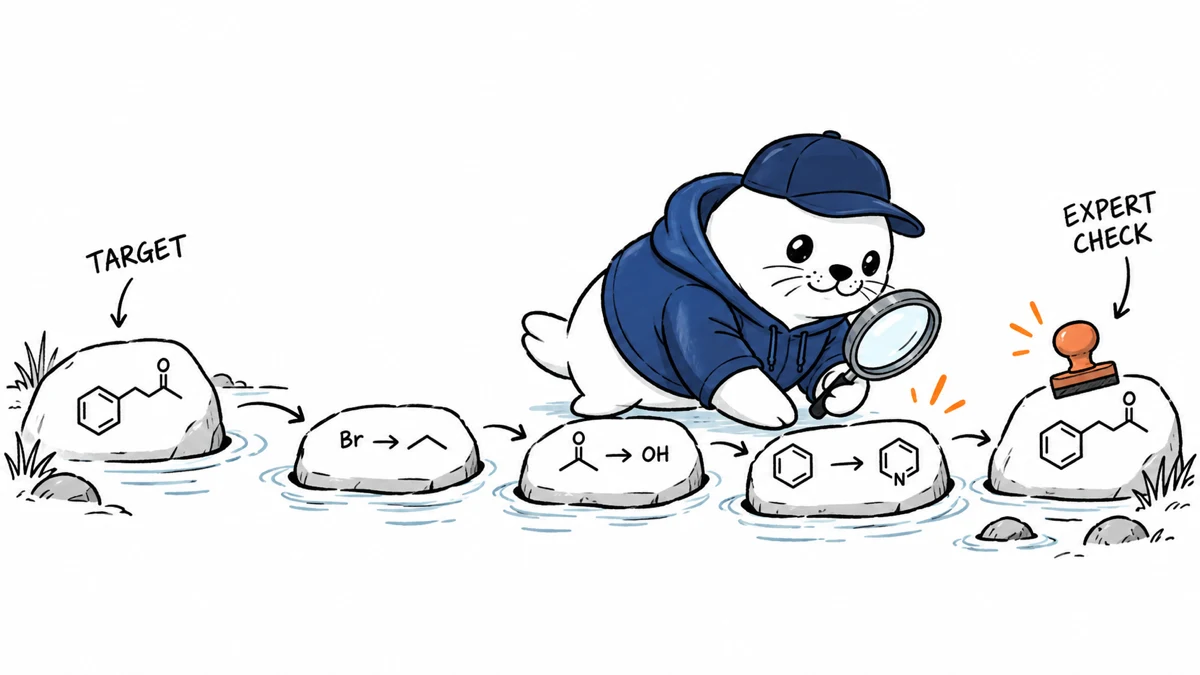
Microsoft researchers published RetroChimera, a route-planning system for small-molecule synthesis that combines a reaction language model with learned route ranking.
RetroChimera appeared in Nature on September 21, 2026, with code, checkpoints and a Microsoft Foundry deployment path. The system is designed to propose retrosynthetic routes, but Microsoft explicitly warns that outputs can be wrong, incomplete or outside the model’s training distribution. Expert review remains part of the workflow.
What RetroChimera combines
| Component | Role | Risk |
|---|---|---|
| R-SMILES2 | Represents reactions for neural synthesis prediction | Representation does not guarantee chemical feasibility |
| NeuralLoc | Ranks candidate routes | Ranking can inherit training-data bias |
| Search procedure | Expands steps from target toward purchasable precursors | Search may favor plausible but impractical paths |
| Expert review | Checks conditions, selectivity and laboratory reality | Review quality depends on domain experience and evidence |
The strongest result is an expert evaluation, not autonomous synthesis
Microsoft reports that experts accepted nine of ten routes produced by RetroChimera in one evaluation, compared with two to five routes for the compared systems. The underlying work uses public and proprietary reaction data. The result is promising, but the sample is small and route acceptance is not the same as successfully executing every synthesis in a laboratory.
A useful reading is that the system improves the quality of candidates that chemists inspect. It does not remove the need to assess reagents, conditions, availability, hazards, yield, stereochemistry and scale. The article’s value comes from treating the model as a route recommender inside a verified process.
Why learned route ranking matters
A retrosynthesis search can generate many trees that reach known building blocks. Only some are useful. A learned ranker can prioritize routes that resemble successful chemistry, reduce branching and direct attention toward stronger candidates. That is different from asking a language model to produce one confident answer.
This mirrors a broader pattern in scientific AI: generation becomes more useful when a separate selection layer scores bounded outputs. Our Jev typed-decision model guide examines the same separation in software, where a model returns bounded decisions instead of unconstrained prose.
Open code improves inspection, not certainty
Microsoft released the RetroChimera repository under the MIT license and includes checkpoints. That gives researchers a path to inspect implementation choices, reproduce portions of the pipeline and test new targets. It does not automatically reproduce proprietary-data experiments or validate chemistry beyond the published evaluation.
- Record the exact checkpoint and code commit.
- Separate public-data results from any proprietary-data result.
- Store every generated route, score and rejected alternative.
- Require a chemist to document why a route was accepted or rejected.
- Track whether a proposed step has close literature precedent.
The failure modes Microsoft names
The repository and research materials warn about hallucinated reactions, out-of-distribution targets and the need for expert verification. Those warnings should become product requirements. A user interface should show uncertainty and evidence rather than presenting one route as a final plan. An integration should preserve alternative routes and allow a reviewer to stop the process before procurement or execution.
For a related example of AI assisting life-science work with verification boundaries, see our biomolecular optimization guide.
A responsible validation protocol
- Choose targets that represent routine, difficult and out-of-distribution chemistry.
- Blind the reviewer to which system generated each route.
- Score step validity, precursor availability, condition plausibility, safety and total route burden.
- Require literature support for unusual transformations.
- Compare the best route and the diversity of acceptable alternatives.
- Run laboratory validation only after safety and procurement review.
- Publish negative results, not only successful examples.
Where RetroChimera could help first
The near-term opportunity is decision support for trained chemists: triaging targets, proposing alternatives when a building block is unavailable, comparing route families and documenting why a path was chosen. High-stakes autonomous execution would require stronger validation, facility controls and evidence than the public release establishes.
Procurement is another practical test. A route can be chemically plausible yet unusable because a precursor is unavailable, highly regulated or too expensive at the required purity. Add catalog availability and safety review after route generation, then return those constraints to the ranking stage. This creates a human-auditable loop instead of treating the first generated tree as the answer.
Organizations evaluating the Foundry deployment should also isolate research data from general prompts, record model and checkpoint versions, and prevent a generated route from triggering an external order automatically. The public evidence supports assisted planning, not unsupervised laboratory operations.
Primary sources
A separate biotech transaction now puts a price on model access: the Tempus Recursion RNA model deal licenses TxFM for oncology under a two-year agreement.
Checked September 22, 2026. Performance figures are from the published study and Microsoft materials; MustHave.ai did not independently reproduce them.