
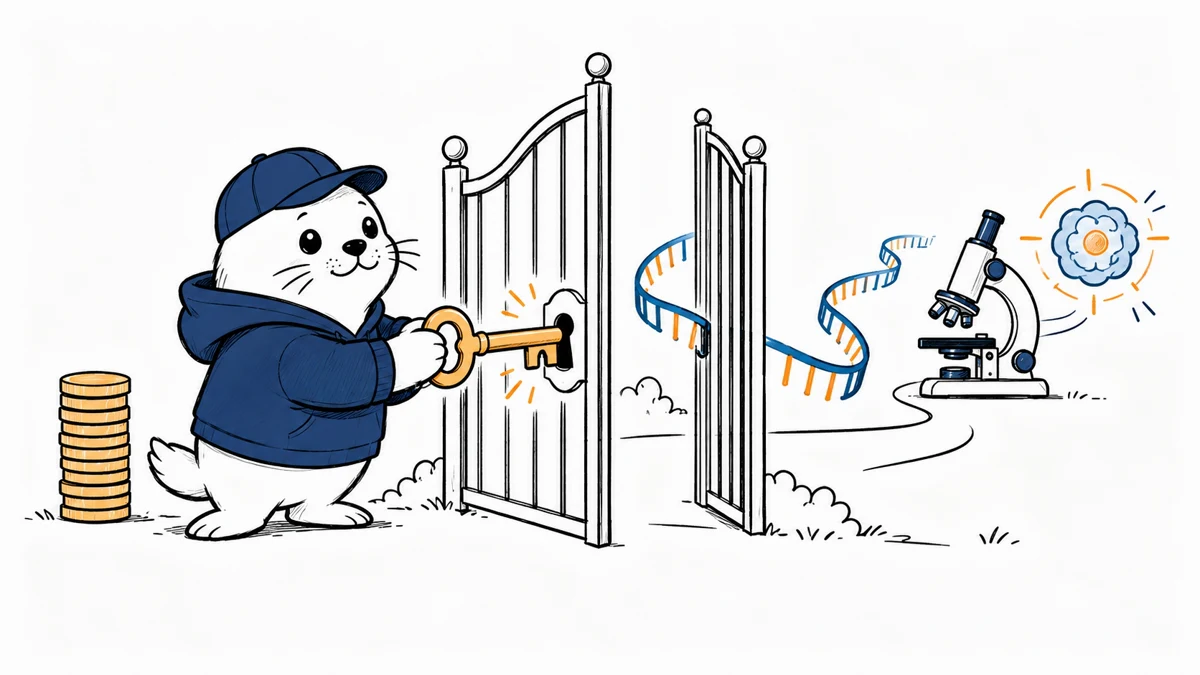
Tempus AI agreed to pay Recursion $12 million for a two-year oncology license to TxFM, Recursion’s RNA foundation model, according to a September 21 SEC filing.
The Tempus Recursion RNA model agreement is unusually concrete for an AI-biotech partnership. It names the license fee, field, duration and permitted uses. It also changes the companies’ older data arrangement. What it does not provide is evidence that TxFM has improved a diagnostic product, passed clinical validation or produced better patient outcomes.
The transaction in numbers
| Term | Confirmed detail | Boundary |
|---|---|---|
| TxFM license fee | $12 million, non-refundable | Two installments of $6 million |
| License term | Two years | From the effective date |
| Field | Oncology only | Not a general biomedical license |
| Rights | Worldwide and non-exclusive | Non-sublicensable and non-transferable |
| Permitted uses | Diagnostic, clinical and internal research applications | Subject to the final agreement |
| Data consideration | De-identified pathology records with linked clinical data | The public filing does not state the record count |
The older data deal was rewritten
Recursion and Tempus also amended their 2023 master agreement. The original five-year arrangement allowed Recursion to terminate for convenience after three years and contemplated larger annual payments. The amendment extends the term to six years, removes the convenience termination right and sets annual license fees of $14 million on the third, fourth and fifth anniversaries.
That produces $42 million in committed future annual fees. At least $4 million of each installment must be paid in cash. Recursion can pay the remainder in shares, cash or a mixture. The amendment also reduces the total quantity of unique de-identified records that Recursion may access. These details matter because a partnership headline can hide a major change in payment timing and data scope.
What an RNA foundation model can contribute
An RNA foundation model learns patterns from gene-expression measurements and can provide representations for downstream analysis. In oncology, a licensed model might support research into tumor biology, patient stratification or signals used in diagnostic development. The license permits these categories, but permission is not proof that a validated product exists.
The distinction resembles the boundary in our coverage of Microsoft RetroChimera’s synthesis-route planning: an AI system can help scientists generate or prioritize options while expert review, laboratory testing and regulated validation remain separate steps.
Why the linked pathology data may matter as much as the model
Tempus will provide Recursion access to a specified number of de-identified pathology records linked to clinical data. A general model can become more useful when researchers can test it against a carefully governed dataset with outcome or treatment context. The filing does not disclose the number of records, their representativeness, the diseases covered or the validation design.
- De-identification reduces privacy risk but does not remove every re-identification concern.
- Linked clinical data can introduce missingness and selection bias.
- A model trained on one patient population may not transfer evenly to another.
- Diagnostic use requires controls beyond exploratory research performance.
- Any future product claim needs evidence tied to a defined clinical task.
Five questions the next filings should answer
- Which TxFM version and model artifacts are covered by the license?
- Can Tempus fine-tune the model, and who owns resulting adaptations?
- What audit and privacy controls govern pathology-data access?
- Which diagnostic or clinical workflows move beyond internal research?
- How will performance be validated across cancer types and patient groups?
What investors should not infer
The agreement confirms commercial value assigned to model access, but it does not establish revenue from a deployed diagnostic, regulatory clearance or clinical benefit. It also does not make the license exclusive. Other organizations could receive rights from Recursion under separate agreements. Readers comparing this deal with smaller specialized systems such as Jev’s typed decision model should focus on task, data and validation rather than parameter count alone.
Accounting treatment will also deserve attention. The cash schedule, share-payment option in the amended data agreement and exchange of data access create different economic effects from a simple software subscription. Future quarterly filings should show how each company recognizes the license, values any shares and describes the remaining performance obligations. Investors should reconcile those disclosures with the contract chronology rather than adding every announced figure as immediate revenue. The SEC filing says fuller agreement text will appear with the quarterly report for the period in which the agreements were executed.
Primary sources
Checked September 22, 2026. Financial terms are confirmed by the SEC filing. No clinical-performance conclusion is implied.