
The UK government is asking where AI can improve clean-energy forecasting, planning, optimization and coordination, and what blocks adoption. It is a call for evidence, not a final strategy or a claim that the benefits have already been measured.
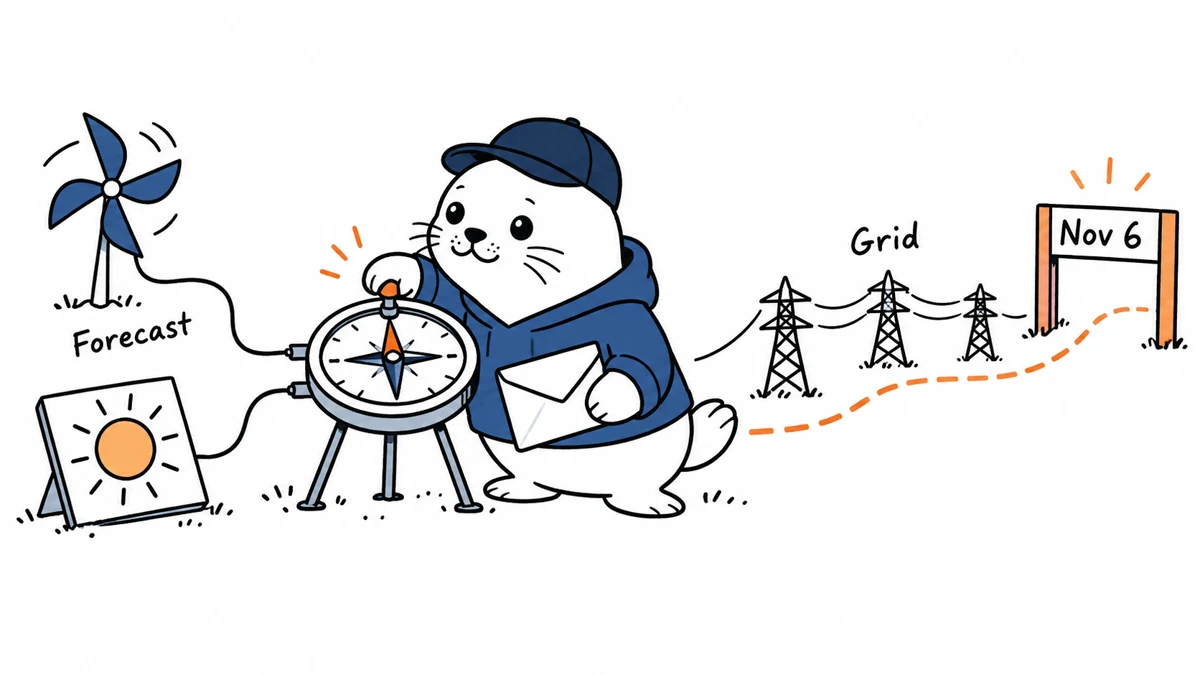
The Department for Energy Security and Net Zero opened the consultation on September 8, 2026. It applies to England, Scotland and Wales. Responses are due November 6 by email to aiforenergy@energysecurity.gov.uk.
Who should respond
The call is aimed at industry, academia, system operators, regulators and other energy stakeholders. A useful response can come from an AI vendor, but it should include the energy operator, data owner or evaluator who can describe the operating environment and consequences of error.
A product brochure is unlikely to answer the government’s main questions. The consultation seeks evidence about opportunities, risks, barriers and longer-term system effects that could inform a UK AI for Clean Energy Strategy.
The four evidence buckets
| Bucket | Question to answer | Evidence worth submitting |
|---|---|---|
| Forecasting | What prediction improves which operational decision? | Baseline error, horizon, geography, weather regime and uncertainty |
| Planning | Which investment or maintenance choice changes? | Historical cases, avoided work, failure cost and human override |
| Optimization | What objective is improved and under which constraints? | Cost, carbon, reliability, latency and constraint violations |
| Coordination | Which organizations or systems must exchange data or actions? | Interfaces, permissions, standards, incident ownership and fallback |
Turn a use case into a measurable claim
Start with the decision, not the model. State who acts, how often, on what horizon and what happens when the prediction is wrong. Then give the baseline. A 10% improvement is meaningless without the current method, test period, denominator and reliability conditions.
Weather-dependent cases should disclose the forecast source and spatial and temporal resolution. Our WeatherNext 3 resolution guide shows why an hourly output and a 5 km grid do not by themselves establish local operational accuracy.
Data barriers need an owner
A response should identify the exact dataset, controller, update frequency, quality checks and sharing restriction. Separate missing data from inaccessible data and incompatible data. Each barrier points to a different intervention.
If the proposal needs real-time access across several organizations, specify authentication, audit logs, incident response and a degraded mode. Do not assume a central data platform is the only answer. A stable interface and common vocabulary may solve part of the problem with less concentration risk.
Include energy and compute costs
An AI-for-energy proposal should report the compute it requires and where that compute runs. A model that marginally improves dispatch but consumes expensive low-latency infrastructure may still be a poor system choice. Include retraining, data movement, monitoring and human review rather than only inference cost.
For browser or agent-based operating tools, our Energy AI agent permission guide explains why a useful assistant should not inherit every credential available to its operator.
Describe the risk and fallback
- Name the worst plausible error and the time available to detect it.
- Explain whether the system advises a human or executes an action.
- Define confidence thresholds, abstention and manual fallback.
- Test unusual weather, missing telemetry, delayed data and adversarial input.
- Assign responsibility for model updates, incidents and contested decisions.
- State which claims come from simulation and which were observed in live operation.
A ten-day response sprint
- Days 1 and 2: choose one decision and freeze the baseline, metric and operating boundary.
- Days 3 and 4: assemble the data, method, result and uncertainty in a reproducible evidence pack.
- Days 5 and 6: document risks, fallback, permissions, compute and governance.
- Days 7 and 8: identify the precise policy, standard or coordination barrier and test alternatives.
- Days 9 and 10: have an independent reviewer challenge the causal claim and edit the response.
What the consultation does not do
It does not adopt a final AI-for-energy strategy, mandate a platform, certify a vendor or prove that AI will lower bills. Government speeches about cheaper or faster systems describe ambitions. The response record must still establish where a benefit is plausible and under what conditions.
My take: submit the counterfactual
The strongest contribution will explain what happens without the proposed AI system. Compare against a competent non-AI process, not no action. Show where the model changes a decision and where ordinary data engineering, automation or market reform could produce the same result.
That counterfactual gives policymakers something they can act on. It separates a genuine regulatory or coordination barrier from a vendor asking government to create demand.
Primary source
Checked September 8, 2026. Scope, audience, geography and deadline come from GOV.UK. The response framework is Musthave.ai analysis.