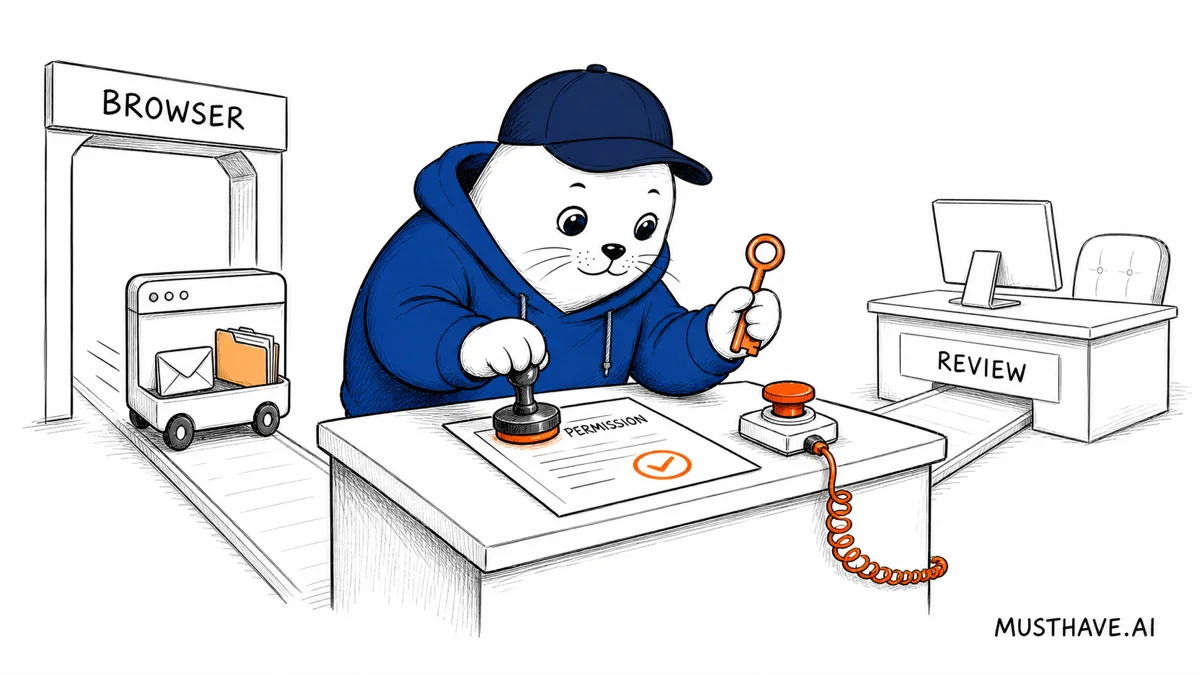
The Energy AI agent can work inside a signed-in browser, search an inbox, and act across connected tools. That convenience turns one sentence into delegated authority. Test the authority before you test the speed.
Energy launched on August 6 with an appealing promise: describe an outcome, connect the tools, and review a finished result. The examples are familiar office chores, clearing an inbox, researching prospects, coordinating a project, or reconciling finance work. The new part is not the task list. It is that the agent can drive the same browser profile where the user is already signed in.
That can remove a lot of copying and pasting. It also means a prompt can reach email, documents, calendars, forms, and websites with whatever permissions the connected account already has. The right question is therefore not "Can Energy save time?" It is "What can this session read, change, send, or buy if the instruction is misunderstood?"
What Energy launched, and what remains a claim
Energy cofounder Gabriel, who says he previously worked in research at OpenAI and Midjourney, introduced the product in an X launch post. He wrote that early users were completing "days of work in hours." That is a founder claim from launch day, not an independently measured productivity result.
The official Energy website does support a narrower description. A user gives the agent an outcome, connects tools, and receives a result to review. Energy says it gathers relevant context from emails, files, conversations, and connected apps, then completes the steps in a real browser.
Evidence note
What is documented, claimed, and still unknown
Launch-day language separated by evidence level.
Documented
Energy can use a real signed-in browser and connect services including Google Workspace.
Company claim
Early users complete "days of work in hours." No independent timing study was published.
Published price
Free is $0; Plus is $50 monthly; Pro is $200 monthly; Enterprise is custom.
Still unknown
The public pricing page does not quantify plan limits, and the privacy policy does not name the AI model providers.
A signed-in browser is an authority layer
A browser agent is not just a better search box. If it can do what the user can do in a browser, it may be able to draft or send a message, upload a file, edit a record, submit a form, archive an item, or trigger a purchase. Whether each action is possible depends on the site, connection, and review flow, but the risk rises with side effects.
Energy’s own examples make that distinction visible. "Research Scout" can be largely read-only. "Inbox Zero" may archive or label messages. "Sales Master" can touch customer records and outbound communication. "Finance Keeper" can encounter data where a wrong click matters more than a weak summary.
Permission budget
Start with work that is easy to observe and undo
The same agent can carry very different operational risk.
| Task | Authority | Risk | First-test control |
|---|---|---|---|
| Search and summarize | Read | Lower | Use a test folder with known answers |
| Prepare email replies | Read + draft | Medium | Draft only; human sends |
| Archive, send, or edit records | Write | High | Require item-by-item approval |
| Submit forms or purchases | External side effect | Critical | Keep disabled until rollback is proven |
This is the same reason our Reddit Rules Hub analysis recommends a visible human escape hatch before automatic removals. Model quality matters. Consequence design matters more when the system can act.
Energy pricing starts free, but the limits are not published
The Energy pricing page lists four plans. Free costs $0 and tells users to connect a ChatGPT account. Plus is $50 per month, Pro is $200 per month, and Enterprise uses custom pricing. The page does not publish message, run-time, browser-action, connector, or compute allowances for those tiers.
Published pricing
The price is exact; the capacity is not
Checked August 6, 2026. Taxes and future pricing may vary.
| Plan | Monthly price | Published detail |
|---|---|---|
| Free | $0 | Connect a ChatGPT account |
| Plus | $50 | No quantified public limits |
| Pro | $200 | No quantified public limits |
| Enterprise | Custom | Contact sales |
Do not infer that a higher number means a specific amount of agent work. Before paying, ask what counts as a run, which model is used, whether failed attempts consume capacity, how long jobs can run, and whether the agent can pause for approval without losing state. A pricing table without capacity is a checkout menu, not a workload estimate.
The privacy policy reaches email, files, pages, and model providers
Energy’s privacy policy, last updated August 5, describes the data needed for this kind of product. Google Workspace connections may expose messages, files, calendars, documents, spreadsheets, presentations, and related metadata. Browser use can involve the text or compressed content of pages, the sequence of visited pages and links, and related thread information.
The policy says Energy does not capture screenshots or record screen images. That is a useful boundary, but it does not make page content invisible: text and compressed page content can still be processed. Relevant Workspace and page content may also be sent to AI model providers to complete a request. The current policy does not name those providers.
Energy says personal data is kept no longer than reasonably necessary, with longer retention possible for legal, dispute, or compliance reasons. It does not give one fixed retention period for agent data. The policy also leaves room for browser and page content to be used in the future (including in aggregated or deidentified form) to train or improve models.
Those statements do not prove misuse. They define questions a company should answer before connecting production mail or customer data: Which model providers receive which fields? Is training disabled today? What does deletion cover? How quickly are OAuth tokens revoked? Which logs remain after an account is deleted?
A safer first test takes one hour, not your whole workspace
- Create a separate browser profile and test account. Do not begin in the profile that holds payroll, billing, production admin, or personal sessions.
- Connect the minimum source. Use one test folder or mailbox label with synthetic or non-sensitive material.
- Choose a read-only outcome. Ask Energy to find five items and produce a summary with source references.
- Check completeness and provenance. Compare its result with the known test set, including one deliberately ambiguous item.
- Allow drafts before actions. If the read test passes, let it prepare changes but require a human to send, archive, submit, or purchase.
- Prove revocation and rollback. Disconnect the integration, confirm the token is revoked, and restore one controlled change before increasing scope.
Record the request, the pages or records touched, the proposed action, the approved action, and the final state. That ledger is not bureaucracy; it is how you tell a useful agent from an impressive animation. Our overnight-agent handoff guide uses the same principle: persistent work needs replayable state and an inspectable morning-after review.
Who should try Energy now
Energy is a reasonable experiment for an individual or small team with repetitive browser work, a test account, and time to inspect the output. Research collection, draft preparation, and non-sensitive inbox triage are better starting points than payments, deletions, or customer-facing messages.
I would wait before connecting regulated, confidential, or production-critical data unless Energy supplies the required security, retention, processor, audit, and contractual details. A polished browser action is not a substitute for an enterprise control plane. Our AI agent security questions offer a longer due-diligence list for vendors that can act on behalf of users.
My verdict: buy a result only after you price the authority
The Energy AI agent has a clear product idea: remove the handoffs between a request, the browser, and the connected work. That could be genuinely useful. It also concentrates permission. The value of an agent grows when it can act; the cost of a mistake grows for the same reason.
Start with one reversible job and a deliberately small permission budget. Measure completed work, corrections, review time, and side effects, not just the time between prompt and celebration screen. If Energy saves hours under those constraints, expand one boundary at a time. If the workflow only looks fast because review and rollback are ignored, the demo has hidden the bill.
Go deeper
- Read the official Energy product overview.
- Compare the published Energy plans; ask for quantified limits before assuming capacity.
- Review the Energy privacy policy before connecting Workspace or a signed-in browser.
- Read the founder’s launch post as a product claim, not an independent performance study.
Which browser action would you delegate first, and which one would you never let an agent complete without a final human click?
Checked August 6, 2026. Product capabilities, prices, privacy terms, and plan limits can change. The "days of work in hours" statement is a founder claim. Musthave.AI did not independently benchmark Energy for this article.