

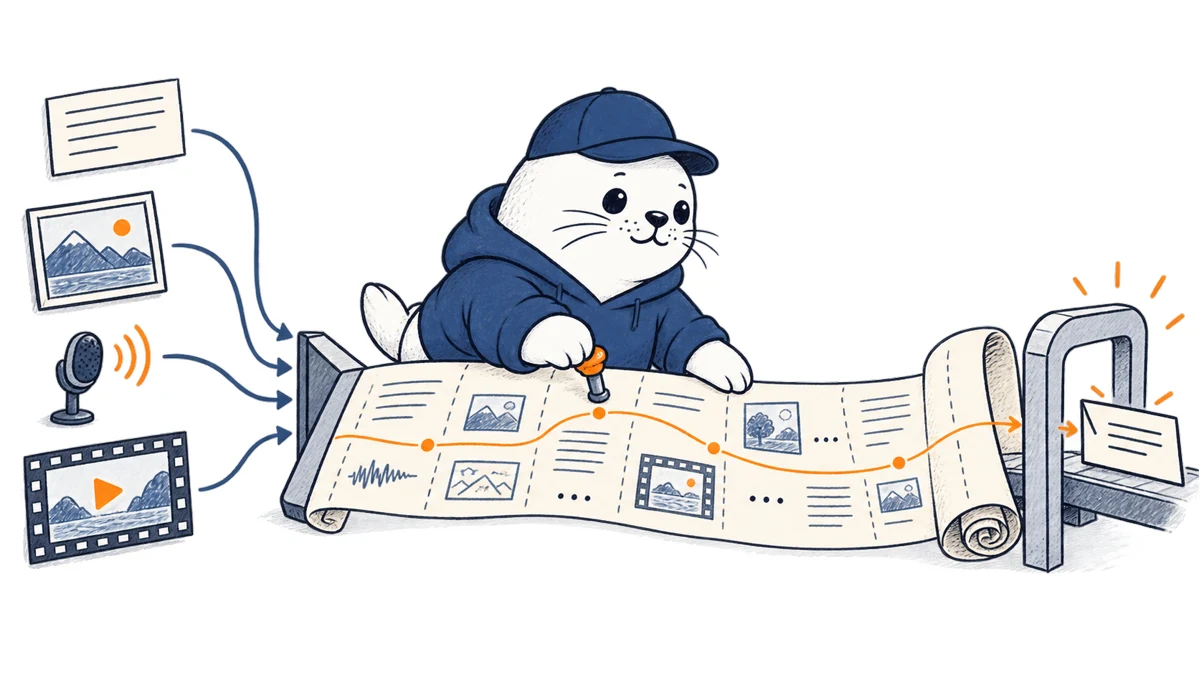
A million-token context sounds like one capability. In a multimodal model, it is really a shared budget for very different kinds of evidence.
Qwen3.8-Omni-Flash became globally available through Alibaba Cloud Model Studio on September 17, 2026. It accepts text, images, audio and video, exposes a one-million-token context window and can return up to 131,072 output tokens. The important limit is easy to miss: the model returns text, not generated speech.
The capability map in one table
| Field | Documented behavior | Operational consequence |
|---|---|---|
| Inputs | Text, image, audio and video | One request can combine a transcript, frames and instructions. |
| Output | Text only | Add a separate speech model when an agent must speak. |
| Context | 1,000,000 tokens | Media conversion and prompt text compete for the same budget. |
| Maximum output | 131,072 tokens | Applications still need output caps and stop conditions. |
| Function calling | Supported | Tool schemas need acceptance tests across mixed media. |
| Built-in tools | Web search in the Responses API | Do not assume every Qwen tool is available on this model. |
One million tokens is not one million words of every media type
Images, audio and video must be represented internally before the model can reason over them. A long meeting recording or dense video can therefore consume context differently from plain text. Alibaba Cloud publishes the overall ceiling, but teams should measure the token accounting returned by the API for their actual media mix.
- Record the billed input tokens for one image, one minute of audio and one minute of video.
- Repeat with different resolutions, frame sampling and audio quality.
- Place the answer-bearing moment at the beginning, middle and end of a long input.
- Compare retrieval accuracy before and after adding unrelated media.
- Set a hard output limit even though the maximum is large.
The model is better suited to analyst agents than voice agents
A useful Qwen3.8-Omni-Flash workflow can inspect a product demo video, read slides, listen to the narration and return a structured report. It can also call a function after finding a defect. It cannot by itself stream a spoken response back to a caller. That distinction separates it from our Qwen3.8 LiveTranslate guide, where translated speech output is the product.
Function calling needs a mixed-media failure set
Tool support matters only when the model produces valid arguments under pressure. Build cases where the audio contradicts the slide, the video contains a late correction, an image is unreadable and the requested tool rejects one argument. A safe agent should cite the evidence it used, expose uncertainty and recover after a validation error instead of repeating the same call.
| Test | Expected behavior | Failure signal |
|---|---|---|
| Conflicting modalities | Identify the conflict and avoid inventing a resolution. | Silently chooses one source. |
| Malformed tool result | Repair or ask for clarification. | Loops the same invalid call. |
| Long-video retrieval | Find the target scene consistently. | Accuracy collapses by position. |
| Search disabled | Stay within supplied evidence. | Claims fresh web evidence without a call. |
Region support does not remove data-routing work
Alibaba Cloud lists six available regions for the model. Availability is not the same as automatic residency. Confirm the endpoint hostname, project region, storage path, logging policy and any cross-region fallback before sending recordings or customer video. The broader Qwen Studio overview helps separate the model API from the surrounding assistant product.
A practical launch checklist
- Pin the exact model ID rather than relying on a floating alias.
- Measure media token use with production-like files.
- Test retrieval at multiple positions across the context.
- Validate function arguments and retry ceilings.
- Confirm that web search is enabled only where policy allows it.
- Add a separate speech model if the product needs audio output.
- Log endpoint region, model ID, token use, latency and tool traces.
The practical verdict
Budget tests should separate prompt construction from model price. Run one representative request with a transcript only, then add images, audio and sampled video in stages. Record input tokens, output tokens, latency and any cache result after each addition. This reveals the cost of each modality and catches a pipeline that silently sends duplicate frames or a full transcript twice. A one-million-token ceiling prevents some truncation failures, but it does not make waste free. For agent workloads, also count every tool round trip and the context returned by the tool. The most useful number is the cost of an accepted report, not the price of one ideal request.
Qwen3.8-Omni-Flash is a meaningful launch for agents that must inspect mixed media over long sessions. Its strongest product shape is analysis and tool use, not realtime conversation. The one-million-token headline becomes useful only after a team measures media accounting, positional retrieval, tool reliability and regional data flow.
Primary sources
- Alibaba Cloud newly released models
- Qwen3.8-Omni-Flash documentation
- Qwen Omni model documentation
- Alibaba Cloud Model Studio model catalog
Qwen-Image-2.1 adds a separate visual-generation path with native transparency, multi-reference editing and a non-commercial research license.
China Telecom's Xing4.0-29B-A4B offers a separate open-weight coding path with 29B total parameters, 4B active per token and a native 256K context window.
Qwen Live Harness adds a separate realtime desktop layer that can pass multimodal tasks to Codex, Claude Code and other coding agents through explicit approvals.
Checked September 20, 2026. Limits, regions and tool support can change; verify the current model documentation before deployment.