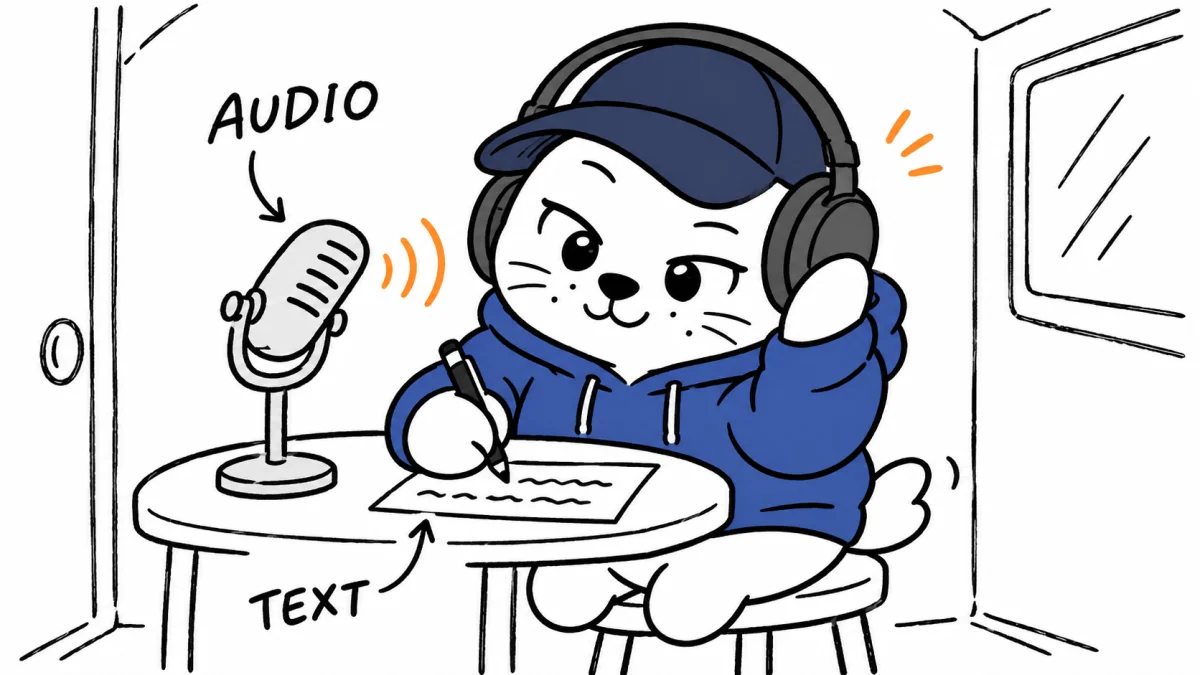
A multilingual transcript is useful when it preserves the words that matter in the conversation you actually recorded.
Reson8 released Rumble-2-Flash on November 18, publishing a 0.5-billion-parameter speech-recognition model under Apache 2.0. The release article describes support for more than 40 languages, automatic language detection, and native Transformers and vLLM integrations.
The model card lists 45 language tags, including Arabic, English, and French. That makes the release relevant to founders handling multilingual interviews, support calls, or recorded content. The language list shows documented support; it does not guarantee the same error rate across languages or regional varieties.
The developer also reports accuracy and throughput results. Their usefulness depends on the dataset, batching, and scoring method. A team choosing a recognizer should keep those conditions alongside the headline model size.
The release gives developers a concrete artifact to inspect
The weights and model card provide a starting point for a deployment review. Reson8 describes a model based on the Qwen3-ASR architecture, with support in existing Transformers and vLLM workflows. It says the standard integration does not need a forked runtime trust_remote_code.
That reduces one kind of integration uncertainty, but an actual deployment still needs a pinned environment. Record the model revision, library versions, hardware, and decoding settings used in a test. Later results should remain tied to those choices.
The model supports output controls, including number formatting, fillers, repeated words, and a forced language. These settings can change how a transcript reads even when the underlying audio is the same. Choose them according to the intended use, then keep them fixed during an accuracy comparison.
A transcript used for a searchable content library may tolerate different formatting from one used to check a customer’s quoted amount. The model’s settings should support that purpose rather than silently change between recordings.
Three published accuracy figures describe different samples
Reson8 reports the following results. They should remain attributed to the developer unless an independent evaluation reproduces them under the same conditions.
| Reported evaluation | Published result | Scope that belongs with the number |
|---|---|---|
| Multilingual Open ASR track | 6.96% average error rate | Nine named languages, not all 45 listed languages |
| English Open ASR track | 6.6% word error rate | The English evaluation track |
| AppTek call-center dataset | 7.86% word error rate | 302 hours and 14 English accents, using the stated scoring method |
The multilingual average covers Chinese, German, French, Italian, Spanish, Portuguese, Hindi, Dutch, and English. Arabic appears in the model card’s support list, but it is absent from that nine-language average. A Moroccan business therefore cannot use 6.96% as a measured Darija error rate.
Reson8 also compares the call-center result with 7.78% for NVIDIA’s Nemotron 3.5 Transcribe in the reported setup. The numerical gap is 0.08 percentage points. That is a close result on the specified dataset, rather than a general statement that the two systems behave alike on every call.
A startup handling French-Arabic switching, local place names, or product names should preserve those cases in its own evaluation. A broad language label cannot describe every accent, vocabulary, recording condition, or language mixture the product receives.
Understand what word error rate counts
Word error rate combines substitutions, deletions, and insertions, then divides their total by the number of words in the reference transcript. The reference and its normalization rules are therefore part of the measurement.
For a simple illustrative example, take a 100-word reference with six substitutions, two deletions, and one insertion. That’s nine word errors, or a 9% word error rate. This is arithmetic showing the metric’s definition, not a Rumble-2-Flash result.
The metric is useful, but different mistakes can have different business consequences. Substituting an ordinary adjective and changing a price are each word errors. The second can make a customer record materially wrong even when the rest of the transcript reads well.
Keep an additional record of the fields the application depends on: names, dates, amounts, identifiers, or agreed actions. A lower average word error rate does not establish that every critical field is reliable enough for automatic use.
Batch throughput and a user’s waiting time are different measures
The release reports throughput above 7,000 times real time on full batches in larger evaluation datasets. At that ratio, an hour of audio corresponds to roughly half a second of processing in the reported throughput calculation.
That statement applies to the measured batch setup. It does not supply the waiting time for a single file uploaded to a new service. Queueing, audio transfer, decoding, model startup, and result formatting can all affect the delay the user experiences.
For a recorded-content workflow, measure from upload completion to a usable transcript. For an interactive workflow, establish how the integration handles incoming audio and partial results. A large batch-throughput number alone does not establish a streaming interface.
Keep throughput and latency separate in a comparison sheet. Throughput helps with capacity planning for a backlog of recordings. Latency helps decide whether the interaction feels responsive. Both need the relevant hardware and concurrency conditions.
Build a small evaluation around actual recordings
A useful pilot can include clean speech, compressed phone audio, background noise, uncommon names, and language switching. Use recordings the team is authorized to process and create a checked reference transcript for each sample.
Record the original language, accent where known, audio format, duration, and relevant output settings. Review the same sample with the same settings across candidate systems. Otherwise, differences in punctuation or number normalization can make a model comparison misleading.
Set an acceptance rule for the application. A content index may allow a searchable draft with human correction. A workflow that extracts a payment amount may need explicit review when that field is uncertain. State those rules before examining the results.
This is a proposed evaluation plan. We have not run an independent transcription benchmark for this article. The release provides inspectable weights and developer-reported results; the product’s own recordings determine whether the model meets its needs.
Choose the workflow along with the recognizer
A recognizer supplies a transcript. A working product also needs a way to retain the original audio, link it to the transcript, correct mistakes, and show users which record is current.
Those choices affect whether a small model is useful in practice. A team can accept a modest amount of correction if the workflow makes errors easy to find. The same error rate can be much harder to manage when the transcript becomes an unreviewed business record.
Rumble-2-Flash offers a compact, openly licensed candidate for that evaluation. Its strongest documented case is worth reading with the conditions intact: a broad support list, specific measured samples, and batching-dependent speed figures. Matching those facts to the intended language and recording conditions produces a more useful decision than model size alone.

Abdessalam Alaoui
I'm Abdessalam Alaoui, founder of Musthave.AI. I write practical guides to AI models, tools, generative media.