

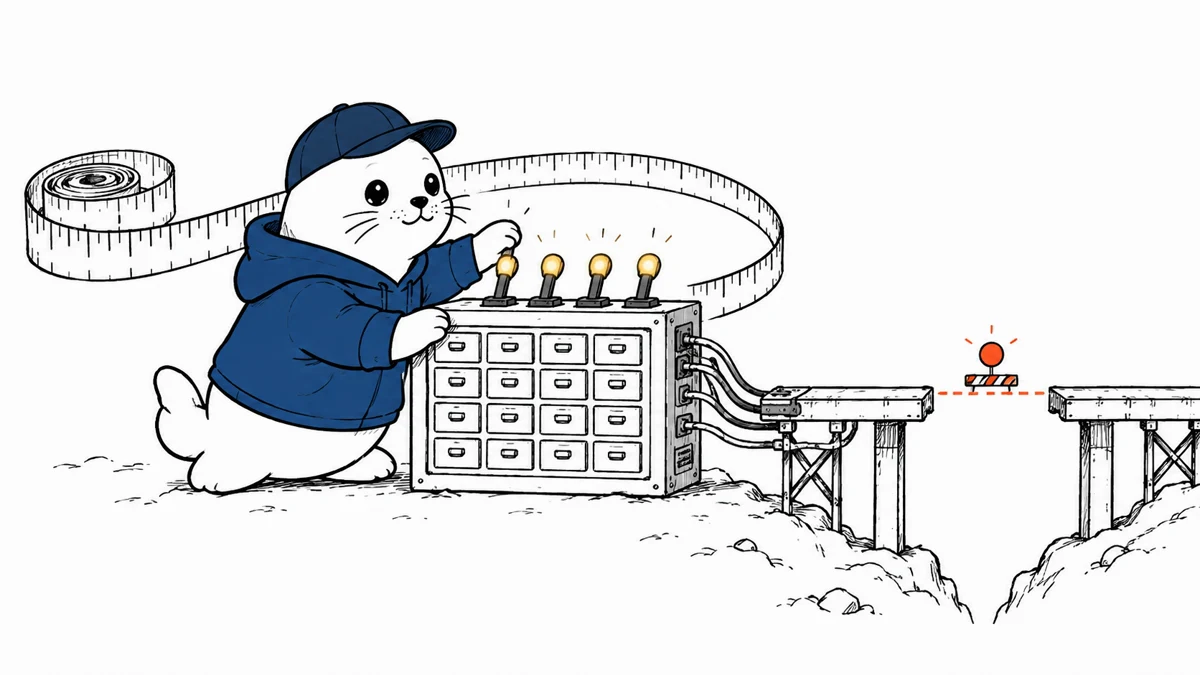
Open weights solve the download problem. They do not automatically solve serving, tool use or production reliability.
Xing4.0-29B-A4B is a new open-weight coding model from China Telecom’s Xingchen team. Released on September 17, 2026 under Apache-2.0, it uses a mixture-of-experts architecture with 29 billion total parameters and 4 billion active parameters per token. The official model card documents a native 256K context window, an experimental path to 512K and agent-oriented training for software engineering tasks.
The model in one operational table
| Property | Officially documented value | What it means |
|---|---|---|
| Total parameters | 29 billion | All expert weights stored in memory |
| Active parameters | 4 billion per token | A smaller subset performs each forward pass |
| Native context | 256K tokens | Large repositories and long agent traces can fit in one request |
| Extended context | Up to 512K experimentally | Requires separate validation for quality, memory and speed |
| License | Apache-2.0 | Permissive use with notice and license obligations |
| Training stack | Ascend NPUs and MindSpore | China Telecom documents a domestic hardware and software path |
Why 29B total and 4B active are both important
Mixture-of-experts models route each token through selected expert blocks. The active count helps explain compute per token, while the total count affects memory, loading and distribution. It is misleading to market Xing4.0 as simply a 4B model because a deployment still needs access to the broader 29B parameter set. It is equally incomplete to compare it with a dense 29B model using only the total count.
For a real capacity plan, operators should measure weight memory, key-value cache growth, expert routing overhead, tokens per second and latency at the context lengths their agents actually use. Sparse activation can reduce arithmetic without eliminating memory movement or routing costs.
The 256K context window changes the coding test
A long context window is useful only when the model retrieves the right detail and preserves it across a multi-step task. Coding evaluations should place related files far apart, introduce similarly named functions and require the agent to trace configuration through several modules. The experimental 512K mode needs a separate scorecard because context extension can change accuracy, latency and memory behavior.
- Test symbol resolution across distant files rather than asking for repository summaries.
- Include generated files and irrelevant logs to measure context filtering.
- Require a patch, test result and explanation for each task.
- Measure accepted changes, not only whether the model produced code.
- Record failure recovery after a tool error or rejected patch.
The SWE-bench result is a claim to reproduce
China Telecom reports a 75.0 score on SWE-bench Verified and publishes additional coding and agent benchmark results. These are vendor-reported numbers. The repository identifies its evaluation stack, but a comparable reproduction also needs the exact model revision, agent harness, prompts, tool configuration, retry policy and cost boundary.
A benchmark score does not tell a team whether the model will respect a repository’s conventions, avoid unnecessary edits or stay inside an approval boundary. Our TensorRT deployment guide explains why throughput and reproducibility belong beside quality scores. The same rule applies to coding agents.
Runtime support is the launch’s unfinished layer
The Xing4.0 repository links implementation work for SGLang, vLLM, TensorRT-LLM, llama.cpp and KTransformers. At review time, several integrations were represented by pending pull requests or project branches rather than stable packaged releases. That is meaningful early support, but it is not the same as installing the current public release of a runtime and expecting the model to work.
- Choose one documented runtime path and pin the exact commit.
- Check whether the linked pull request was merged after this article’s publication date.
- Validate tokenizer, expert routing, long-context settings and generation output.
- Run a short-context baseline before increasing to 256K.
- Test tool calls inside an isolated repository with human approval for writes.
- Repeat the test after moving to a stable runtime release.
Apache-2.0 broadens use, but deployment still needs governance
The repository and model card identify Apache-2.0, a materially more permissive license than research-only releases. Teams still need to preserve notices, track the exact model and tokenizer artifacts, scan any bundled code and review the data and policy requirements of their own product. A permissive software license is not a guarantee that every generated patch is safe or free of third-party obligations.
China Telecom’s launch also adds another data point to the growing Chinese open-model ecosystem. For comparison, Qwen3.8-Omni-Flash targets multimodal analysis, while Xing4.0 is explicitly optimized around code and agent tasks.
A practical acceptance test
| Gate | Evidence to collect | Pass condition |
|---|---|---|
| Load | Pinned runtime commit and startup log | No unsupported custom-code fallback |
| Context | Needle retrieval at 32K, 128K and 256K | Stable accuracy without silent truncation |
| Patch | Diff, tests and lint result | Minimal accepted change |
| Agent | Tool trace and approval events | No unapproved external action |
| Cost | Tokens, latency and accelerator usage | Fits the workload budget |
The practical verdict
Xing4.0-29B-A4B is notable for combining a permissive license, sparse activation, long context and a coding-agent focus in a model trained on China’s Ascend stack. The honest production status is more measured than the model card headline. The weights are open and the runtime work is active, but teams should treat pending integrations as engineering inputs, not stable support promises. Reproduce the benchmark and serving path before comparing it with an established coding model.
Primary sources
Checked September 21, 2026. Benchmark results are company-reported, and linked runtime integrations may change as pull requests are reviewed.