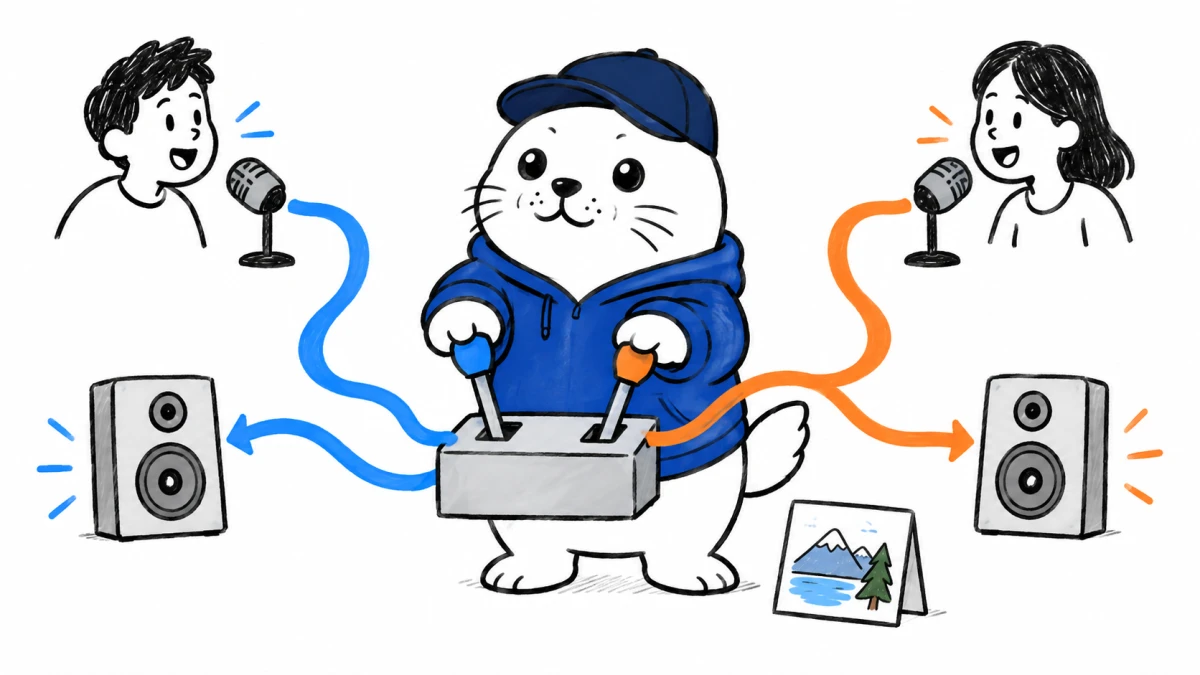
Qwen’s new real-time interpreter listens, watches and separates speakers. Its strongest use is not a generic chatbot, but a bilingual audio service with a defined latency, language and pricing envelope.
Qwen3.8-LiveTranslate-Flash-Realtime is a WebSocket model for live speech translation. Alibaba Cloud says it can understand 60 languages, produce speech in 29 languages and use image input to improve contextual understanding. It returns synchronized translated text and audio while attempting to preserve speaker identity across a conversation.
What happens during a live session
An application streams audio frames to the model over WebSocket. The model identifies speech, translates it and streams text and synthesized audio back. Optional image input can supply visual context such as a slide, menu, diagram or camera view. This can help resolve a word that has several meanings.
Qwen reports average end-to-end lag falling from 2.8 seconds to 2.3 seconds compared with its earlier system. That is a company-reported result, not an independently reproduced guarantee. Network distance, audio chunk size, device buffering and speech complexity all affect a real session.
Languages and speaker handling
The model page lists understanding across 60 languages and speech output across 29. Those numbers are not interchangeable. A language that the model understands may only be available as text output, so product teams should verify both the source and target language in the official list.
Speaker-aware translation is designed to separate voices and maintain a distinct spoken identity for each participant. In a meeting, that could make a translated exchange easier to follow than one generic synthetic voice. Overlapping speech, interruptions, accents and poor microphones should be part of every acceptance test.
The service limits
| Limit | Published value |
|---|---|
| Context window | 53,248 tokens |
| Maximum input | 49,152 tokens |
| Maximum output | 4,096 tokens |
| Request rate | 10 requests per minute |
| Token rate | 100,000 tokens per minute |
The model does not list function calling, web search or fine-tuning. Its job is interpretation. Business logic, recording consent, session access and downstream actions belong in the surrounding application.
How the multimodal pricing works
Alibaba Cloud’s international pricing page lists audio input at $7.50 per million tokens, image input at $0.55, text output at $20 and audio output at $30. A session can incur more than one of those components. The total depends on how much audio is streamed, whether images are supplied and how much translated text and speech is returned.
A simple cost test should record the billable token count for a fixed ten-minute conversation in each target language. Do not estimate only from minutes because tokenization and speech rates vary.
Best first use cases
- Small multilingual meetings where participants need translated speech and text.
- Customer-service calls with clear consent and a human agent able to correct errors.
- Guided tours or events where slides provide useful visual context.
- Remote training sessions that need a bilingual transcript after the event.
- Travel assistance where users can point the camera at a sign or menu.
For a different speech workflow that emphasizes generation, editing and separation, read our Tencent AuK report. If a local compact model matters more than live speech output, our MiniCPM5-2B guide covers that tradeoff.
A launch checklist for real conversations
- Confirm the exact source and spoken-output languages.
- Measure lag on the networks and devices users will actually have.
- Test interruptions, two people speaking and background noise.
- Display the translated text so listeners can recover from a bad spoken phrase.
- Tell participants when audio is processed or retained.
- Provide a clear way to stop translation and delete a session.
What the launch means
Qwen3.8 LiveTranslate turns translation into a continuous audio product rather than a sequence of uploaded clips. The visual input and speaker separation are the differentiators to test. The published 2.3-second lag is promising, but reliability in noisy, multilingual conversations will determine whether the service feels like an interpreter or a delayed transcript.
For the broader multimodal release, our Qwen3.8-Omni-Flash guide maps the 1M context, text-only output and agent testing boundary.
Primary sources: Qwen’s launch announcement, Alibaba Cloud implementation documentation and the official model page.