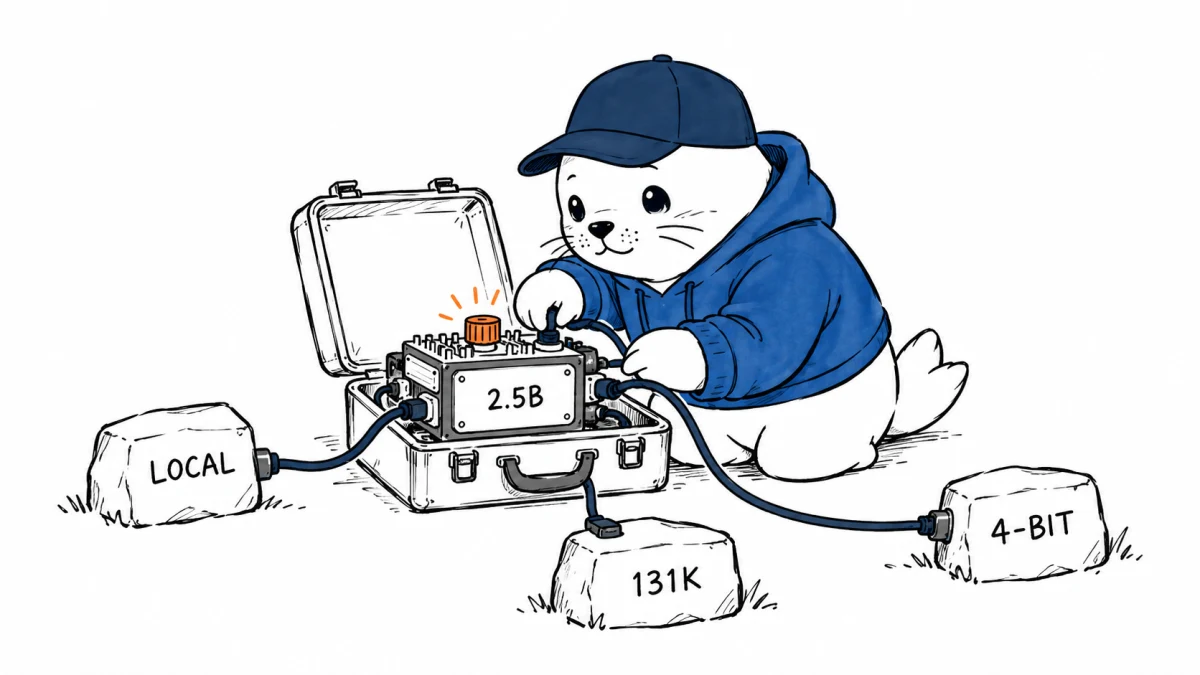
OpenBMB released MiniCPM5-2B on September 7, 2026, with an unusually complete local deployment story: a dense 2B-class model, 131,072-token context, GGUF and MLX variants, mobile-oriented LiteRT support, open training datasets and reusable deployment skills.
The practical question is not whether a small model can top a vendor benchmark table. It is whether developers can put it on real hardware, control its sampling behavior and keep the result reliable enough for local assistants and tool workflows.
MiniCPM5-2B is small, but its exact size deserves precision
The official model card lists 2,516,756,480 total parameters and 1,981,982,720 non-embedding parameters across 42 layers. It uses a standard LlamaForCausalLM architecture with grouped-query attention and native 131K context.
At two bytes per parameter, the total parameter count represents about 5.03 GB of raw BF16 values. A theoretical four-bit packing floor is about 1.26 GB. Real files and runtime memory are larger because quantization metadata, embeddings, KV cache, buffers and the inference engine also consume space. These are derived estimates, not measured peak RAM figures.
The runtime matrix is the real release
| Format or runtime | Best fit | What to verify |
|---|---|---|
| Transformers | Reference Python experiments | Chat template and generation settings |
| vLLM or SGLang | OpenAI-compatible local server | Memory at the intended concurrency and context |
| GGUF with llama.cpp | CPU, GPU and desktop deployment | Quantization quality and sampling defaults |
| Ollama or LM Studio | Fast desktop evaluation | Whether packaged defaults match the model card |
| MLX 4-bit | Apple Silicon | Tokens per second, memory pressure and long-context stability |
| LiteRT-LM | Android, iOS, desktop and IoT | Device-specific kernels and thermal behavior |
OpenBMB also publishes deployment and fine-tuning Agent Skills. That lowers the cost of moving from a model card to a repeatable setup. It also makes MiniCPM5-2B a natural addition to our reference list of useful AI GitHub repositories.
One sampling default can create a repetition loop
The model card warns that llama.cpp’s default min_p=0.05 can produce repetitive output because it may filter away the low-probability token needed to escape a loop. OpenBMB’s example sets temperature=1.0, top_p=0.95 and min_p=0.0.
This is more actionable than calling the model broken. The warning identifies a runtime-specific default and provides a mitigation. Anyone comparing Ollama, LM Studio, llama.cpp and Transformers should pin identical sampling settings before judging model quality.
A fair local test needs five measurements
- Record model file size and peak system memory after the first prompt.
- Measure prompt ingestion and generation speed separately.
- Repeat the same tasks at 8K, 32K and 128K context.
- Test tool-call JSON for validity, argument accuracy and recovery after a failed tool.
- Run a repetition suite with the packaged defaults and with
min_p=0.0.
Report all five together. A fast four-bit model that loses instruction fidelity or loops under the desktop default may be less useful than a slower quantization with predictable outputs.
Open training data makes the release more inspectable
The MiniCPM repository links four associated data releases: UltraX for web pretraining, UltraData-Code with tiered code data, UltraData-SFT-Agent-2609 with 500,000 agent samples, and UltraData-RL-2609 with more than 80,000 reinforcement-learning samples.
Publishing data artifacts does not independently validate the model’s benchmark results, but it gives researchers more material to inspect than weights alone. OpenBMB reports a 53.9 average in its selected comparison, ahead of the listed 2B and larger baselines. Treat that as vendor-reported until reproduced under the disclosed prompts, judges and settings.
Where MiniCPM5-2B fits against larger sparse models
MiniCPM5-2B is a dense small model. That makes its parameter count much closer to its deployment footprint than the active-parameter number on a huge mixture-of-experts model. Our Qwen3.8-Flash-Next guide explains why a sparse model can activate few parameters while still requiring a large weight store.
The tradeoff is capability ceiling. A 2B model is best treated as a local specialist, router, extractor or constrained tool user, not a drop-in replacement for a frontier model across every task. Its value comes from privacy, latency, offline use and control over the runtime.
The best first deployment
Start with a narrow workflow that has objective checks: classify a local document, extract a fixed schema, select from a small tool set or propose a code patch that a test suite can reject. Pin the quantization, prompt template and sampler. Only then expand context or autonomy.
Primary sources and disclosure
- OpenBMB MiniCPM repository and release chronology
- MiniCPM5-2B model card, formats and sampling guidance
Checked September 16, 2026. Benchmark claims are vendor-reported. Memory figures in this article are arithmetic estimates from parameter counts, not a completed device benchmark.