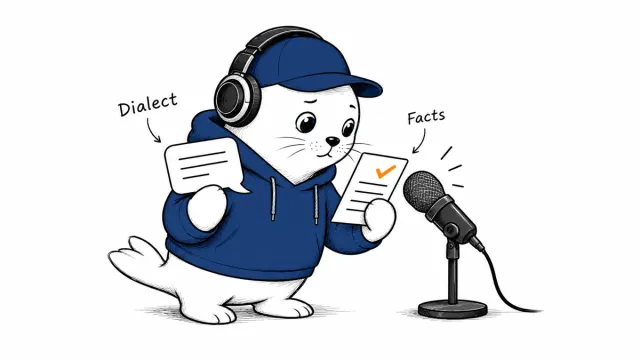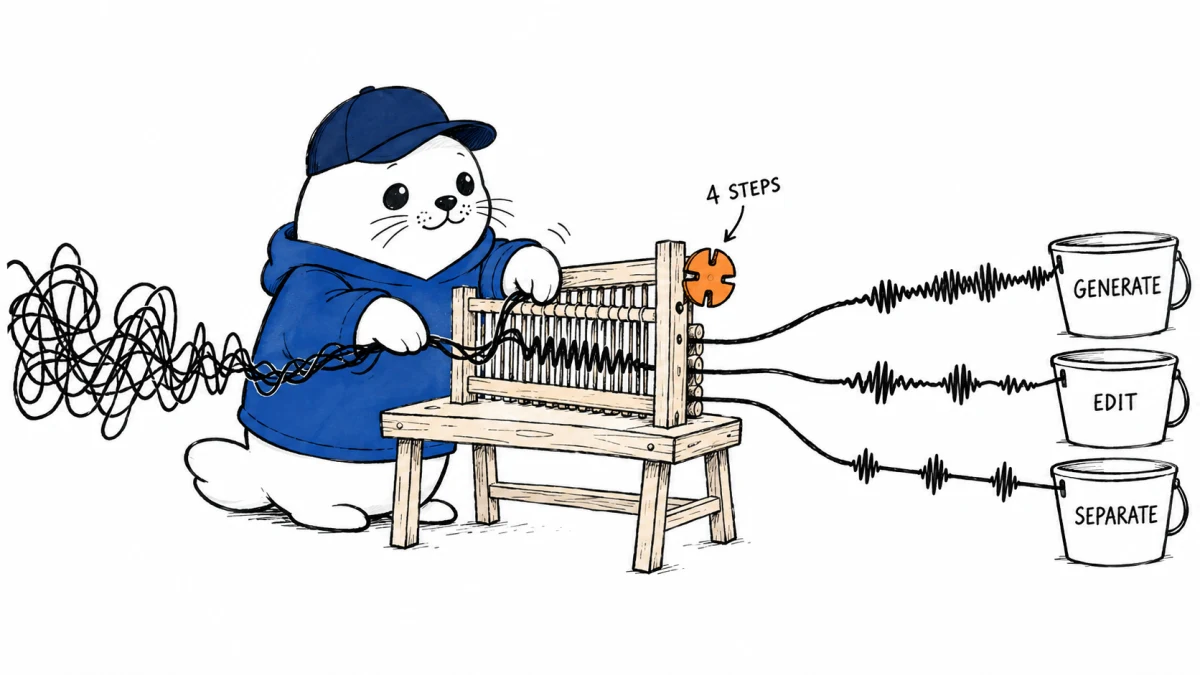
Tencent Hunyuan has open-sourced AuK, a 1.5B foundation model that uses natural-language instructions for speech generation, editing, enhancement and source separation. AuK-Flash distills the process to four fixed inference steps, while new MLX support brings an experimental path to Apple Silicon.
The release matters because speech systems are usually assembled as a chain of specialized models. AuK attempts to place text-to-speech, content repair, voice-property changes, denoising and separation behind one instruction interface.
One checkpoint is being asked to replace a pipeline
The official AuK repository describes a 1.5B diffusion transformer trained on millions of hours of audio. The model uses a separate Qwen2.5-Omni-3B encoder and a VAE at runtime, so the headline 1.5B count is not the complete dependency footprint.
| Task family | Examples in the release | What should be tested |
|---|---|---|
| Generation | Zero-shot and instruction-based TTS | Speaker similarity, pronunciation and long-form consistency |
| Content editing | Replace or repair spoken words and lyrics | Boundary artifacts and timing continuity |
| Acoustic editing | Pitch, speed and volume changes | Whether identity and intelligibility survive the edit |
| Paralinguistic editing | Emotion, timbre, accent, whisper and non-verbal sounds | Control strength versus unintended voice drift |
| Restoration | Enhancement and denoising | Speech preservation under difficult noise |
| Separation | Speech/music separation and target-speaker extraction | Leakage, interference and speaker confusion |
AuK and AuK-Flash serve different priorities
AuK Base offers configurable numbers of function evaluations and classifier-free guidance. AuK-Flash uses four fixed time steps and sets CFG to zero. Tencent presents Base as the quality-oriented option and Flash as the faster option.
Four steps is a property of the distilled sampler, not a universal promise about wall-clock speed. Real latency also depends on the encoder, VAE, audio duration, hardware, data transfer and software stack. A useful review should measure complete request-to-audio time, not only the diffusion stage.
The published VRAM table shows the full stack is not tiny
Tencent reports peak BF16 memory on an NVIDIA A800-SXM4-80GB. For 1.5 seconds of text-only output, AuK used 24.78 GiB without CPU offload and 16.75 GiB with it. AuK-Flash was almost identical at 24.77 GiB and 16.75 GiB. A five-second reference clip raised both configurations slightly.
That table is valuable because it prevents a misleading conclusion from the 1.5B label. The checkpoint sits inside a larger inference graph. CPU offload saved about 8 GiB in Tencent’s setup, but it may trade memory for latency and host bandwidth. These remain company measurements on one hardware configuration.
Apple Silicon support expands access, not proof of speed
On September 13, four days after the initial code and weight release, Tencent added MLX inference on an Apple Silicon branch and CPU offload for CUDA. The MLX path is an important accessibility signal for audio developers, but the repository does not yet provide a cross-Mac latency and memory table.
Mac testers should report the exact chip, unified memory, audio duration, task, model variant and time to first audible result. Without that context, one successful demo says little about production suitability.
A single-model speech test needs paired comparisons
- Create a clean TTS sample from text with no reference audio.
- Edit one word inside a sentence and compare the join with the untouched recording.
- Change speed or emotion while testing whether speaker identity remains stable.
- Remove noise, then score both intelligibility and unwanted smoothing.
- Separate a target speaker from music and another voice, then measure leakage.
- Repeat every task with Base and Flash at matched output duration.
The result should show whether one AuK checkpoint genuinely replaces a multi-model chain or merely makes demos easier. That is the information a model card cannot supply on its own.
Voice identity requires a consent layer
Zero-shot voice generation, timbre editing and target-speaker extraction can be useful for accessibility, localization, restoration and production. They can also process a person’s vocal identity. Teams should require documented permission for reference voices, retain provenance for edited audio and make synthetic or materially altered speech clear to listeners where context requires it.
The same governance issue appears in commercial audio platforms. Our ElevenLabs and UMG licensing analysis examines how authorization changes the product design. Our Siri AI rollout guide covers another voice interface where privacy and device boundaries matter.
What the MIT release enables
Tencent publishes the repository and released weights under the MIT License. The project includes command-line, Gradio and ComfyUI paths, plus SGLang-Omni support. That gives researchers a broad surface for evaluation and integration. It does not remove obligations attached to input recordings, voices, music or other third-party content.
Primary sources and disclosure
Checked September 16, 2026. Quality and memory results attributed to Tencent are company-reported. This article does not claim an independent listening test.