Magentic has raised an $18 million Series A to expand AI agents for procurement and supply-chain work. Felicis led the round, with existing investors Sequoia Capital and The Westly Group participating, according to the company’s September 17 announcement.
The funding is notable because Magentic is not pitching another analytics dashboard. It describes “digital workers” that act through Microsoft Teams, email and enterprise systems to help with supplier selection, contract negotiation, orders and invoices. That raises a more consequential question than whether a model can summarize procurement data: what should an agent be allowed to change?
The financing facts
| Round | $18 million Series A |
|---|---|
| Lead investor | Felicis |
| Existing investors named | Sequoia Capital and The Westly Group |
| Company launch | July 2025 |
| Headquarters described | London and New York |
| Product focus | Procurement and supply-chain agents for large industrial companies |
Magentic says the capital will extend agent coverage across procurement and supply-chain workflows and support research on long-horizon optimization problems. The announcement does not disclose valuation, detailed revenue, burn rate or contract terms.
A digital worker is an execution claim
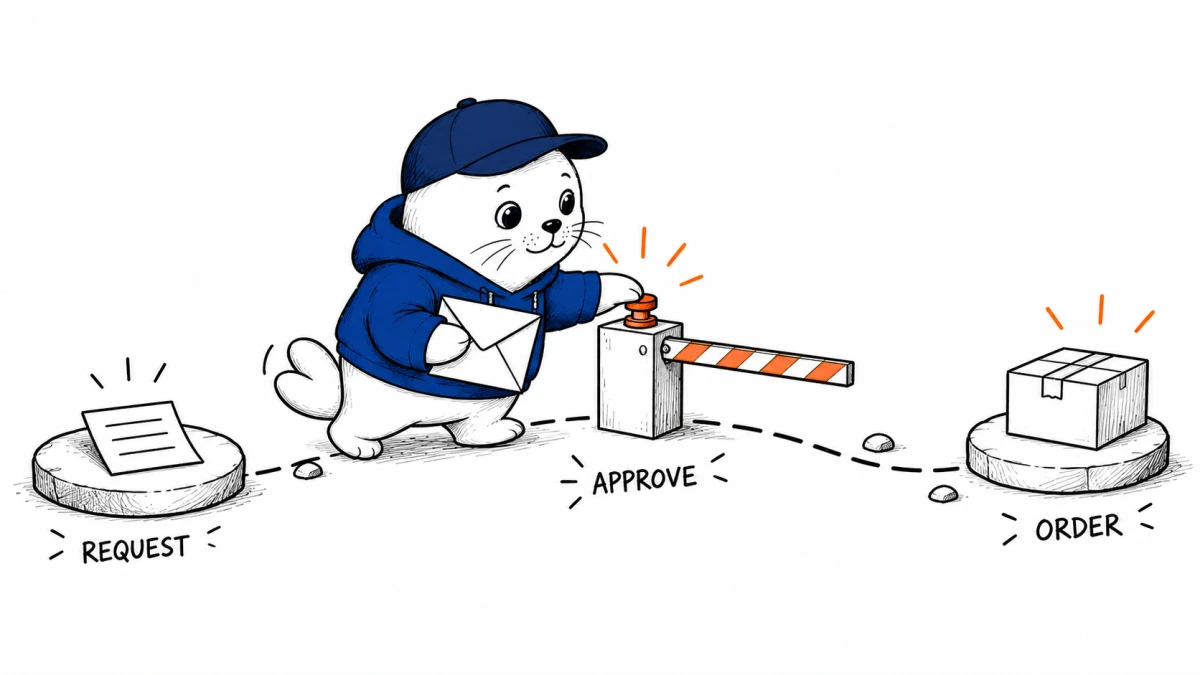
A procurement copilot can draft an email or surface a price variance. A procurement agent can potentially select a supplier, negotiate within a boundary, create an order or clear an invoice. The second category crosses from advice into enterprise action, so deployment quality depends on authorization, data quality, exception handling and auditability as much as model reasoning.
| Operating level | Example | Recommended control |
|---|---|---|
| Read | Summarize supplier history | Source links and data-freshness checks |
| Recommend | Rank bids or propose a reorder | Visible criteria and human review |
| Prepare | Draft a contract change or purchase order | Diff, policy validation and named approver |
| Execute | Send an order or update an ERP record | Scoped identity, limit, confirmation and immutable audit event |
| Recover | Reverse or correct an erroneous action | Compensating action, escalation owner and incident record |
The customer results are company-reported
Magentic says one customer runs more than one million orders a year through its agents and another has found $4 million in savings. Across what the company describes as a Global 500 customer base, it reports typical savings of 2% to 5%, a 60% improvement in data quality and large reductions in manual work.
Those figures are useful signals, but they come from the vendor. A buyer should ask for the measurement period, baseline, sample size, excluded workflows, implementation cost and the distinction between identified and realized savings. Data-quality improvement also needs a denominator and an error definition.
Savings need a reconciliation model
A sourcing recommendation can identify a lower unit price without producing realized savings. Volume changes, minimum commitments, shipping, quality, payment terms and supplier risk can erase the apparent gain. A credible deployment should reconcile opportunity, negotiated outcome, ordered value and paid invoice.
- Define the baseline price and period before the agent acts.
- Separate price savings from demand reduction and specification changes.
- Record whether the recommendation was accepted, changed or rejected.
- Include implementation and exception-handling costs.
- Reconcile the claim against invoices or financial-system records.
Procurement data is fragmented by design
Magentic positions its system for environments with billions of data rows, large spend and a mixture of spreadsheets and older ERP systems. That fragmentation is not only a technical nuisance. Different records can represent requested, approved, ordered, received and paid states. An agent that joins them incorrectly may produce a confident but operationally wrong answer.
Structured knowledge improves retrieval only when ownership and freshness are explicit. Our Atlassian structured-content analysis shows why answer accuracy depends on the shape and governance of the underlying knowledge, not just a stronger model.
Security claims still need workload evidence
Magentic says its controls include zero-data-retention agreements with major AI providers, deployment in different cloud environments and isolated deployments in different data regions. Buyers should map those statements to the exact workload: which model sees which field, where prompts and tool traces are stored, which subprocessor handles them and whether the selected deployment has the claimed retention policy.
The most important identity is often not the model’s identity but the enterprise account used to act. Give each agent or workload a scoped service identity. Do not let a general Teams or ERP integration inherit every privilege available to the person supervising it.
A 30-day pilot should prove one bounded workflow
- Choose one workflow with a clear owner, measurable baseline and reversible action.
- Run the agent in read-only mode and compare its interpretation with completed historical cases.
- Allow recommendations while humans record acceptance and corrections.
- Enable preparation of transactions, but require a named approver for every write.
- Permit execution only below explicit value, supplier and category limits.
- Test revocation, stale data, duplicate requests, ERP downtime and rollback.
- Review exceptions and realized outcomes before expanding scope.
The goal is not to maximize the number of automated steps. It is to find the highest useful level of autonomy that remains observable and recoverable. Our agent permission-boundary guide explains why tool descriptions, session state and server authorization must agree before an action is safe.
The practical verdict
Magentic’s Series A reflects growing investor interest in agents that do operational work inside large companies, not only generate text. Procurement and supply chains are attractive because the workflows are repetitive, measurable and economically significant. They are also unforgiving: a wrong supplier, duplicated order or improperly cleared invoice creates a real cost. The winners in this category will need to prove controlled action, recovery and realized savings, not only fluent multi-agent demos.
Primary source
Vertical procurement agents and broad enterprise agent platforms face the same proof test: completed work under control. The Ema enterprise AI agent funding analysis provides a governance and outcome checklist.
Checked September 21, 2026. Funding, customer and security statements are company-reported. Deployment and measurement guidance is MustHave.ai analysis.