

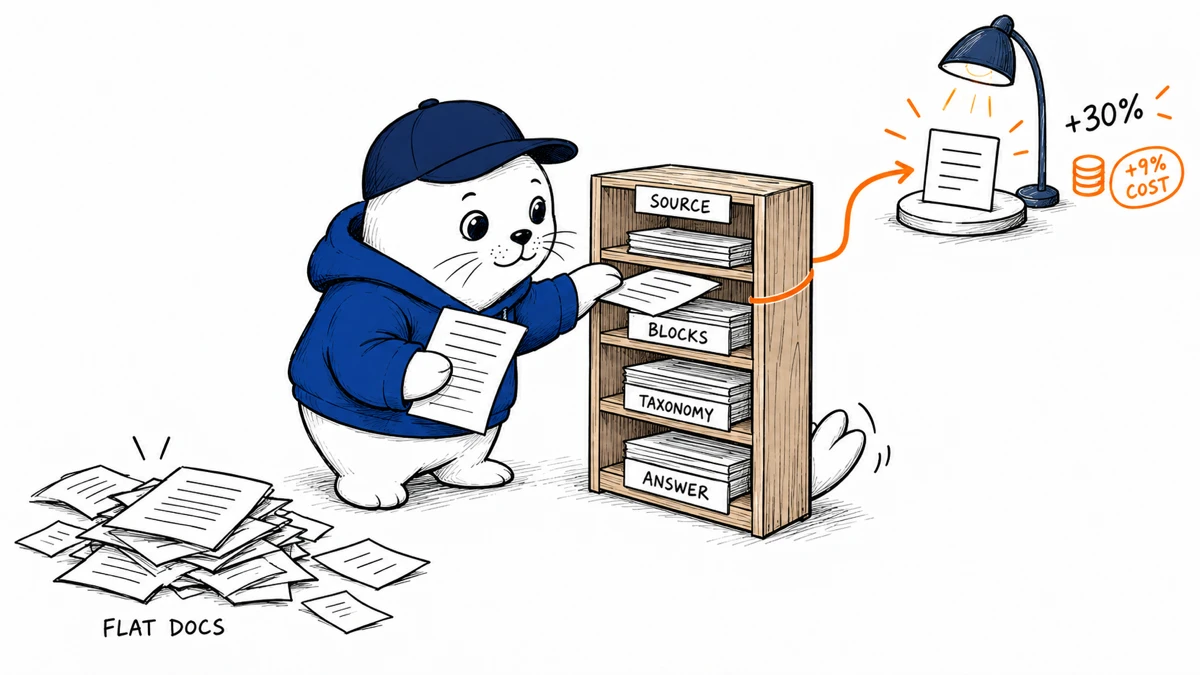
Atlassian says restructuring support documents improved grounded AI answers more than changing the model: 30% higher accuracy and about 45% higher consistency for about 9% more cost per query.
Atlassian structured content is the subject of a company-published controlled experiment released September 18, 2026. Atlassian compared its current flat support documents with content rebuilt as discrete knowledge blocks inside a four-layer content model enriched with taxonomy metadata. The company reports that answers grounded in the structured version were 30% more accurate and about 45% more consistent, at about 9% additional cost per query.
The claim in one evidence table
| Reported change | Company result | What remains unpublished |
|---|---|---|
| Flat documents to four-layer structured content | 30% higher answer accuracy | Question set, sample size and scoring rubric |
| Taxonomy-enriched knowledge blocks | About 45% higher consistency | Number of repeated runs and variance |
| More retrieval structure | About 9% higher cost per query | Model, token counts and cost basis |
These figures are useful because they put a price beside the quality gain. They are not independently reproducible from the blog post alone. Atlassian does not publish the full experimental protocol, baseline prompts, answer set or statistical treatment. The correct label is company-reported, not proven for every retrieval system.
Why structure can beat a larger context window
Flat documents often mix prerequisites, procedures, exceptions and version notes on one page. A retriever may find the page but still feed the model a section that lacks the condition needed to answer correctly. Smaller knowledge blocks can carry their own metadata: product, version, audience, task, validity period and relationship to other blocks.
- Source layer: the authoritative policy, code or product record.
- Block layer: one self-contained fact, step, warning or decision.
- Taxonomy layer: metadata that distinguishes similar concepts.
- Assembly layer: rules for selecting and ordering blocks for a user.
The four labels above are a practical reconstruction, not Atlassian’s disclosed schema. The company confirms a four-layer model and taxonomy metadata but does not name every layer in the article. Publishers should avoid copying an imagined architecture as if it were official.
Atlassian also reports a cheaper standards repository
A separate project assembled 140 verified content standards and exposed them through Rovo Agents, MCP and Skills. Atlassian reports about 21% lower cost, twice the retrieval speed, about 20% fewer tokens and about 60% fewer tool calls. That result points in the opposite cost direction from the support-content experiment, which is a useful reminder that structure can either add retrieval work or remove waste depending on the baseline.
How to reproduce the test on your own knowledge base
- Select 100 real questions with known answers, including ambiguous and version-sensitive cases.
- Freeze the model, system prompt, retrieval settings and tool permissions.
- Run the questions against the current flat documents and store every retrieved passage.
- Split a copy of the content into independently useful blocks with explicit metadata.
- Run the same questions against the structured copy with the same model settings.
- Use blind human review to score correctness, completeness and unsupported claims.
- Repeat a subset several times to measure consistency rather than one lucky run.
- Compare total tokens, retrieval calls, latency and dollar cost for completed answers.
Measure accuracy at the claim level
A single answer can contain five factual claims and get four right. A binary pass or fail score hides where structure helped. Break the reference answer into atomic claims, then mark each generated claim as supported, contradicted, missing or unverifiable. Add a separate penalty for citations that point to the wrong block.
| Metric | Definition | Failure it exposes |
|---|---|---|
| Claim precision | Supported generated claims divided by all generated claims | Confident additions |
| Claim recall | Required claims found in the answer | Missing conditions or steps |
| Citation match | Citation directly supports the nearby claim | Decorative sourcing |
| Repeat consistency | Agreement across repeated runs | Unstable retrieval or generation |
| Cost per accepted answer | Total spend divided by answers that pass review | Cheap queries that produce unusable work |
The content technologist is becoming an infrastructure role
Atlassian describes content technologists as people who turn editorial judgment into schemas, metadata, guardrails and retrieval signals. That places content work inside the system that decides what an agent sees, not only on the page a person reads. The role sits between content design and engineering because both the language and the delivery mechanism affect the answer.
This idea connects to our Notion 3.7 skills guide, where reusable instructions package knowledge for agents. It also connects to our cPanel Meridian AI guide, which shows why tool access and source authority must be separated from generated explanations.
What publishers should do next
Do not begin by rewriting every article. Pick one high-value support journey, define the answer claims and structure only the content needed for that test. If accuracy rises, inspect which metadata fields caused better retrieval. If cost rises, calculate cost per accepted answer rather than cost per query. A nine percent query premium can be a bargain when it prevents repeated support contacts, but only your own workload can prove that.
Primary source
A related workforce issue appears in the IBM AI invisible work study, which tracks validation, correction and exception handling around AI output.
Checked September 21, 2026. All improvement percentages in this article are Atlassian-reported and have not been independently reproduced by MustHave.ai.