Enterprise agent startup Ema has raised $77 million in a Series B led by Creaegis. The financing is confirmed; the harder story is whether teams of specialized agents can replace fragmented software and services without creating a new layer of access, audit and cost risk.
The financing facts
Ema enterprise AI agents received $77 million in new Series B financing. Creaegis led the round, and existing investors Accel, Section 32 and Prosus participated. Ema says the transaction brings its total funding to $140 million.
The company says its valuation has increased by more than four times since the prior round, but it did not disclose the current valuation. The new financing is reported as primary equity rather than debt or a secondary sale.
What Ema is selling
Ema describes its product as a universal AI employee made from specialized agents that can work across enterprise systems. The proposition is broader than a chat assistant. An agent team might read requests, retrieve context, take permitted actions, route exceptions and record the result across several applications.
That architecture targets a real cost: enterprises often buy separate software and services for workflows that still depend on manual handoffs. Replacing the handoff can be valuable. Replacing the evidence and accountability around it would not be.
The Wipro case is important but still company-reported
Ema says Wipro has deployed the platform across 240,000 associates in 65 countries and more than 100 workflows. It also reports about 2.9 million annual queries and a 20 percent increase in satisfaction. These numbers come from the companies and have not been independently audited in the public material.
Query volume measures use, not value. Satisfaction can improve because answers are faster, because employees have fewer systems to open or because expectations changed. A credible case study needs the baseline, survey method, workflow mix, exception rate and total cost.
The four ledgers an enterprise deployment needs
| Ledger | Minimum record | Decision it supports |
|---|---|---|
| Identity and access | User, agent, credential scope and approved systems | Whether the action was authorized |
| Workflow evidence | Inputs, steps, tools, exceptions and final state | Whether the task was completed correctly |
| Human accountability | Reviewer, escalation and approval record | Who accepted the outcome |
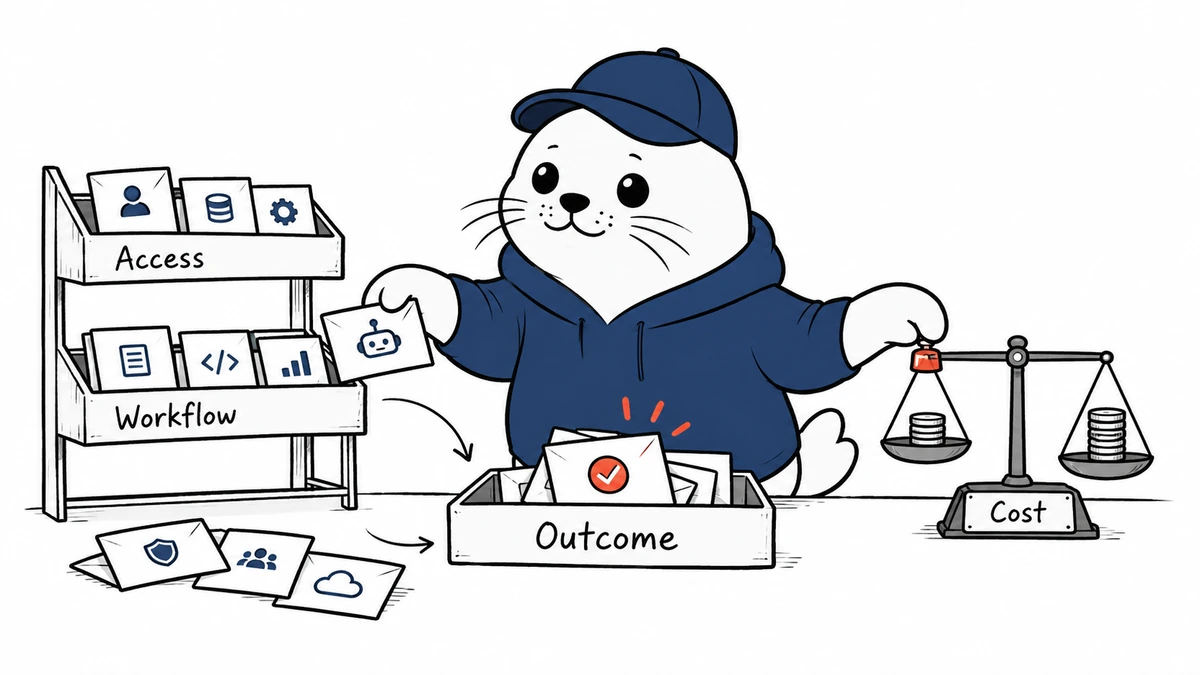
| Economics | Model, tool, infrastructure and correction cost | Whether automation saved money at equivalent quality |
Agent teams can multiply hidden failure modes
One agent can misunderstand a request. Several agents can pass the misunderstanding between them while making the process look organized. Each handoff adds possible context loss, stale data, mismatched permissions and duplicated work. Teams should test the complete workflow rather than approving agents one at a time.
- Use service-side permissions for every action.
- Require structured handoff records between agents.
- Make exceptions visible instead of silently retrying forever.
- Separate recommendations from irreversible actions.
- Measure correction and rollback work as part of cost.
A 30-day pilot scorecard
- Choose one bounded workflow with a known volume and baseline.
- Define what counts as completed, correct, escalated and reversed.
- Give each agent only the access required for that workflow.
- Run a shadow period before allowing external side effects.
- Compare cycle time, error rate, human review time and total cost.
- Sample failures and near misses, not only successful sessions.
- Expand only when the evidence remains stable across a second workflow.
The Magentic procurement-agent analysis shows why domain boundaries matter, while the Microsoft agent-metrics review explains how to interrogate dramatic productivity figures.
What the Series B does not prove
The round does not prove that an AI agent can replace a software category, that the reported satisfaction increase will transfer to another company or that the platform lowers total cost after governance and correction work. Funding validates investor interest and gives Ema resources to expand the product and sales effort.
The next evidence should include workflow-specific baselines, error and escalation rates, independent customer references, data-retention controls and cost per completed task. Those details will show whether the universal-employee framing is an architecture or a marketing umbrella.
The practical verdict
Ema has raised a substantial round around a timely enterprise thesis: organizations want outcomes that span applications, not another isolated chatbot. The opportunity is credible. The public evidence still depends heavily on company-reported scale and adoption figures.
Buyers should evaluate Ema at the workflow boundary. If a team can prove authorization, completion, human accountability and economics in one record, the platform may consolidate real work. If it only produces more agent activity, the complexity has moved rather than disappeared.
Primary sources
Checked September 23, 2026. Funding terms are confirmed by the company and independent reporting. Adoption and outcome figures are company-reported and not independently audited.