

A one-line filing can look boring beside a viral number. In this story, the boring part is exactly what keeps the coverage honest.
The filing gives us one solid piece of the unwind
Leopold Aschenbrenner’s name surged in search interest after reports that his AI-focused investment firm, Situational Awareness, had suffered a brutal July. The cleanest new evidence is less dramatic, but more useful: an August 4 Schedule 13D amendment covering the firm’s position in Core Scientific.
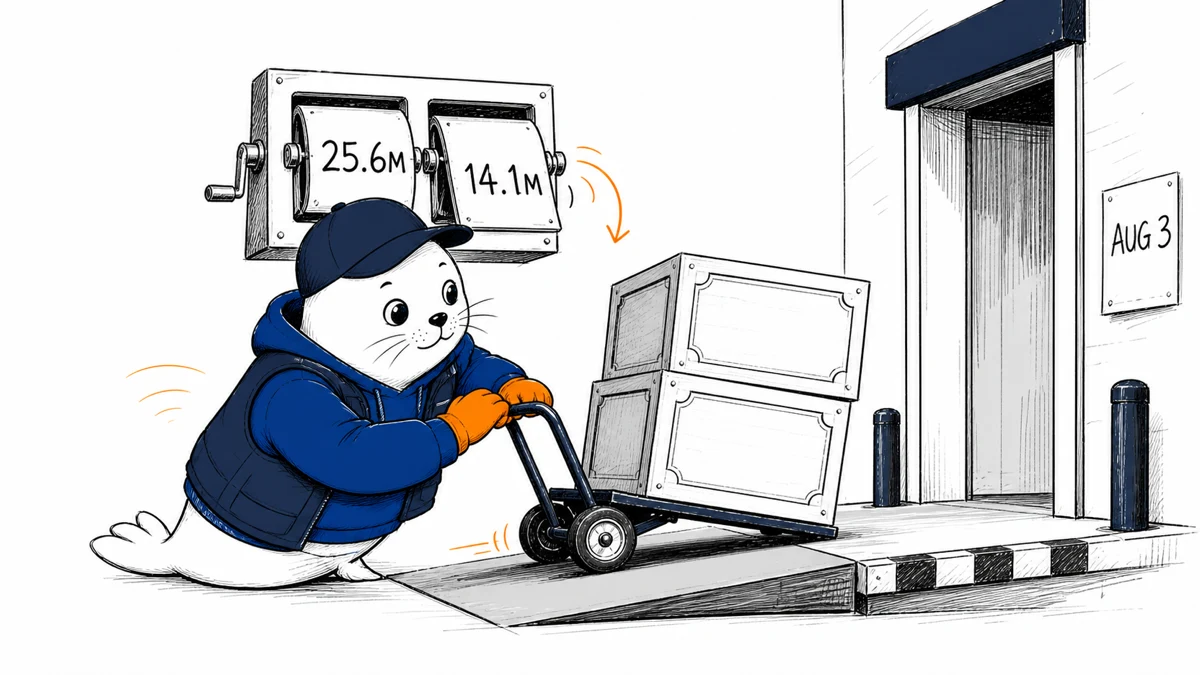
The filing says the reporting group held 25,608,473 Core Scientific shares on July 15. By the close of August 4, that figure was 14,089,395 shares. That is a reduction of 11,519,078 shares, or 44.98% of the July 15 position.
Core Scientific shares reported by Situational Awareness
The August 4 filing compares the group’s position on July 15 with its position after the August 3 block trades.
July 15, 2026
25.61M
August 4, 2026
14.09M
The ownership percentage fell from 8.1% to 4.4%. The filing also names August 3 as the date the group dropped below the 5% reporting threshold. Those are filing-backed facts, not estimates from a social post.
The trade exhibit is unusually specific
The attached SEC transaction exhibit lists four sales. Two smaller open-market trades happened in mid-July. The big move came on August 3, when two equal blocks of 5,759,539 shares were sold to unaffiliated third parties.
What the transaction exhibit records
Prices exclude commissions. The August 3 entries were separate block trades with unaffiliated third parties.
July 14
134,011 shares sold
$22.4083 per share
Open-market sale through a broker.
July 15
265,989 shares sold
$22.1836 per share
A second, larger open-market sale.
August 3
11,519,078 shares sold
Two blocks at $19.6896 and $19.4807
The filing identifies the buyers only as unaffiliated third parties.
Multiplying the two August 3 blocks by their disclosed prices gives estimated gross proceeds of $225,602,870 before commissions. I would round that to $225.6 million, not pretend the last dollar is economically meaningful.
That calculation tells us something concrete about one public position. It does not tell us the fund’s net profit or loss on Core Scientific because the filing does not provide a complete cost basis for the shares sold.
Now separate the filing from the reporting
This is where the story gets messy. The Wall Street Journal reported that Situational Awareness was down around 67% in July, citing a person who saw an investor letter. The Journal also reported that the firm backed out of a deal to sell $3.5 billion of Anthropic shares.
Separately, Axios reported, based on a source, that the fund sold its entire public-equities portfolio to Citadel. A separate Journal report described Citadel as buying the bulk of the stock portfolio after deep losses.
Evidence check: filed, reported, or still unknown
The labels matter because these claims come from different kinds of evidence.
✓
Filed: the Core Scientific position fell by 11.52 million shares
The August 4 SEC amendment and its transaction exhibit provide the share counts, dates, and prices.
✓
Filed: the group crossed below 5% on August 3
The amendment states the threshold date and reports 4.4% ownership as of the next day's close.
!
Reported: the fund lost around 67% in July
The number comes from Journal reporting about an investor letter, not the SEC amendment.
!
Reported: Citadel acquired the public-equities portfolio
Axios and the Journal cite sources; the Core Scientific filing does not identify Citadel.
?
Unknown from this filing: the fund's total assets and complete portfolio
A 13D amendment covers one issuer. It is not a full balance sheet or performance report.
That does not make the reporting weak. It means readers should know which statements are backed by a public document and which depend on people familiar with private transactions or investor communications.
A 67% drawdown changes the recovery math
If the reported 67% July loss is accurate, a fund that started at 100 would finish at 33. Getting back to 100 would then require a 203% gain, not 67%. Drawdowns work against a smaller base, which is why leveraged losses can become existential long before the underlying investment thesis is settled.
That is the number I would keep in mind. A big rebound in AI stocks would not automatically repair the damage. Capital, financing terms, investor redemptions, and the timing of any forced sales can matter more than being right about demand five years from now.
Our earlier look at Ray Dalio’s AI bubble warning made a similar distinction: an expensive market can keep rising, while a sensible thesis can still be expressed through a dangerous trade.
The AI thesis and the portfolio construction are different questions
Aschenbrenner became well known for an aggressive view of AI progress and the infrastructure needed to support it. Plenty of the underlying demand signals remain visible. Anthropic’s reported compute appetite is one example; we broke down the numbers and uncertainty in the reported Anthropic-Volta deal. Power is another, as shown by the SpaceX and xAI battery purchases.
But a long-term belief in AI compute does not excuse concentration, leverage, or poor liquidity planning. The market can punish the implementation even when the narrative eventually proves right. Builders should understand that distinction too. A company can have a growing market and still fail because it runs out of cash before the market arrives.
I also would not turn a fund loss into a character trial. The public filing documents a large reduction in one holding. Reputable outlets describe a wider crisis. Neither is evidence of fraud or misconduct, and the story does not need that kind of seasoning to be worth reading.
My verdict: cover the evidence stack, not the spectacle
Yes, the Leopold Aschenbrenner story is worth covering. Search interest is real, the reported loss is enormous, and the new SEC filing adds a verifiable transaction that was missing from the first wave of headlines.
The useful version of the article is not “AI prophet crashes.” It is a map of what we can prove today. The filing confirms a $225.6 million Core Scientific sale and a 44.98% reduction in that position. The 67% drawdown and Citadel portfolio transfer remain well-sourced reporting, but they are not contained in that filing. The rest should wait for more evidence.
Go deeper
- Read the August 4 Schedule 13D amendment.
- Check the SEC transaction exhibit with the four disclosed sales.
- Review the Journal’s reporting on the 67% July drawdown.
- Read Axios on the reported public-equities transfer to Citadel.
Which part of this story matters more to you: the AI thesis, the leverage lesson, or the gap between public filings and private reporting?
Checked August 5, 2026. The $225.6 million proceeds figure, 44.98% position reduction, and 203% recovery requirement are Musthave.ai calculations from the cited filing data and reported drawdown.