
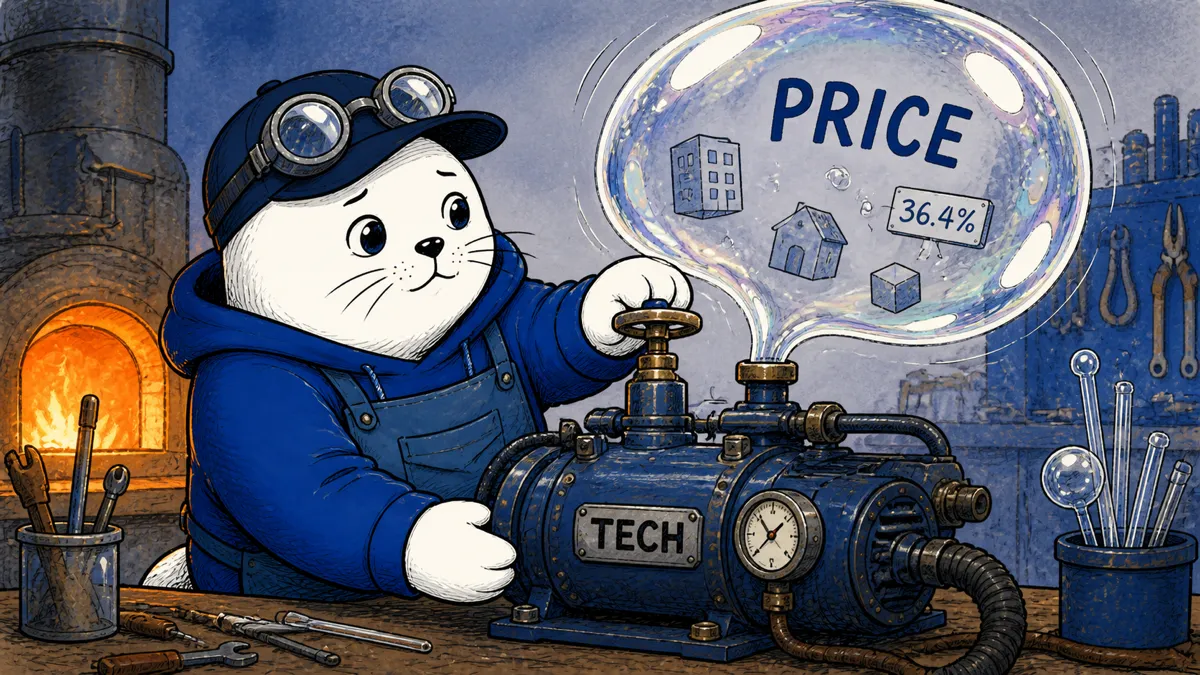
The Ray Dalio AI bubble warning is trending again because “bubble” is an irresistible word. The useful part of his argument is quieter: a technology can win, a company can struggle, and an investor can still pay too much.
Dalio has argued that the AI boom is in an early bubble phase and has compared current market euphoria with roughly 80% of the intensity near the 1929 and 2000 peaks. He is not saying artificial intelligence is fake. He is separating lasting invention from the price paid for expected profits.
That distinction matters to investors. It also matters to builders deciding whether an AI product has a business underneath the demo.
Two numbers behind the warning
They describe different risks and should not be combined into one forecast.
~80%
Dalio's comparison of current euphoria with conditions near prior major peaks.
36.4%
Weight of the ten largest S&P 500 constituents at June 30, 2026.
The first is Dalio’s cycle assessment. The second is an S&P Dow Jones Indices concentration measure, not proof of a bubble.
Winning technology does not guarantee a winning stock
The internet changed commerce, media, and communication. Many internet companies still disappeared after 2000. Railroads transformed economies while repeatedly destroying investor capital. The product can be important even when the financing, competition, or entry price is poor.
AI has the same separation. A model may deliver obvious value. The company serving it may face expensive compute, fast-moving competitors, weak customer retention, or a larger platform that bundles the same feature. A durable company can still be a bad purchase if its price assumes impossible growth.
Three questions that often get collapsed
Treat each layer as a separate piece of evidence.
Does the technology work?
Can it complete a valuable task with acceptable quality, speed, and risk?
Can the company keep the value?
Does it have distribution, margins, retention, data, or a defensible workflow?
What does the price assume?
How much growth and profit must arrive to justify today's valuation?
This is not a forced choice between optimism and pessimism. You can believe AI adoption will be enormous and still ask whether a particular business captures enough of that value.
Concentration makes mistakes travel farther
S&P Dow Jones Indices reported that the ten largest S&P 500 constituents represented 36.4% of the index at the end of June 2026. A concentrated index can rise quickly when its largest companies deliver. It can also make broad portfolios more sensitive to a small group of expectations.
That number does not prove an AI bubble. Several of the largest companies have large existing businesses and cash flows. It does mean the AI story is not isolated in a speculative corner. It is tied to companies that influence retirement accounts, index funds, suppliers, data centers, and national power demand.
Our report on the Texas data-center grid audit shows the physical side of those expectations. Forecasts eventually become land, power contracts, cooling systems, and construction schedules.
Builders need a bubble test too
Founders do not need to predict a market crash. They do need to know whether revenue survives cheaper models and bundled features. If a product is only a thin interface around an API, falling model prices can help margins and invite dozens of competitors at the same time.
A practical AI business stress test
Use real customer data where possible.
Workflow value
What costly step disappears, and how often does the customer repeat it?
Revenue quality
Are people renewing because the product works or because a promotion delayed the decision?
Model cost
What happens to gross margin when usage doubles or the best model costs more?
Distribution
Can a platform bundle the feature and reach the customer first?
Switching cost
Does the product own a trusted workflow, or can the user leave after exporting one file?
For an AI buyer, the same discipline applies. Do not sign a long contract because a category is moving quickly. Run a measured pilot. Compare successful-task cost, human review, adoption, data risk, and the manual fallback.
What the warning cannot tell you
A cycle comparison cannot identify the top. Markets can remain expensive, become more expensive, or correct while the technology keeps improving. The 80% description is an interpretation, not a countdown clock.
This article is not investment advice and does not recommend buying, selling, or shorting any security. If a financial decision matters to you, use professional advice that accounts for your situation rather than a trending search term.
For technology decisions, our guide to choosing an AI model with evidence uses the same principle: separate a strong demo from a repeatable result.
My read: ask what has to be true
The Ray Dalio AI bubble warning is most useful when it stops being a crash prediction. Ask what has to be true for the technology to work, for the company to capture value, and for today’s price to make sense.
Then watch the evidence. Adoption, retention, margins, capacity, competition, and cash flow will answer the question more reliably than another viral chart. AI can be a generational technology and still punish lazy assumptions.
Go deeper
- Watch Ray Dalio’s official discussion of whether AI is in a bubble.
- Read the Reuters report on Dalio’s early-bubble assessment.
- Check the official S&P 500 index facts and concentration data.
- See how falling model prices change AI product economics.
Data checked August 5, 2026. This article is for general information, not investment advice.