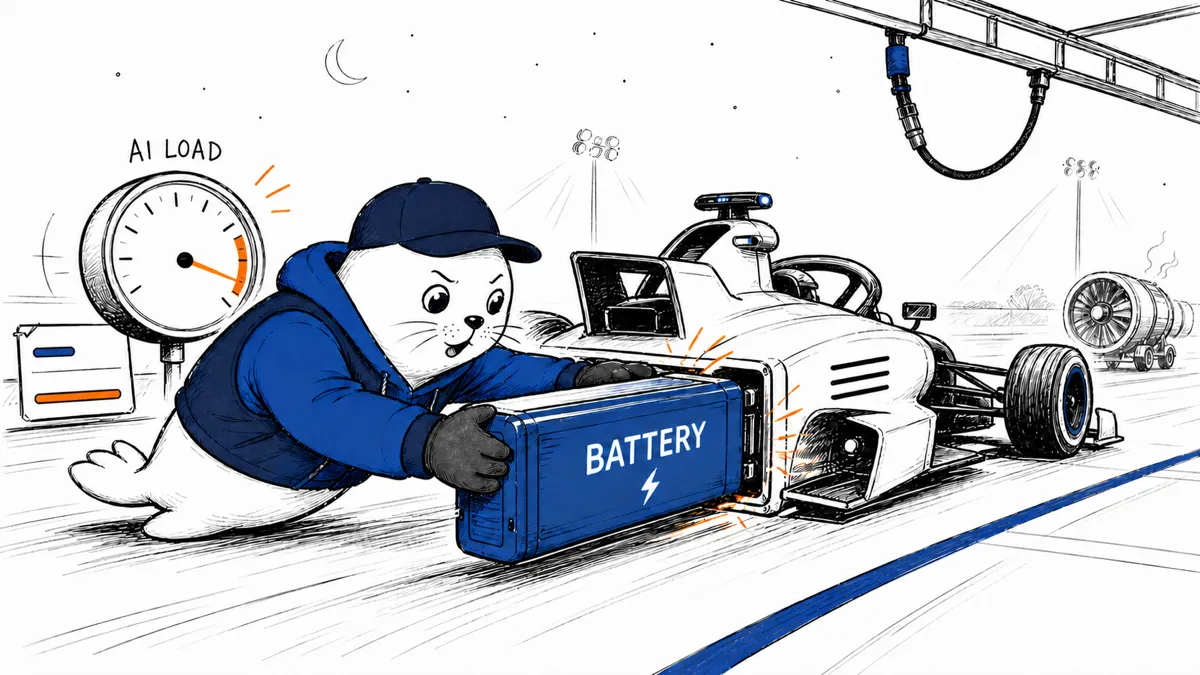
AI data centers are usually pictured as rows of GPUs. SpaceX’s latest spending disclosure points to the less glamorous hardware that keeps those GPUs useful: hundreds of millions of dollars in industrial batteries.
SpaceX Megapack purchases reached $329 million
SpaceX spent $295 million on Tesla Megapacks in the second quarter of 2026 and $329 million across the first half of the year, according to its quarterly reporting as summarized by TechCrunch. That makes the first-quarter amount $34 million by subtraction.
The Q2 purchase was about 8.68 times the Q1 amount. Put another way, quarterly SpaceX Megapack purchases increased by $261 million, or roughly 768%. Those are calculations from the disclosed quarterly and year-to-date figures, not forecasts.
SpaceX’s 2026 Megapack spending jumped in Q2
Q1 is calculated as $329M year to date minus the disclosed $295M Q2 amount.
Q1 2026
$34M
Q2 2026
$295M
First half
$329M
The likely destination is xAI, but that is an inference
SpaceX now includes xAI, and TechCrunch argues that the batteries are likely headed to xAI data centers. The companies have not publicly mapped each newly purchased Megapack to a named site in the disclosure, so "for xAI" should remain an informed inference.
The inference is reasonable. Before xAI merged with SpaceX, xAI had purchased $430 million of Megapacks for its data centers. Large AI facilities also need equipment that can cover brief outages, smooth sudden power demand, and reduce the cost of sharp peaks. Still, a related-party purchase and a likely use are not the same thing as a site-by-site deployment record.
The evidence ladder
Separating disclosed facts from interpretation makes this story more useful.
Disclosed:
SpaceX bought $295M of Tesla Megapacks in Q2 and $329M in the first half.
Historical context:
xAI bought $430M of Megapacks for data centers before joining SpaceX.
Reasonable inference:
at least some of the 2026 batteries will support xAI compute infrastructure.
Still unknown:
exact sites, installed megawatt-hours, commissioning dates, and the split between backup and grid management.
Batteries solve a different problem from turbines
A gas turbine can provide long-duration on-site generation. A Megapack stores energy and releases it quickly. Those jobs overlap at the edges, but they are not substitutes.
An AI data center needs a power stack
The useful question is how the layers work together, not which single technology "powers AI."
Grid connection
Supplies the normal load, subject to utility capacity, rates, and interconnection limits.
On-site generation
Can add longer-duration capacity where permitted, with fuel, emissions, and maintenance obligations.
Battery storage
Responds quickly to outages and peaks, bridges transitions, and can smooth demand seen by the grid.
Our report on SpacexAI’s temporary turbines covers the generation layer. The Texas data-center audit shows why utilities and communities increasingly want the whole stack documented: power source, water, cooling, ownership, incentives, and exit plan.
Related-party spending deserves its own question
Tesla and SpaceX share Elon Musk as a central executive and large shareholder, so these transactions deserve more scrutiny than a normal vendor invoice. The existence of a related-party relationship does not make the purchase improper. It does make price, approval, alternatives, and disclosure important.
Investors should want to know whether SpaceX compared competing storage systems, how pricing was set, which board processes applied, and whether delivery priority changed. Data-center operators should ask a different question: whether the battery configuration is designed around actual load behavior or around whatever equipment was available.
What the $329 million does not tell us
Purchase value alone cannot reveal storage capacity because contract pricing can include hardware, software, installation, transport, services, and site-specific work. It also does not tell us the percentage of an xAI site that can run on batteries or for how long.
- Missing capacity: no disclosed megawatt-hour total tied to the $329 million.
- Missing location: no complete site allocation for the Q2 order.
- Missing duty cycle: backup, peak shaving, grid services, and transition support have different designs.
- Missing timeline: a purchase can precede delivery and commissioning by months.
- Missing alternatives: the filing does not show the vendor-selection process.
My read: AI infrastructure is becoming an energy product
The spending jump is the signal. SpaceX did not slowly add a few batteries to a mature facility; the Q2 amount was nearly nine times Q1. Whether every unit serves xAI or not, the company is building around a load profile that values fast, large-scale storage.
For builders, the wider lesson is simple. Once an AI product reaches enough scale, model choice and GPU count stop describing the system. Power quality, backup duration, interconnection, cooling, and recovery become product features because they determine whether the model is available when a customer needs it.
Go deeper
- Read TechCrunch’s report on SpaceX’s Megapack purchases.
- Review SpaceX investor relations for the underlying quarterly materials.
- See Tesla’s Megapack product overview for the system’s stated use cases.
Which missing number matters most to you: storage capacity, site location, related-party pricing, or delivery timing?
Checked August 5, 2026. Q1, growth-rate, and ratio figures are calculations from reported Q2 and first-half spending. The xAI deployment link is presented as an inference.