Higgsfield has published the architecture behind Supercomputer, its agentic creative workspace for research, code, files, images, video and audio. The September 16 engineering account says the product is a coordination harness rather than a single model, with selective visual-memory retrieval and workflow-specific Skills designed to keep long creative projects usable.
The announcement is useful because it describes the problem beneath the product demo. A creative agent can reason about a character, prop, location and previous shot, but repeatedly loading every asset into every model call would make the context expensive and unwieldy. Higgsfield says Supercomputer retrieves the relevant visual reference when it is needed instead.
Higgsfield Supercomputer is a harness, not one model
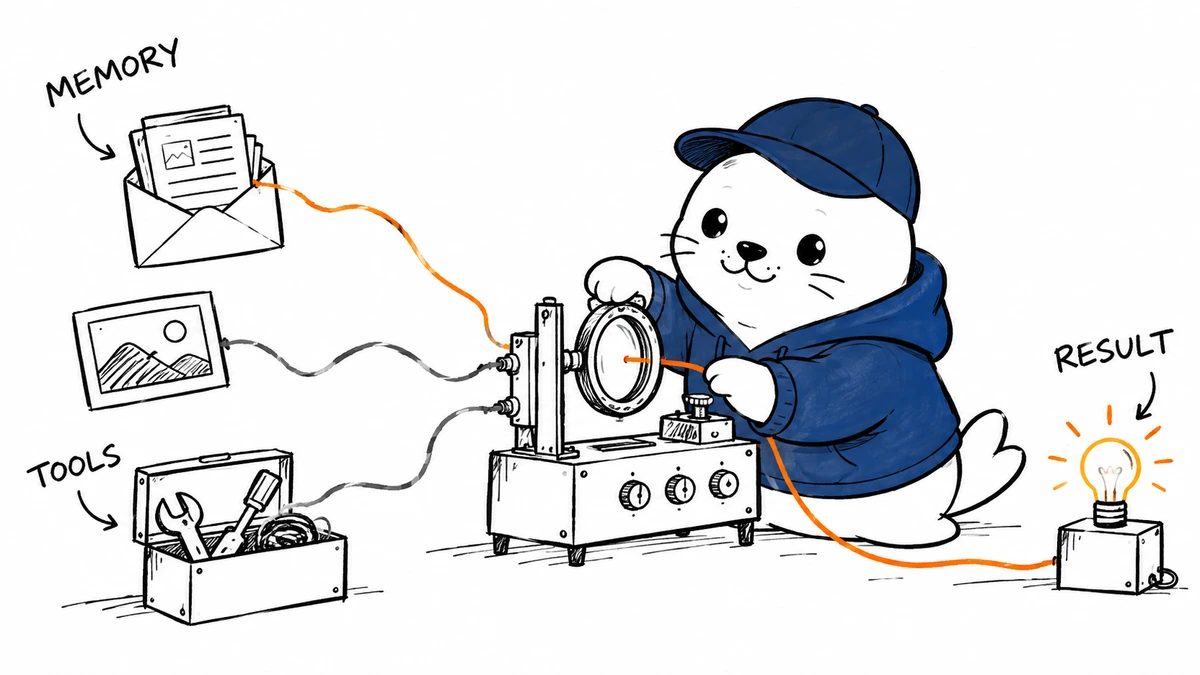
In How We Built Supercomputer, Higgsfield describes a system that coordinates multiple models, tools and context sources. The user interacts with one workspace, while the harness decides when to research, write code, inspect a file, retrieve an asset or invoke an image, video or audio generator.
That distinction matters. A model produces an answer from the context it receives. A harness decides what context to retrieve, which tool to call, how to preserve state and what to do when a step fails. Higgsfield says the first version took about six weeks to build, but that timeline is a company-reported development account, not an independent measure of system maturity.
Visual memory solves a different problem from a larger context window
A text agent can summarize earlier messages. A visual creative agent also needs to preserve faces, wardrobes, environments, compositions and motion references. Sending every full-resolution source into every step would consume bandwidth and model context while making retrieval less selective.
Higgsfield says its system keeps visual assets available and retrieves the relevant one for the current task. In practical terms, a request to extend scene three should pull the scene-three camera reference and the approved character appearance, not every unused draft from the project.
| Layer | Job | Failure to test |
|---|---|---|
| Conversation | Captures the goal and revisions | Instructions get diluted over a long project |
| Harness | Selects tools, models and next actions | The wrong tool is called or a costly loop continues |
| Visual memory | Retrieves the relevant approved asset | An obsolete face, prop or frame is reused |
| Skills | Encode workflow and model-specific know-how | A brittle instruction fails when a model changes |
| Media generation | Produces image, video or audio output | The result is technically complete but creatively inconsistent |
Skills turn creative know-how into reusable instructions
Higgsfield uses the term Skills for model- and workflow-specific operating knowledge. A Skill can tell the agent how a particular generator handles references, which settings fit a shot type or how to sequence a multi-stage task. This is closer to a maintained operating procedure than a one-off prompt.
The approach can improve consistency only if Skills are versioned and tested. A workflow written for one model release can become stale when parameters, moderation rules or output behavior change. Teams evaluating the product should ask whether a Skill records its compatible model version and whether a failed step can be replayed without rerunning the whole chain.
Failure recovery is part of the product claim
Higgsfield says Supercomputer was built to recover from failures rather than abandon a long workflow. That is an important design goal for media generation because a sequence can contain research, asset retrieval, generation, review and export steps, each with different failure modes.
However, the engineering post does not publish independent reliability measurements, recovery rates, median latency, cost per completed workflow or an evaluation set. Readers should separate the architecture description from demonstrated performance. A recovery mechanism is not proven until it is tested against intentionally broken tools, expired assets, rejected generations and conflicting user instructions.
Free Mode is free for text, not for generated media
The Supercomputer product page says Free Mode text interaction costs zero credits. Media generation still consumes credits. That creates a two-part cost model: planning and discussion may be free, while each image, video or audio action draws from a paid balance.
A useful evaluation should therefore measure cost per accepted project, not the apparent price of the chat layer. If an agent creates many rejected clips while exploring, the free planning conversation can still lead to an expensive outcome. The same principle appears in our guide to AI agent spend caps and routing.
Where Supercomputer fits in Higgsfield
Higgsfield positions Supercomputer inside Cinema Studio and Canvas, where the agent can act on a live creative project rather than return only text. The company also describes an MCP connection that can expose its capabilities to external agents. This makes Supercomputer both a user-facing workspace and a coordination layer for other software.
The direction resembles a wider shift from isolated AI features to workspaces that retain state and operate tools. For comparison, our report on Claude Slides, Docs, Design and Cowork examines how another platform is bringing conversation and editable work into the same environment.
A five-test evaluation for visual agents
- Reference recall: approve two similar character images, then verify that the agent consistently retrieves the correct one for a later scene.
- Stale-memory handling: replace a prop or wardrobe reference and confirm the old asset no longer appears.
- Recovery: force one generation to fail and record whether the workflow resumes at the failed step.
- Cost boundary: set a fixed media budget and test whether the agent asks before exceeding it.
- Export continuity: reopen the project later and verify that files, decisions and generated media remain connected.
Higgsfield’s architecture is plausible and addresses a real creative-agent bottleneck. The useful next evidence is operational: reproducible tests showing which visual references were retrieved, how a failed chain resumed, what the completed workflow cost and whether an independent reviewer accepted the result.
Sources and evidence limits
Checked September 17, 2026. Architecture, development timeline and capability descriptions are Higgsfield’s first-party claims. The launch materials reviewed by MustHave.ai do not include independent reliability benchmarks, latency results or cost-per-workflow evaluations.