
AI agent budgets fail when the only control is an email after the money is gone. Two recent production patterns show a better design: pause the expensive route before the ceiling, preserve a cheaper path for essential work, and make exceptions temporary and visible.
Google Cloud introduced hard monthly project caps for agent workloads. Jamf separately described a production system on Amazon Bedrock that limits models according to each user’s daily spend. These are vendor and customer accounts, not a universal benchmark, but together they produce a useful control stack.
September 2026 update: Foundry Model Router adds session affinity and routing traces
Microsoft’s September 2026 preview adds two controls that make model routing easier to operate: session affinity and per-request routing metadata. Session affinity lets an application supply an opaque session identifier so related requests can remain on a stable route when eligible. The trace metadata exposes which model path handled each request.
| Control | Why it matters | What it does not guarantee |
|---|---|---|
| Session affinity | Reduces route changes during one conversation or workflow. | It does not guarantee prompt-cache reuse or permanent model pinning. |
| Per-request route metadata | Connects cost, latency and quality to the selected path. | It does not replace application-level task outcomes. |
| 32-region expansion | Broadens deployment choices. | It does not automatically satisfy residency or failover policy. |
Use a random, non-sensitive affinity ID rather than an email address, customer name or conversation text. Log the affinity ID separately from the returned route metadata, then compare cost per accepted task by route. Microsoft says existing eligibility and fallback behavior remain in place, so an affinity request can still meet policy constraints that send it elsewhere.
- Test the same session ID across ordinary, long-context and tool-heavy requests.
- Verify what happens when the preferred route is unavailable.
- Do not assume session affinity creates a cache hit; measure cached tokens directly.
- Store route metadata with latency, token use, retries and the final task outcome.
- Recheck data residency for each of the 32 supported regions and every fallback.
Primary documentation: Microsoft Foundry Model Router updates and the Model Router implementation guide. The feature is in preview, so production behavior, availability and billing should be rechecked before deployment.
Two production patterns solve different layers
| Control | Google Cloud pattern | Jamf pattern |
|---|---|---|
| Scope | Project and monthly spend | User and daily spend |
| Early warning | Alerts at 50%, 80%, and 100% | Usage evaluated before model access |
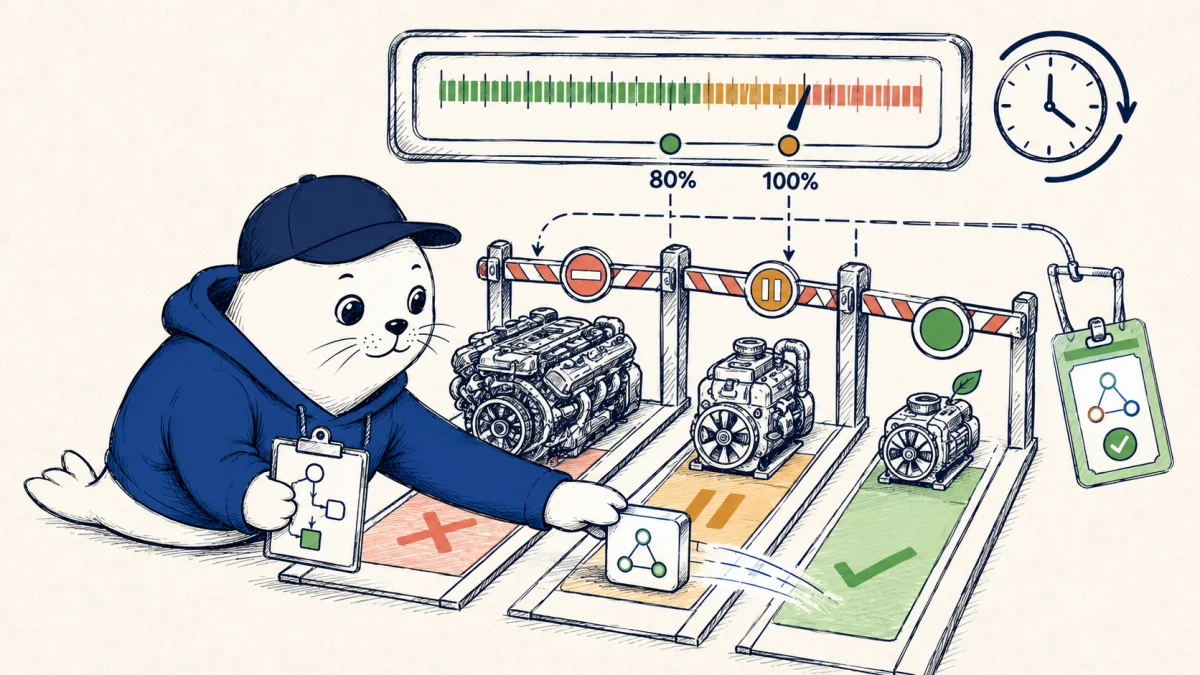
| Hard action | Pause agent API calls at cap | Block Opus at 80%, Sonnet at 100% |
| Continuity | Optional overage or manual resume | Haiku remains available |
| Renewal | Monthly | Daily reset |
| Exception | Console action or overage policy | Timed user exception |
The important distinction is graceful degradation. A budget control should stop the costliest optional behavior before it disables the entire workflow. A support agent can still search a knowledge base with a smaller model even after deep reasoning is paused.
Set three thresholds, not one surprise wall
- At 50%, show the user and owner the projected exhaustion date.
- At 80%, route routine tasks to an efficient model and require justification for premium runs.
- At 100%, pause nonessential agent calls while keeping a safe low-cost path available.
The percentages are a starting point, not a law. A batch-processing team may need a weekly envelope. A customer-facing agent may require a reserved emergency pool. What matters is that the transition is designed before the meter reaches the line.
Enforce before the request leaves
A dashboard is observability. A gate is control. Check the authenticated user, project, route, estimated maximum cost, current spend, and exception state before calling the model. Reconcile actual usage afterward because an estimate cannot know the final output length or tool trajectory.
Show the decision at the point of use. A developer should see that a premium model was paused because the project crossed a threshold, which route replaced it, and when the allowance renews. A generic tool error invites retries, exactly the behavior a cost control is supposed to prevent.
Reserve the budget atomically for concurrent agents. Without a reservation, ten workers can all see $5 remaining and each start a $2 job. Return unused reserve after completion and expire abandoned reservations.
Route by work class
Define a small assignment board: extraction, simple drafting, tool selection, code change, deep review, and recovery. Give each class a default model, maximum attempts, timeout, and allowed escalation. Do not let the agent select an unlimited premium route merely by saying a task is difficult.
Our AI model selection guide shows how to compare completed tasks. The same evidence should feed the cost router.
Make exceptions narrow and temporary
An exception should name the user, job, maximum additional amount, approver, reason, and expiry. It should not become a permanent bypass hidden in a support ticket. Jamf’s reported timed exceptions are useful because access returns to normal automatically.
Keep an audit record of the requested route, allowed route, budget snapshot, final cost, and verifier outcome. This turns a budget complaint into an explainable decision instead of a guess.
Measure accepted work, not cheap tokens
Cost per million tokens is an input price. The business metric is cost per verified completion. Include model calls, tool calls, retries, failed generations, and human repair minutes. A cheap route that fails twice can cost more than one careful premium run.
This is especially important for long-running agents. A loop that keeps searching after the answer is sufficient turns a good model price into a bad task price. Add step limits, tool budgets, and a verifier that can stop useful work when the finish line is met. Our AI SaaS pricing failure analysis shows what happens when a flat customer price meets uncapped model use.
My verdict: preserve a minimum useful service
Run a budget-fire drill before launch. Force a test project through each threshold, confirm that in-flight work reaches a defined state, and verify that new premium calls stop. Check the alert recipient, console message, reset time, override expiry, and audit record. Then restore the allowance and make sure queued jobs do not all resume at once. Cost controls that have never been exercised tend to fail when concurrency and user retries are highest.
Separate team budgets from customer entitlements. An internal project cap protects the company invoice, while a user allowance defines the product promise. If both limits trigger, return the reason that the user can act on without exposing internal financial data. Log both decisions for support.
Forecast with a high-percentile task cost rather than the average alone. A few long agent trajectories can dominate spend while the median remains reassuring. Report median, 90th percentile, maximum, and the share of jobs that hit a retry or escalation limit. Tie every alert to an owner who can inspect the expensive trace.
The strongest cost control is not a kill switch. It is a policy that decides what remains available as spend rises. Keep the low-cost path useful, tell the user why a premium route is unavailable, and show when the allowance resets.
Start with one project and one user cohort. Simulate the 80% and 100% states before launch. If the team cannot finish essential work or understand the message, the control is not ready.
Read the primary accounts
- Read Google Cloud’s agent billing and spend-control announcement.
- Review the AWS post on Jamf’s real-time Bedrock spend enforcement.
For a concrete delegated-reading example, our Spotify Shunt analysis separates the reported bulk-read token reduction from the full session bill, including worker usage, latency, and repair work.
The Microsoft Foundry A2A Tool adds a new cost boundary because every delegated agent call can create its own model and tool spend.
Perplexity effort controls are a relative routing layer rather than a hard budget cap, so completed-task cost still needs measurement.
Checked September 3, 2026. Product behavior comes from Google Cloud. The Jamf architecture is company-reported through AWS. Control design and metrics are Musthave.ai analysis.