
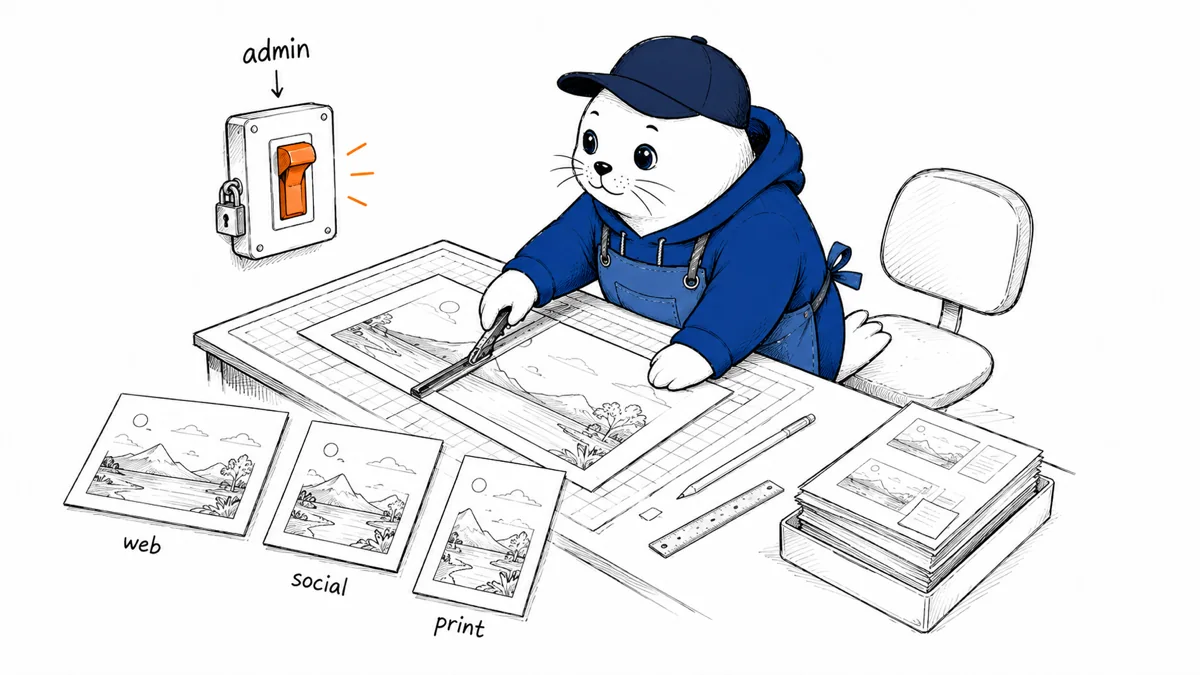
Google Pics is arriving inside Workspace as an image document you can prompt, edit, translate, resize, and share. That sounds simple until you notice the rollout setting: eligible customers get it on by default.
The right first question is not whether Google has built a Canva replacement. It has not supplied the evidence for that verdict. The practical question is whether Pics can produce repeatable, editable, brand-safe files for a team without creating a new approval mess.
Google announced the general rollout on September 1, 2026. Rapid Release domains began receiving it that day. Scheduled Release domains start September 15, and Google says each rollout can take up to 15 days.
Google Pics is a collaborative file, not only a generator
Pics uses Gemini Nano Banana to create and edit images with natural-language instructions. Users can select an object for a focused change, alter or translate text inside an image, restyle a composition, crop for different formats, and upscale to 2K or 4K.
The Workspace part is more interesting than the prompt box. A Pics file can be shared, commented on, and restored through version history. Images can come from Drive or Photos, and finished work can move into Docs and Slides. That gives a team one record of the brief, changes, and approved result.
Check eligibility and rollout timing before training a team
| Rollout item | Current Google detail | Admin action |
|---|---|---|
| Rapid Release | Started Sept. 1, up to 15 days | Check which users have access now |
| Scheduled Release | Starts Sept. 15, up to 15 days | Set the pilot group before access appears |
| Default service state | On for eligible users | Disable or narrow by domain, OU, or group if needed |
| Device | Desktop only | Do not promise a mobile workflow |
| Accepted image files | JPG, PNG, BMP, TIFF | Test imports and exports used by your actual pipeline |
Google lists Business Standard and Plus, Enterprise Standard and Plus, Google AI Pro and Ultra, AI Pro for Education, and AI Expanded Access among eligible plans. Availability can differ by account and rollout track, so the admin console is the final check.
The temporary usage promise belongs in your budget
Google says customers will receive higher access to generative-AI features in Pics through at least February 28, 2027. It also warns that limits may apply after that date. A workflow that feels unlimited during launch can become expensive or constrained later.
Record how many generations, edits, and upscales a normal deliverable consumes. If Google publishes new quotas, you will have a denominator for the change. Without that record, a team will only discover the limit when a deadline hits.
A brand pilot needs more than attractive outputs
- Create five real briefs: product, social, presentation, print, and a text-heavy graphic.
- Give each brief fixed colors, dimensions, required wording, and elements that must not change.
- Have two people edit the same Pics file and restore an earlier version.
- Export every format your publishing stack needs, then inspect dimensions, transparency, text accuracy, and compression.
- Count generations, failed edits, manual repair minutes, and approval rounds.
That last step matters. Our comparison of Midjourney, ChatGPT Images, Nano Banana, and Ideogram shows why one tool rarely wins every image job. Pics may win collaboration while another model wins typography, realism, or style control.
Object edits need a pixel-level acceptance test
A focused edit can still alter nearby details. Check protected areas before and after every object change, especially faces, product labels, logos, prices, and legal text. Do not treat the chat history as proof that only the requested region changed.
This is the same lesson we found in Photoshop’s masked AI editing workflow: the useful artifact is a verified image, not a reassuring instruction. Keep the source image, edited version, approval, and final export together.
Translation can save a layout and still break the message
Pics can translate text inside an image, which is attractive for campaign variants. A translated phrase may be longer, wrap differently, cover another element, or use a font that lacks the required characters. Review meaning and layout separately.
For every target language, compare the extracted text with the approved copy, inspect line breaks at final export size, and have a fluent reviewer check tone. Save that approval with the image version. A readable translation can still be the wrong promise.
A 4K export is not automatically print-ready
Upscaling to 4K increases pixel dimensions. It does not guarantee the color profile, bleed, transparency, vector edges, or dots-per-inch setup a printer expects. Run one physical proof before moving a product catalog or event batch into Pics.
Use the same discipline for social crops. Check safe areas, platform compression, and text at phone size. The source can look excellent on a desktop canvas and fail in the feed where the work is judged.
My verdict: pilot Pics as a team workflow
Google Pics has a credible reason to exist. It combines generative editing with familiar Workspace collaboration, version history, and document handoff. That can remove file shuffling from everyday design work.
I would not switch on broad adoption from the feature list. Put ten users in a controlled group, test the files they actually ship, and measure manual repair. If it improves approvals without weakening brand consistency, expand it. If not, leave it as an occasional editor.
Read the primary documentation
- Read the Google Workspace rollout announcement.
- Review the Google Pics help and availability page.
- See Google’s consumer overview of Pics.
Checked September 2, 2026. Availability, rollout timing, plan eligibility, feature descriptions, file support, and the higher-access period come from Google. The rollout and acceptance tests are Musthave.ai analysis.
If the decision is product fit rather than admin rollout, our Google Pics vs Canva vs Adobe Express comparison maps each tool to its strongest production and handoff workflow.