

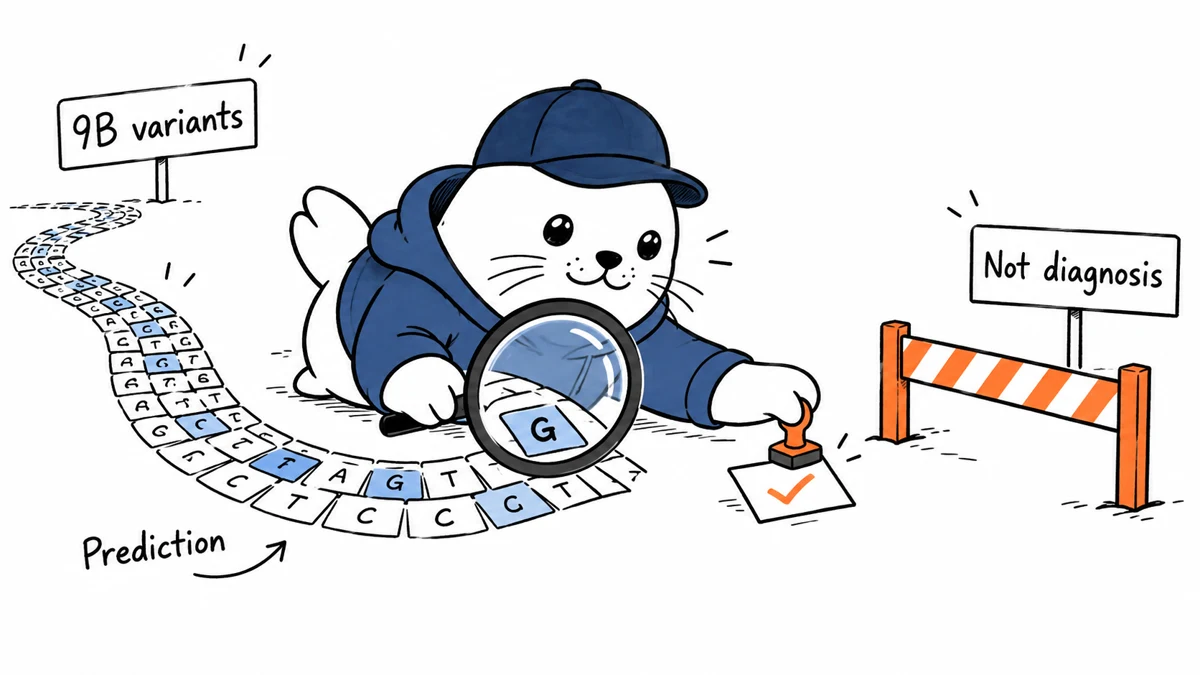
AlphaGenome Atlas changes AlphaGenome from a model researchers run on selected variants into a searchable map of precomputed results. The scale is striking. The useful question is what a scientist can decide faster without confusing a prediction with evidence from a patient or laboratory.
Google DeepMind introduced AlphaGenome Atlas on September 8, 2026. Google says it calculated the regulatory impact of every possible single-letter substitution across the human reference genome, producing predictions for 9 billion single-nucleotide variants in a dataset of about 1 petabyte.
What AlphaGenome Atlas actually contains
The human genome has roughly 3 billion base-pair positions. At each position, a reference letter can be replaced by three alternatives, which produces the 9 billion headline count. Atlas stores model predictions for those substitutions. It is not a database of 9 billion observed patients, disease outcomes or laboratory experiments.
That distinction is the information gain. Researchers no longer have to submit each candidate to the model before seeing a predicted molecular effect. They can search a precomputed resource, rank candidates and reserve compute and wet-lab work for a smaller set.
The AVI score is a triage tool
The new AlphaGenome Variant Impact, or AVI, score compresses several predicted effects into a ranking signal. Google says it covers both protein-coding and regulatory regions by combining signals associated with AlphaGenome and AlphaMissense. A higher-priority result can help decide what to inspect next, but the score does not establish the cause of a disease.
Use the score to order questions, not to end the investigation.
A single score is useful because raw model outputs can span gene expression, splicing and other molecular tracks. It is also a compression. Researchers should open the supporting tracks and biological context before treating two close AVI values as meaningfully different.
Who can use AlphaGenome Atlas now
| Access route | Status on September 8 | Best fit |
|---|---|---|
| Atlas website | Available for research | Interactive lookup and visual inspection without code |
| AlphaGenome API | Available for research | High-throughput computational workflows |
| Antigravity skill | Available for research | Agent-assisted prioritization and linked visual exploration |
| Google Cloud | Commercial access described as coming soon | Enterprise and commercial workflows after launch |
The portal reduces the hardware barrier to browsing precomputed results. It does not remove the need to check usage terms, data-governance rules or the current API documentation before building a pipeline.
Why prediction is not diagnosis
AlphaGenome predicts molecular consequences from sequence context. A clinical interpretation can also depend on phenotype, inheritance, population frequency, other variants, technical quality and evidence from independent assays. Google states that AlphaGenome predictions are intended for research and have not been validated for direct clinical use.
The Atlas also covers single-letter substitutions. It should not be described as a complete model of every structural change, environmental influence or interaction that can affect disease. In a report, label the Atlas output as computational evidence and keep observed clinical and experimental evidence in separate fields.
A practical blinded validation test
- Choose a fixed set of previously classified variants with known supporting evidence, including both positive and negative controls.
- Hide the classifications from the analyst and rank the variants using AVI plus the detailed Atlas tracks.
- Record how often the known high-priority variants appear near the top and where false positives consume review time.
- Ask a domain expert to inspect the top results without seeing the model narrative first.
- Repeat with one existing method so the comparison has a baseline.
This test will not validate the model for clinical use. It can reveal whether Atlas improves triage for the specific research workflow, how much expert review remains and which kinds of variants produce confusing output.
What the launch does and does not prove
The existence, scale and access routes are supported by Google primary sources. Performance and collaborator results remain company-reported unless a linked paper or independent study supplies its own methods and data. The Atlas launch does not prove that every high AVI result will validate experimentally.
Google reports examples in rare-disease and gene-regulation research. Treat those as starting cases with named conditions, not a universal success rate. For another example of separating an AI science claim from its evidence package, see our Claude Fable 5.1 science evidence guide.
My take: precomputation is the real product shift
The headline is 9 billion predictions. The more durable change is that the expensive first pass has been centralized and made searchable. That can move a lab from asking which variants it can afford to score toward asking which predictions deserve scarce experimental attention.
The best first use is therefore a measured triage experiment, not a diagnostic shortcut. Our guide to reading AI research evidence applies the same rule: inspect the artifact, the evaluation and the human verification separately.
Primary sources
- Google DeepMind AlphaGenome Atlas announcement
- AlphaGenome product and access page
- AlphaGenome paper in Nature
Checked September 8, 2026. Scale, access and collaborator statements are attributed to Google. The validation workflow and interpretation are Musthave.ai analysis.