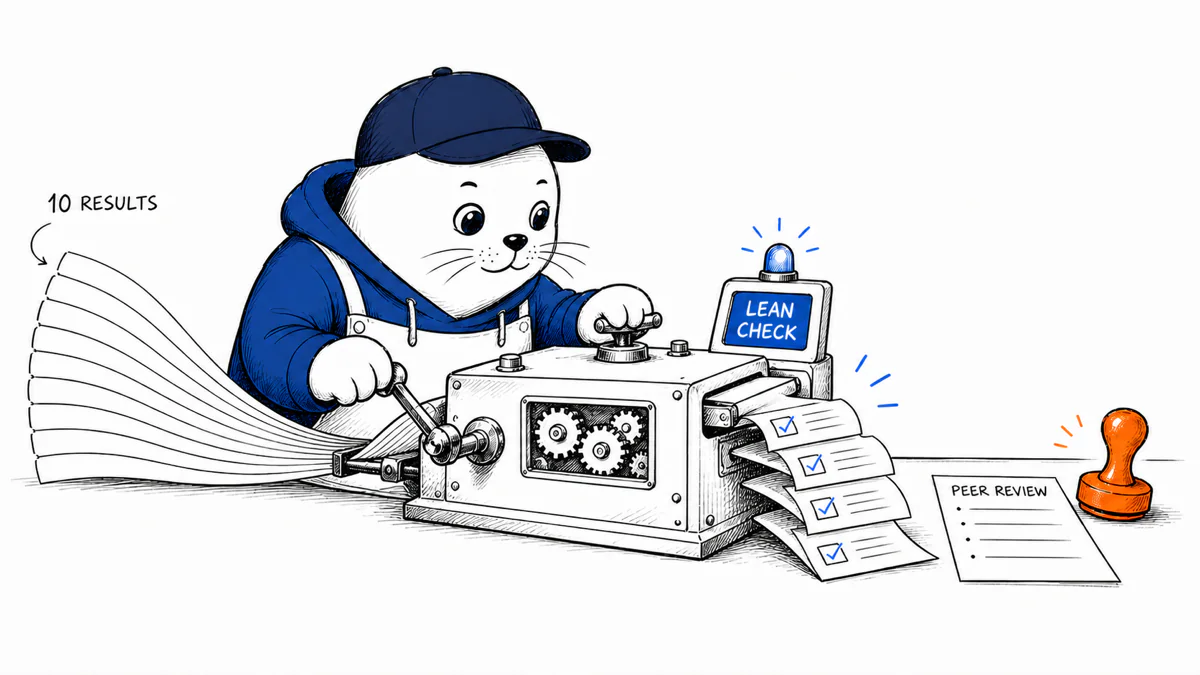
Ten research results, a 253-page paper, a public Lean repository, and a price tag smaller than many laptops. The artifacts are real. The shortcut interpretation is not.
OpenAI says an unreleased model called Astra produced ten advances across mathematics and theoretical computer science. On August 1, the company published the results as a single technical collection, added walkthroughs of the model’s reasoning, and released machine-checkable formalizations for all ten results.
That makes this more substantial than a benchmark announcement. It also makes the details unusually easy to flatten into a bad headline. The OpenAI Astra math proofs deserve attention because there is a serious public evidence package. They do not yet justify treating $2,000 as the end-to-end price of mathematical discovery, or treating formal verification as a substitute for expert review.
Update: GPT-6 Astra is now launching as a product
OpenAI has introduced GPT-6 Astra to a limited set of organizations, with broader ChatGPT and API access planned over the following days. The public API page lists a 1,050,000-token context window, a 128,000-token maximum output, and Standard rates of $10 per million input tokens and $50 per million output tokens.
This changes one conclusion in the original article: Astra is no longer only an unreleased research system. It still does not make the ten mathematics claims independently replicated or peer reviewed. Product access lets outside teams test related workflows, while the published Lean files and expert review remain the evidence for the specific proofs.
Read our GPT-6 Astra pricing, routing, and safety guide before moving a long-context workload. Requests above 272,000 input tokens trigger higher rates for the full request.
What OpenAI actually released
OpenAI’s primary announcement describes Astra as its "next major model." The model is not available through the public API, and OpenAI has not published a model card that would let outside researchers reproduce the workflow independently.
What is public is the output: a 253-page paper collection, a separate set of reasoning walkthroughs, and a Lean 4 repository with one formalization for each result. The current paper says it was updated August 6, which is a useful reminder to distinguish a living preprint from a fixed, peer-reviewed publication.
Evidence status
The paper, reasoning notes, and Lean certificates are public primary evidence. Astra itself remains unreleased, and independent scholarly review is still developing.
The ten results, in plain English
The collection ranges from geometric packing problems to quantum games. "Solved ten problems" is too blunt: OpenAI says some results resolve a conjecture, some disprove one, and others substantially improve a known bound.
| No. | Area | What OpenAI reports |
|---|---|---|
| 1 | Sphere packing | An exact asymptotic result for the Cohn–Elkies method and a stronger general bound. |
| 2 | Error-correcting codes | Exponential-factor improvements to bounds for binary and spherical codes. |
| 3 | Group theory | An explicit construction of a nonsofic group. |
| 4 | Operator algebras | A counterexample disproving a rigidity conjecture associated with Connes. |
| 5 | Circuit complexity | New lower bounds for arithmetic formulas, including a stated Ω(n⁴/log n) leaf bound. |
| 6 | Quantum information | A parallel-repetition theorem for finite two-player entangled games. |
| 7 | Cryptographic hardness | An n1/400-factor hardness result for Euclidean closest vector. |
| 8 | Discrete geometry | A sharp all-dimensional bound related to the Ehrhart volume conjecture. |
| 9 | Ramsey theory | A superexponential multicolor lower bound connected to Erdős problem 183. |
| 10 | Extremal graph theory | Results on compactness and degeneracy conjectures connected to Erdős problems 146 and 180. |
This table is a map, not a mathematical validation. The precise theorem statements, definitions, and assumptions live in the paper and formal files.
The strongest part is the audit trail
AI research announcements often force readers to choose between a press release and a demo. This one provides three layers that can be compared.
- The papers contain the formal claims and proofs in conventional mathematical form.
- The walkthroughs reconstruct how the approaches developed from the model’s working material and the final write-ups. They are edited explanations, not raw hidden chain-of-thought.
- The Lean repository lets a reader install the pinned environment, fetch the mathlib cache, and build the formalizations with
lake build All.
That structure matters. A prose proof can conceal a missing case behind a familiar phrase. A formal proof assistant requires every accepted step to type-check against explicit definitions and previously accepted foundations.
It is also a practical example of the broader distinction in our guide to agentic AI in plain English: autonomy becomes more credible when the work leaves inspectable state, not just a polished answer.
Lean can check a theorem without judging the whole story
A successful Lean build is powerful evidence that a formal theorem follows from its stated definitions and dependencies. It does not answer every question a mathematician or editor should ask.
Paper
Can show the exact claims and the human-readable proof. It cannot establish novelty or community significance by itself.
Reasoning walkthrough
Can explain the path to a result. It is a reconstructed narrative, not an independent replication.
Lean certificate
Can mechanically check a formal statement. It cannot decide whether that statement perfectly captures the informal problem.
Independent review
Can test framing, prior art, novelty, and importance. That process takes people, time, and visible disagreement.
The translation boundary is especially important. If the formal statement is weaker than the headline claim, Lean can certify the former without rescuing the latter. Reviewers still need to compare the natural-language problem, the paper’s theorem, and the formal encoding line by line.
OpenAI says it takes responsibility for correctness. That is a welcome, testable position, not the same thing as broad external acceptance. The company’s own First Proof submissions show why mathematical evaluation benefits from public artifacts and specialist scrutiny rather than a single aggregate score.
The $2,000 number is useful, and easy to misuse
OpenAI estimates that the model tokens used to find the successful solutions would cost roughly $2,000 at Sol API rates. Dividing that figure by ten gives a simple average of $200 per reported result.
That calculation is arithmetic, not accounting. OpenAI reports an aggregate estimate, not the actual token spend for each problem. More importantly, the figure does not include model training, inference infrastructure outside the priced calls, choosing and preparing the problems, unsuccessful research paths that may not be counted, human manuscript work, expert review, or the effort required to formalize and maintain the Lean files.
Do not read $200 as the cost of a theorem. It is the average implied price of the successful solution-finding tokens under OpenAI’s stated API-rate calculation. The surrounding research system costs more and remains undisclosed.
The narrow number is still valuable. It suggests that, once a capable model exists and a problem is ready, the marginal inference bill may be surprisingly small. For a research lab, that changes which ideas are affordable to test. It does not make the lab, the model, or the verification workflow cheap.
Astra is a research result, not a product review
Astra is unreleased. There is no public endpoint, independent benchmark run, complete intervention log, or model card available today. Builders cannot yet reproduce the claimed workflow, compare its reliability with another model, or see how often it fails on similarly difficult problems.
That makes product conclusions premature. The announcement supports "OpenAI demonstrated a documented research workflow." It does not support "anyone can now buy ten theorems for $2,000," nor does it establish that Astra is a renamed future GPT release.
Which Astra? This article concerns OpenAI’s internal research model. It is unrelated to Google Project Astra and to the Astra tutoring tool in our directory.
What I would verify next
Five checks before the headline hardens into history
- Build every Lean file in the pinned environment and record dependency or comparator failures.
- Compare each formal theorem with the corresponding informal claim and original conjecture.
- Track version changes to the paper, proofs, and repository rather than citing "the publication" as a fixed object.
- Separate correctness from novelty by following reviews from specialists in each field.
- Ask for an end-to-end cost ledger that includes human work, failed paths, formalization, and infrastructure.
This is the same editorial discipline behind how we separate a useful product signal from a polished claim. The higher the apparent leap, the more valuable the audit trail becomes.
My verdict: this is evidence, not the end of verification
OpenAI has done something unusually helpful: it published enough material for specialists to disagree concretely. The ten results are not merely screenshots or self-graded answers. The OpenAI Astra package comes with detailed manuscripts and formal objects that can be built, inspected, and challenged.
That is the reason to take Astra seriously. It is also the reason not to oversell it. Formal checking strengthens the correctness case; it does not automatically settle novelty, importance, attribution, or the fit between the formal theorem and the original problem. The $2,000 estimate shows a potentially low marginal inference cost; it does not reveal the cost of the research machine around it.
The best next step is not belief or dismissal. It is replication: build the files, read the theorem statements, follow the corrections, and wait for specialists in ten different areas to report what survives.
Read the primary material
- Read OpenAI’s announcement and methodology summary.
- Inspect the current technical collection.
- Compare the edited reasoning walkthroughs with the final proofs.
- Build the Lean 4 formalizations.
- Review the Leiden Declaration on responsible AI in science, which OpenAI links from its announcement.
What would change your mind most: a clean Lean build, a specialist’s review, or an independent reproduction with the model?
Checked August 7, 2026. OpenAI’s current technical collection says it was updated August 6. Astra remains unreleased, and the $2,000 figure is OpenAI’s estimate for successful solution-finding tokens at Sol API rates, not a complete project cost.