

Salesforce says Missionforce will expand with OpenAI frontier models in Government Cloud through Amazon Bedrock, planned Missionforce workflows in ChatGPT and NVIDIA-backed options for private or air-gapped workloads. It is an ambitious multi-surface architecture. It is also a forward-looking announcement with important availability and authorization details still missing.
The distinction matters for public-sector buyers. A partnership announcement can describe direction without proving that a specific model, region, security boundary and authorization level are available for procurement today.
Missionforce now describes three deployment paths
| Path | Planned role | Question left open |
|---|---|---|
| Government Cloud through Amazon Bedrock | Access OpenAI frontier models inside a governed cloud path | Which models, regions and authorization levels are included? |
| Missionforce workflows in ChatGPT | Bring selected government workflows to a familiar assistant surface | How are identity, records and retention separated? |
| NVIDIA private or air-gapped infrastructure | Support workloads that cannot rely on a public service path | Which models and update processes operate fully offline? |
The Salesforce Missionforce OpenAI government agents plan is therefore not one product endpoint. It is an orchestration strategy that may span separate trust boundaries. Buyers should request a diagram for the exact configuration they will use rather than applying one security statement to every path.
The Policy Engine may be the most important layer
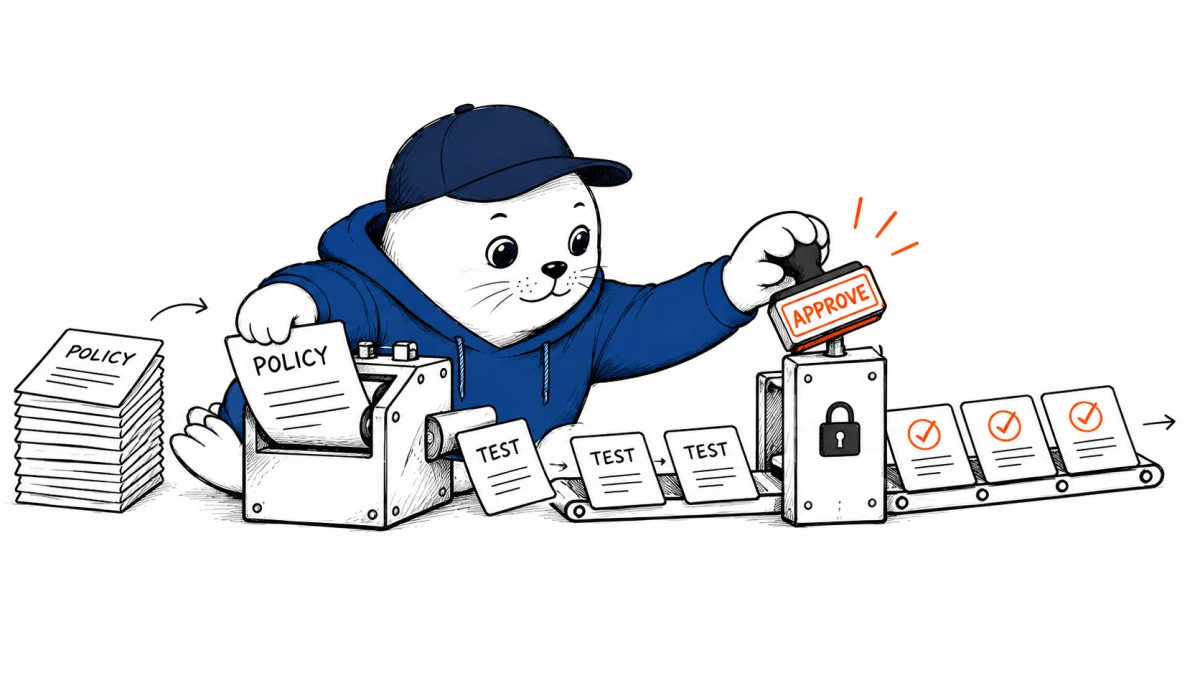
Salesforce describes a Policy Engine that converts approved policy documents into deterministic rule code and test cases, with human review. That is more specific than asking a language model to remember a manual. It creates a potential boundary between probabilistic interpretation and enforceable rules.
- The source policy must be approved and versioned.
- Generated rules need a trace back to the exact clause.
- Tests should cover conflicts, missing facts and policy exceptions.
- A human reviewer must approve the generated rule set.
- Production decisions should record which rule version was applied.
The hard cases are not the rules that map cleanly. Agencies need a process for ambiguous language, conflicting authorities, emergency exceptions and policies that require discretion. Deterministic execution does not make a flawed translation correct.
Bedrock is a control plane, not a blanket authorization
Running access through Amazon Bedrock can centralize model selection, permissions and observability. It does not automatically mean every OpenAI model inherits every authorization held by the surrounding service. Model availability, data path, region, logging, support personnel and downstream integrations all need to match the target workload.
Procurement teams should ask for the service name, model identifier, hosting region, authorization package and shared-responsibility matrix in writing. A phrase such as “through Bedrock” is an architectural clue, not the complete approval record.
ChatGPT creates a separate records question
Planned Missionforce workflows in ChatGPT could make government processes easier to access. They also raise operational questions: which account owns the conversation, what becomes an official record, which connectors can be called, how sensitive fields are redacted and whether a user can move information from an authorized workflow into an unrelated chat.
Those controls should be tested with real roles, not described only at the tenant level. Our ChatGPT Work and Codex analytics analysis shows how usage data can support oversight, while also warning that activity metrics are not outcome quality.
What the announcement does not establish
- A general-availability date for each integration.
- A complete list of supported OpenAI models.
- Pricing or minimum contract commitments.
- A region-by-region Government Cloud matrix.
- The exact authorization level for every component.
- Retention and support boundaries for ChatGPT workflows.
- Independent accuracy, security or policy-translation benchmarks.
Salesforce includes forward-looking language in the announcement. Buyers should treat planned capabilities as roadmap items until the relevant product documentation, contract and authorization artifacts are available.
A procurement test before a pilot
- Select one narrow workflow with an approved source policy.
- Require a component and data-flow diagram for the chosen deployment path.
- Generate the deterministic rules and compare every one with the policy clause.
- Test ambiguous, missing and conflicting facts.
- Inspect logs, records handling and human override behavior.
- Measure incorrect approvals and incorrect denials separately.
- Confirm rollback before expanding the workflow.
Readers tracking Salesforce’s broader agent strategy can compare our AIforce, Claude, Slack and CRM analysis. Missionforce adds a public-sector context where availability claims and system boundaries deserve even tighter wording.
The practical verdict
Missionforce points toward a flexible government-agent stack: managed frontier models, ChatGPT workflows, private infrastructure and a deterministic policy layer. The Policy Engine could be the strongest governance feature if rule generation is traceable and reviewed. Until Salesforce publishes a complete availability and authorization matrix, the announcement should guide questions, not close procurement decisions.
Primary source
Checked September 17, 2026. Planned features are labeled as planned. Buyers should verify current documentation, contracts and authorization artifacts for the exact deployment.