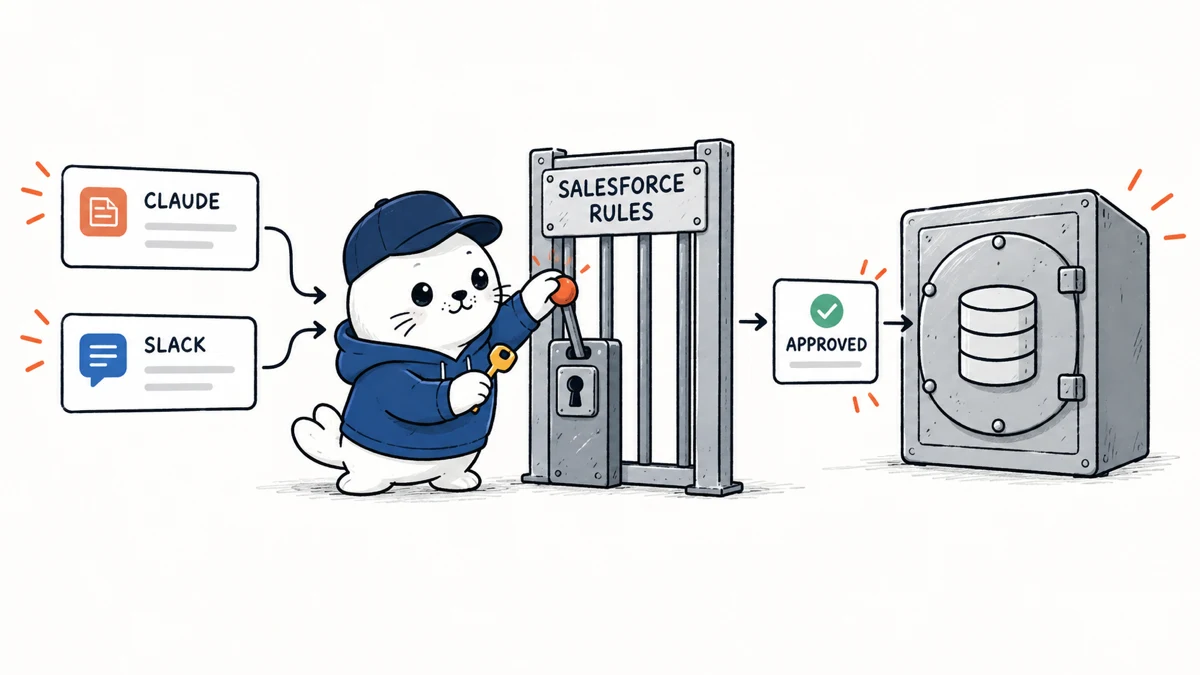
Salesforce has unveiled AIforce, a live interface layer designed to expose governed CRM data, workflows and actions inside Claude, Slack and other AI workspaces. The announcement is strategically important, but the flagship Claude integration is launching in beta rather than general availability.
AIforce is the new name for the platform previously introduced as Headless 360. Salesforce says the September 16 launch adds three named experiences: Claudeforce, Slackforce and Agentforce Coworker. The larger idea is to separate Salesforce capabilities from the traditional Salesforce screen while keeping permissions and actions anchored in the platform.
Follow one AIforce request from question to action
- A user asks a question inside an approved AI interface such as Claude or Slack.
- AIforce connects the request to Salesforce context through MCPs, APIs, plugins or skills.
- Salesforce applies the user's existing permissions, business rules and semantic context.
- The model reasons over the permitted information and proposes an answer or action.
- An action routes back through Salesforce workflows rather than bypassing the system of record.
That request path is the product. AIforce is not simply a chatbot added to CRM. It is an interface and control layer intended to let external AI clients use Salesforce capabilities without inventing a second authorization model.
What is new and what was renamed
| Element | Status | Why it matters |
|---|---|---|
| Headless 360 | Renamed AIforce on September 4 | The platform concept predates the launch announcement |
| Claudeforce | Salesforce in Claude is available to customers in beta | Brings governed CRM context into Anthropic's interface |
| Slackforce | Launch experience | Puts conversational work closer to Salesforce actions |
| Agentforce Coworker | Launch experience | Connects agent work to Salesforce context and logic |
| Additional interfaces | More are promised | The multi-interface strategy is not limited to the initial three |
The permission claim is the real enterprise test
Salesforce says every request uses existing permissions and business rules, so an AI client should see only what the requesting user is allowed to see. That is the right design target. Buyers should still test field-level security, sharing rules, delegated administration, connected systems, prompt injection and whether generated interfaces expose data in combinations that were never visible on one screen.
Our earlier Salesforce AI control-plane analysis explains why policy enforcement and auditability determine whether agents can safely move from answers to actions.
Zero Data Retention needs configuration proof
Salesforce describes AIforce as built with Zero Data Retention, meaning business data used for a response is not retained by the model provider. Enterprises should verify the exact provider, region, contract, logging path, failure mode and feature combination. A platform-level statement is not a substitute for a deployment-specific data-flow record.
No custom integration does not mean no integration work
Salesforce says admins can connect once without creating a new permissions model or custom integration. That may reduce plumbing for standard configurations. Real deployments still have to clean metadata, define trusted actions, resolve inconsistent access policies, monitor tool calls and teach users which interface is authoritative when a generated view disagrees with a conventional Salesforce page.
A rollout plan for Claudeforce and Slackforce
- Start with a read-only workflow and a small group whose Salesforce permissions are already reviewed.
- Capture the identity, source records, model, tools and resulting action for every request.
- Test adversarial instructions inside CRM text fields and connected documents.
- Require confirmation for write actions until the error and recovery rates are understood.
- Compare answers across Claude, Slack and the native Salesforce interface.
- Document retention and residency for each enabled model provider.
How AIforce differs from Koa
AIforce is the interface and governance layer. Salesforce Koa is a separate reasoning model being developed for CRM tool use. An enterprise could use AIforce to connect an outside model, a Salesforce model or multiple models to the same governed business system.
The practical verdict
AIforce turns the AI interface battle into a governance question: can Salesforce make its data and actions available wherever employees work without weakening the controls that make CRM dependable? The architecture is plausible and the initial integrations are significant. The evidence to watch now is beta availability, permission behavior, audit quality and how much setup standard customers actually need.
Primary sources
Checked September 16, 2026. Availability, security and deployment claims are Salesforce reported. Customers should verify region, agreement, model provider and configuration before relying on them.