
Salesforce and NVIDIA have announced Koa, a CRM reasoning model built by post-training NVIDIA Nemotron 3 Super on synthetic enterprise scenarios. Koa is entering a select pilot now, with United States general availability expected in winter 2026.
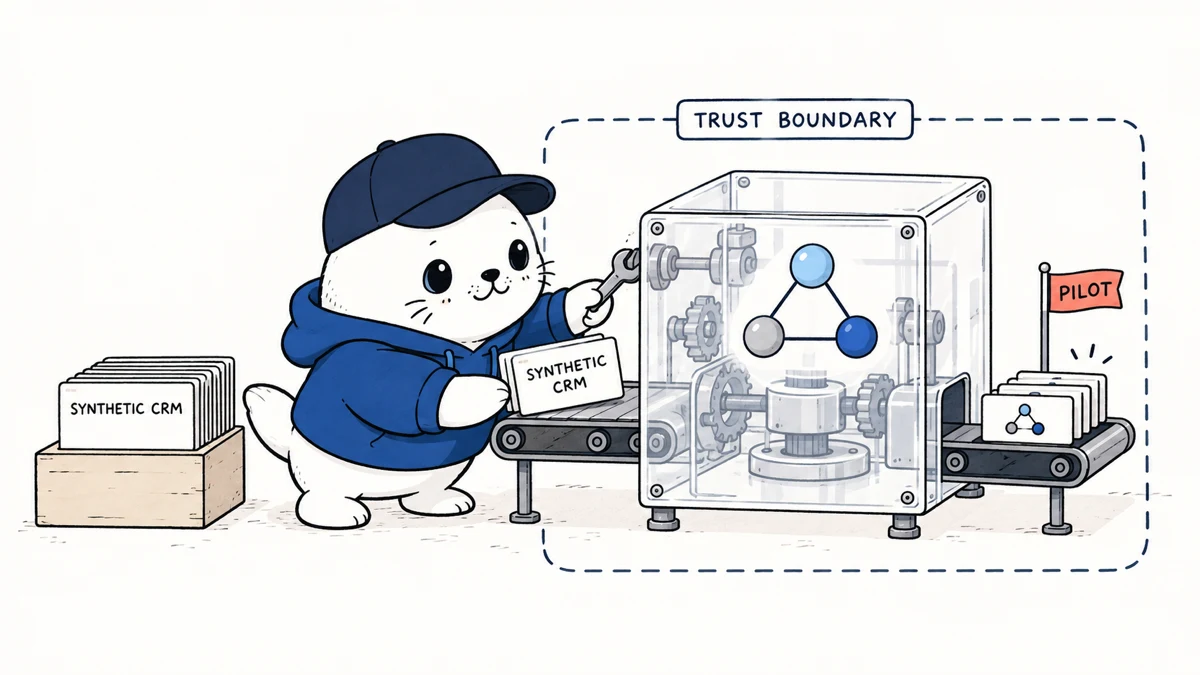
Salesforce calls Koa its first CRM reasoning model for Agentforce. The company says it controls the resulting model weights and runs post-training and inference inside its trust boundary. That makes Koa a vertical-model strategy: start with a strong base model, then specialize it for the tools, rules and interaction patterns common in customer relationship management.
Koa's development path in five stages
| Stage | What Salesforce describes | Question that remains |
|---|---|---|
| Base | NVIDIA Nemotron 3 Super | Which capabilities come from the base versus post-training? |
| Scenario creation | Synthetic tasks informed by nearly 27 years of CRM deployments | How closely do synthetic cases match messy customer environments? |
| Post-training | Supervised and reinforcement-learning methods for CRM tool use | How robust is behavior outside the training distribution? |
| Pilot | Select customers evaluate Koa in Agentforce | What are the real error, escalation and recovery rates? |
| Release | US availability expected in winter 2026 | Which clouds, regions and features will be included? |
Why synthetic CRM work is central
Salesforce says no customer data was used to train Koa. Instead, it generated synthetic scenarios based on recurring patterns from its CRM history. That reduces one direct privacy concern and can produce large volumes of targeted training tasks. It also creates a realism problem: synthetic data can reproduce the assumptions of its generators while missing rare permissions, incomplete records, local customizations and contradictory business rules.
The benchmark claims need a careful label
Salesforce reports that Koa matches or exceeds leading models on its CRM benchmark and makes three times fewer errors. These are company-run results on a new domain-specific evaluation, not an independent public leaderboard. The accompanying paper improves transparency, but buyers still need model cards, reproducible tasks and evaluation on their own Salesforce configuration.
The distinction matters because a smaller specialist can outperform a larger model on a narrow tool-use distribution without becoming a better general reasoner. Our Nemotron inference analysis similarly separates model, system and workload claims.
Owning the weights changes the operating model
Salesforce says it owns Koa's weights and keeps post-training and inference within its trust boundary. That can provide more control over release cadence, data handling, observability and cost than relying only on an external frontier API. It also makes Salesforce responsible for evaluation, patching, drift management and communicating limitations.
Koa and AIforce solve different layers
Salesforce AIforce connects governed Salesforce data and actions to multiple AI interfaces. Koa supplies one reasoning engine that can operate inside that broader architecture. Customers should avoid treating the two announcements as one indivisible product: interface governance can improve independently of the model, and model quality can change without rewriting the interface layer.
Six questions for the select pilot
- Which CRM objects, workflows and tools are supported in the pilot?
- How does Koa behave when permissions hide a field needed for the requested task?
- What action is taken when confidence is low or records conflict?
- Can customers reproduce the evaluation on their own metadata and data distribution?
- How are tool-call traces, intermediate reasoning and human corrections logged?
- What fallback model or workflow runs when Koa cannot complete the request?
The milestone that matters next
Winter availability will matter less than the evidence released with it. A useful launch package would disclose supported actions, per-task accuracy, unsafe-action prevention, latency, cost, abstention behavior, pilot sample size and failures by customer configuration. Those details would show whether specialization produced a dependable CRM operator rather than a strong demo.
The practical verdict
Salesforce Koa is a credible example of enterprise AI moving from generic assistants toward domain-owned reasoning models. Nemotron provides the base, synthetic CRM tasks provide specialization, and Agentforce provides the operating environment. The current evidence supports watching the pilot closely, not assuming the reported threefold error reduction will transfer unchanged to every Salesforce org.
Primary sources
Checked September 16, 2026. Availability, training and benchmark results are reported by Salesforce and NVIDIA. MustHave.ai has not independently evaluated Koa.