The same model family offers separate options for serving an agent and training it.
NVIDIA announced Nemotron for Science on November 16. It packages the existing Nemotron 3.5 Super VL with LitmusBench v0.2 and recipes to adapt a model for chemistry work. The announcement describes nearly 50,000 questions for training and evaluation. The resources support work on molecular properties and other chemistry tasks.
Pick the checkpoint for the job
| Published checkpoint | Documented starting point | What the setup tells you |
|---|---|---|
| BF16 reference weights | Four H100 GPUs or two GB200s in the model summary | Full-precision reference for adaptation and evaluation. |
| NVFP4 deployment weights | One DGX Spark is among the documented options | The published Spark quickstart uses one concurrent sequence. |
The BF16 model card and NVFP4 model card describe versions of the same 120-billion-parameter model, with about 12 billion parameters active per token. Active parameters describe computation during inference. The full set of weights must still be available to the runtime. Use the serving recipe for your checkpoint, hardware, and intended workload when estimating memory and capacity.
A lab can start by running inference on a small batch and collecting peak memory, elapsed time, and output quality. Record context length and concurrency alongside those measurements. A one-sequence run on a desk machine gives you different evidence from a shared service handling several lab members’ requests.
The example grades a molecule submission
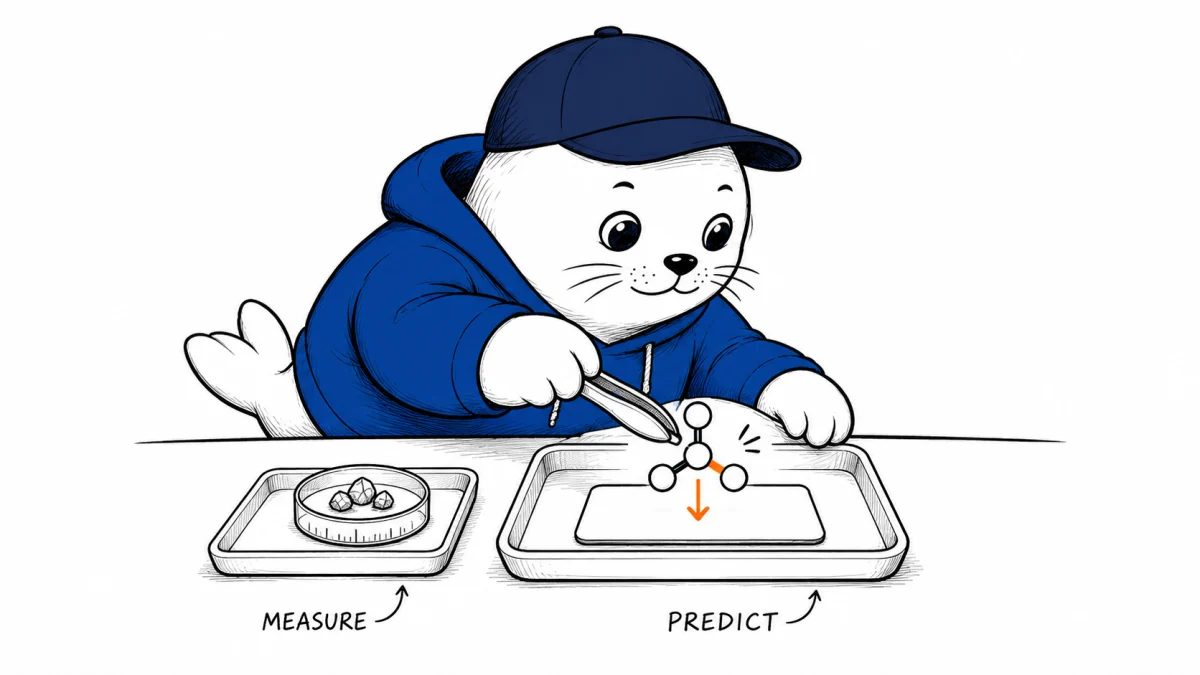
In NVIDIA’s drug-metabolism example, the model sees a parent molecule and a specified enzyme. It calls a tool to submit a predicted metabolite as a SMILES string, a text representation of a molecular structure. The recipe scores the first submission by comparing structural fingerprints with a reference metabolite. The score is Tanimoto similarity, the overlap divided by the union of the two fingerprints.
For a simple illustration, fingerprints with six shared features out of eight distinct features score 0.75. Six shared features out of twelve score 0.50. Those are arithmetic examples, and a chemistry evaluation would use the exact fingerprint and tool behavior from the recipe. Track invalid submissions and exact matches separately so a higher average similarity score can be interpreted alongside actual answer quality.
Hold back the right examples
Before training, freeze the evaluation set and save its molecule identifiers. If the intended use is to handle new molecular scaffolds, group related structures before making the split. Otherwise, two close variants can end up on opposite sides of the split, making a transfer claim hard to judge. Keep candidate training examples and held-out cases distinct when distilling reasoning traces from a stronger model.
Use the same output budget and first-submission rule for the original and adapted checkpoint. This gives a lab a way to tell whether a change came from training, extra tokens, or extra attempts at the tool.

Abdessalam Alaoui
I'm Abdessalam Alaoui, founder of Musthave.AI. I write practical guides to AI models, tools, generative media.