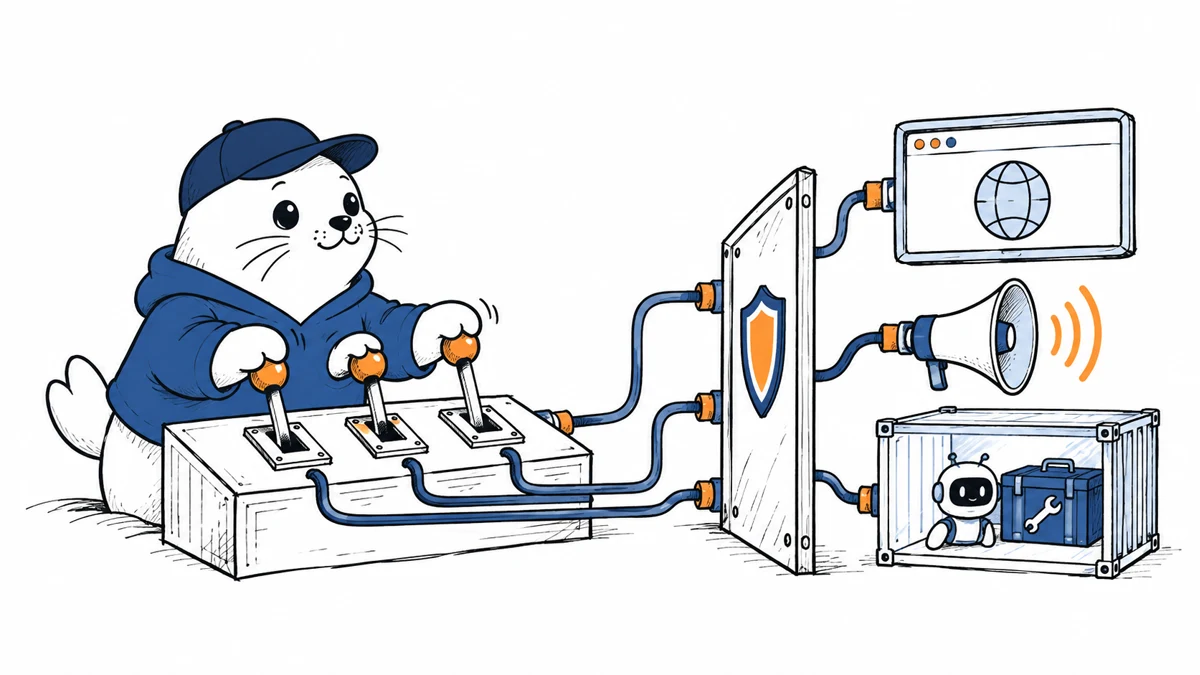
A coding agent becomes a different security product the moment it can operate a browser, listen to a voice and start isolated workers.
Qwen Code 0.24.1, published as a stable release on September 19, 2026, adds a Playwright Browser SDK, a Chrome Native Messaging relay, a browser Live Host, live voice, container execution for subagents and new workflow controls. The release also adds agent tool allowlists, checkpoints, a named workflow lock and Mem0 providers.
This is four product expansions in one release
| Surface | What changed | New trust question |
|---|---|---|
| Browser | Playwright SDK, Chrome relay and Live Host | Which profiles, cookies and origins can the agent reach? |
| Voice | Live Voice from the browser | When is audio captured, retained or sent? |
| Subagents | Container execution | What filesystem, network and secret boundaries are real? |
| Workflow | Locks and checkpoints | Can an interrupted job resume without repeating side effects? |
Browser control needs a disposable profile first
The safest first test is not an everyday Chrome profile. Create a separate browser profile with no personal cookies, saved passwords or payment sessions. Allow only a local test site and one disposable external account. Then verify navigation, form submission, download behavior, pop-up handling and whether the relay can cross into another profile.
- Use an origin allowlist where the integration supports one.
- Block password-manager access and browser sync.
- Require confirmation before sending a form or downloading a file.
- Record screenshots and action traces for irreversible steps.
- Test what happens when a page attempts to redirect to an unapproved domain.
The older Qwen Code browser-pairing guide covers the remote-session boundary. Version 0.24.1 adds more client surfaces, so previous approval assumptions should be retested.
Voice changes the prompt boundary
Voice is convenient for hands-free debugging, but spoken instructions are easier to mishear and harder to review before execution. A production policy should separate conversational planning from action authorization. The agent can accept a spoken goal, but a destructive command, deployment or credential change should require a readable confirmation.
Containerized subagents are isolation only when the policy is narrow
A container can reduce host exposure, but it can also be launched with broad mounts, network access and forwarded secrets. Record the image digest, mounted paths, environment variables, network mode, CPU and memory ceilings, process timeout and artifact export path. If the worker needs one repository, do not mount a home directory.
| Boundary | Safer default | Verification |
|---|---|---|
| Filesystem | One workspace mount, read-only where possible | Attempt access outside the mount. |
| Network | Denied or allowlisted | Try DNS and outbound HTTP to an unlisted host. |
| Secrets | Task-scoped token only | Inspect environment and common credential paths. |
| Resources | Time, CPU and memory limits | Run a deliberate runaway task. |
| Output | Explicit artifact directory | Reject path traversal and executable surprises. |
Tool allowlists should be different for each agent
The release makes it possible to restrict tools per agent. Use that separation. A documentation worker may need search and file reads, while a test worker needs a container and a narrow command set. Neither automatically needs browser cookies, deployment credentials or production writes. The shared-agent comparison in our Codex versus Claude Code guide explains why the host permission model still matters even when prompts are portable.
Locks and checkpoints protect against a different class of failure
A named workflow lock prevents two workers from believing they own the same job. A checkpoint makes long work recoverable after an interruption. These controls do not make external side effects idempotent. If a workflow creates an issue, sends a message or deploys a build before checkpointing, a resumed job can repeat the action unless the integration also records an idempotency key.
A staged rollout plan
- Pin version 0.24.1 in a disposable test project.
- Start with file-only tasks and explicit agent tool allowlists.
- Add container execution with no network and one workspace mount.
- Test checkpoint recovery around a simulated crash.
- Add a disposable browser profile and origin allowlist.
- Enable voice only after typed confirmation gates work.
- Review Mem0 retention, deletion and tenant isolation before storing memory.
The practical verdict
The PWA and Android shell widen the release beyond a terminal workflow. Mobile access can make voice and remote review practical, but it also creates new device-loss, notification and background-execution questions. Enforce short sessions, device revocation and a visible account boundary. Mem0 providers deserve the same care: decide which facts may become durable memory, how a user deletes them and whether one project can retrieve another project’s records. Browser history, spoken instructions and durable memory should not collapse into one implicit trust zone simply because the same agent can reach all three.
Qwen Code 0.24.1 is a substantial agent-platform release, not a routine patch. Browser, voice and container support can make the tool more useful, while allowlists, locks and checkpoints provide controls teams genuinely need. Adopt the capabilities one at a time, with separate identities and a trace for every action that can leave the workspace.
Primary source
Our Kiro Crew scaling guide shows how coordination, permissions and audit logs change when coding-agent work expands beyond a few sessions.
Qwen Live Harness can delegate live voice and screen requests to Qwen Code and other coding agents, but its data paths and regional access need a separate review.
ZCode 3.14 takes a different approach to coding-agent orchestration by opening desktop, web and terminal components and adding script-driven subagent workflows.
Checked September 20, 2026. Test exact client, extension and SDK versions because browser and voice surfaces can evolve independently.