

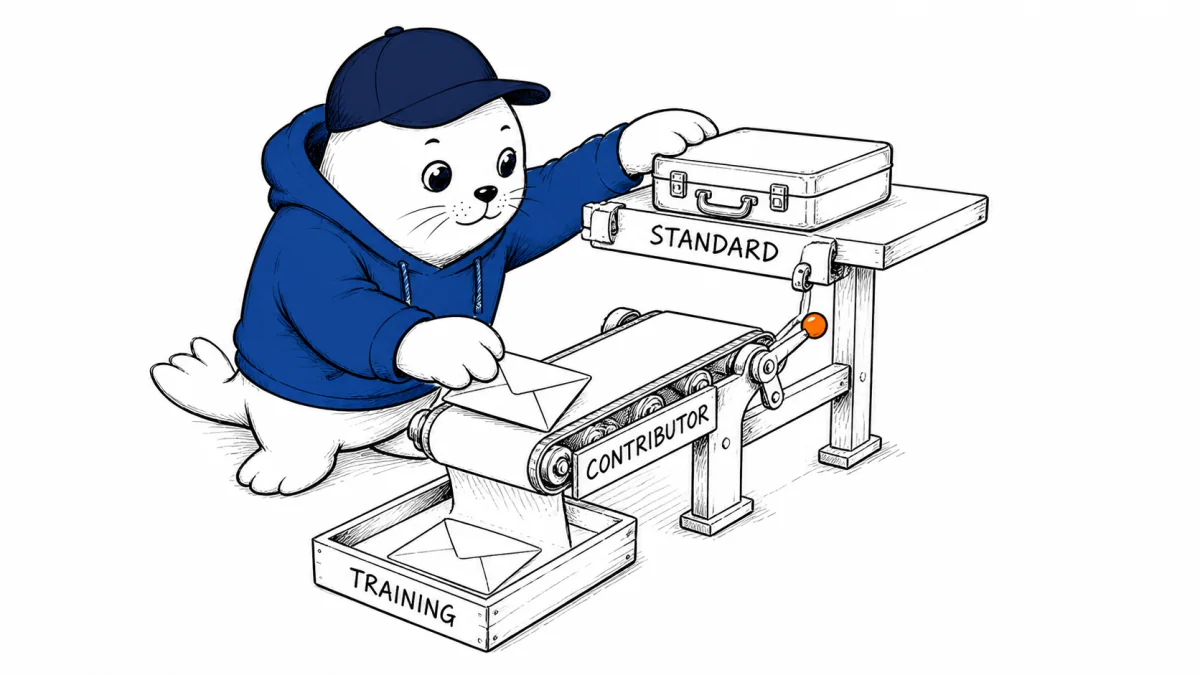
Meta will sell the same Muse Spark 1.2 model through two doors. One protects your prompts from model training. The other cuts output pricing by about 95% because your traffic can help train future Meta models.
That is the decision hidden inside the Muse Spark 1.2 model page. The model launched on August 5, 2026, so this is not a new-release story. The useful update is Meta’s now-documented choice between a Standard endpoint and a Contributor endpoint.
Both endpoints expose Muse Spark 1.2 with a 1,048,576-token context window. The prices, request ceilings, and permitted use of your traffic are different. Builders should route workloads by data sensitivity before chasing the discount.
September 2 update: Muse Spark 1.3 changes the model, not the data bargain
Meta is rolling out Muse Spark 1.3 in Muse Code and Meta Model API. The new version focuses on long-running work, instruction retention, help-seeking when stuck, clarifying ambiguous requests, and confirmation before consequential actions.
Meta reports that version 1.3 uses about 20% fewer tool calls and 25% fewer tokens than Muse Spark 1.2 on coding work. Those figures are company-reported. The public evaluation package does not turn them into a guaranteed saving for every repository or agent harness.
| Muse Spark 1.3 item | What is available now | What still needs proof |
|---|---|---|
| Reasoning | Previously available modes | Max reasoning follows after more safety testing |
| Coding efficiency | Meta reports fewer calls and tokens than 1.2 | Completed-task cost on your harness |
| Long-running work | Improved clarification, help-seeking, and task switching | Recovery from your real failures and interruptions |
| Safety | Meta reports better prompt-injection resistance and irreversible-action calibration | Independent tests against your tools and data |
| Open weights | Roadmap promise | No 1.3 weight release is available with the announcement |
The evaluation report also needs careful reading. Meta compares version 1.3 with Muse Spark 1.2, Claude Opus 5, and GPT-5.6 Sol across coding, operating-system, research, and professional tasks. Some comparison scores come from Meta runs, official leaderboards, or model-provider self-reports. Third-party models may not be tuned optimally, and one OSWorld comparison uses a different benchmark version for Muse Spark 1.2.
My test would repeat ten repository jobs on 1.2 and 1.3 with the same harness, reasoning mode, tools, timeout, and verifier. Count tool calls, total tokens, wall time, retries, false completion, and human repair minutes. The claimed efficiency gain matters only if verified completion holds.
The Standard-versus-Contributor decision described below still applies until Meta documents a different data-use contract for the new version. A model upgrade should not silently change which traffic you permit Meta to use for training.
The model is not new. The pricing decision is
Meta introduced Muse Spark 1.2 alongside Muse Code. Our earlier report covered persistent coding agents, restartable state, event logs, and the risk of trusting an overnight run without a morning audit.
The direct Model API creates a different question. Standard uses the identifier muse-spark-1.2. Contributor uses muse-spark-1.2-contributor. Meta describes the Contributor tier as heavily discounted in exchange for permission to use prompts and completions to train future models.
| Decision point | Standard | Contributor |
|---|---|---|
| Input per 1M tokens | $1.25 | $0.10 |
| Cached input per 1M | $0.15 | $0.002 |
| Output per 1M tokens | $4.25 | $0.20 |
| Context window | 1,048,576 tokens | 1,048,576 tokens |
| Training use | Meta says no | Meta says yes |
| Requests per minute | 3,000 | 100 |
| Tokens per minute | 4 million | 3 million |
Contributor input is 92% cheaper, cached input is about 98.7% cheaper, and output is about 95.3% cheaper. Standard also allows 30 times as many requests per minute. The token-per-minute difference is smaller: 4 million for Standard versus 3 million for Contributor.
A real coding turn costs 16.75 cents or 1.2 cents
Consider an agent turn that sends 100,000 input tokens and receives 10,000 output tokens. This is large enough to include repository context, instructions, tool results, and a substantial answer.
- Standard: 0.1 × $1.25 plus 0.01 × $4.25 equals $0.1675.
- Contributor: 0.1 × $0.10 plus 0.01 × $0.20 equals $0.012.
The Contributor request saves 15.55 cents, or about 92.8%. At 10,000 comparable turns, the difference is $1,555. That is real money. It does not make the Contributor endpoint the correct default for every repository. Our breakdown of a $29 customer who triggered a $4,000 model bill shows why routing rules still need hard budget caps.
A maximum-size example shows the same pattern. One million input tokens and 100,000 output tokens cost $1.675 on Standard and $0.12 on Contributor. The context window has no separate long-context premium in Meta’s current pricing table, but filling it still creates latency, relevance, and review problems that a price calculation does not capture.
Do not translate “not used to train” into “nothing is retained”
Meta’s pricing documentation makes a specific promise for Standard: prompts and completions are not used to train Meta models. That is useful. It is not the same sentence as zero retention, zero logging, or approval for every regulated workload.
Before sending customer data, source code covered by a confidentiality agreement, credentials, security findings, health information, or unpublished intellectual property, read the current API terms and your organization’s data policy. The model page answers the training-use question. Your contract and deployment design still have to answer the rest.
Builder rule: If you would not knowingly place the prompt in a future training corpus, do not send it to the Contributor endpoint.
My routing rule for Muse Spark 1.2
I would make the tier an explicit field in the job router, not a developer preference hidden in one API key.
- Contributor fits public or synthetic work. Examples include public repositories, synthetic test cases, published documentation, and disposable benchmark prompts.
- Standard fits sensitive work. Examples include private repositories, customer tickets, internal incident logs, unpublished product plans, and proprietary datasets.
- Use neither tier yet when the contract is unclear. Public documentation cannot approve a regulated or confidential workload for your organization.
Keep separate credentials, budgets, and logs for the two endpoints. Label the chosen tier in every trace. A redaction step should run before routing, not after the model has already received the prompt.
Search grounding can dominate small requests
Meta charges $2.50 per 1,000 web-search grounding queries in addition to token charges. That is a quarter for 100 searches. On Contributor, where a 100,000-input and 10,000-output request costs 1.2 cents before search, repeated grounding can become the larger line item.
Count search calls separately from model tokens. Cache sources your workflow is allowed to reuse, set a search budget per task, and stop an agent from turning every uncertain sentence into another paid query.
The API is familiar, but the boundary must stay visible
Meta says its Model API works with the OpenAI SDK, Anthropic SDK, and OpenAI-compatible command-line tools. That lowers migration work. It also makes it easy to swap a model identifier without noticing that the data-use agreement changed with it.
Treat the endpoint choice like a data classification, not a speed toggle. The same lesson applies to local models such as Muse Glimmer: deployment location, model capability, and data handling are separate decisions.
My verdict: buy Standard for anything you would not publish
The Contributor price is compelling for public and synthetic work. A 95% output discount can turn large evaluations and open-source coding tasks into affordable experiments.
The discount is not free. It is an exchange of data-use permission, plus a much smaller request-per-minute ceiling. Put public work on Contributor, sensitive work on Standard, and ambiguous work behind a review gate. If your router cannot explain which tier received a prompt and why, it is not ready to exploit the cheaper endpoint.
Read the primary documentation
- Review Meta’s Muse Spark 1.2 model page.
- Check the current pricing and rate limits.
- Read the August 5 launch announcement.
- Compare OpenRouter’s Standard listing.
Checked September 1, 2026. Prices, limits, context size, model identifiers, and training-use statements come from Meta’s official developer documentation. Cost examples are Musthave.ai calculations and exclude caching, search grounding, and other workflow costs unless stated.