
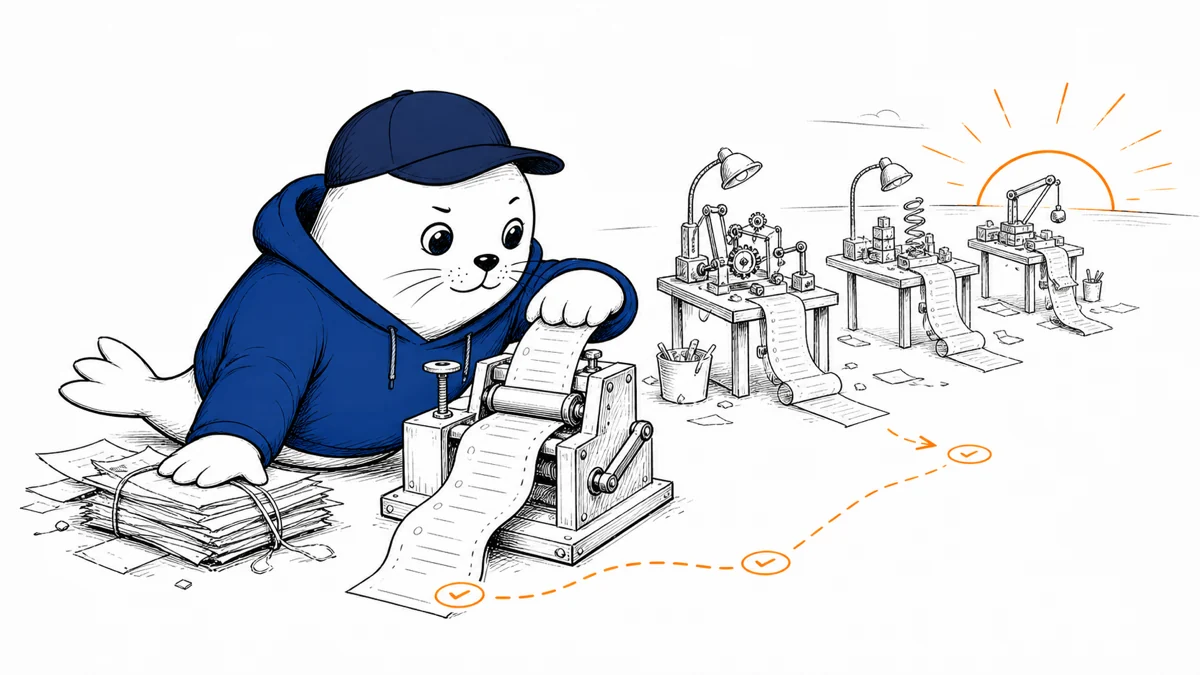
An overnight coding agent is only impressive if the morning handoff tells you what changed, what failed, and what still needs a human decision.
Meta Muse Code combines the model and its runtime
Meta released Muse Code in beta on August 5. It runs in the terminal on macOS and Linux and uses the new Muse Spark 1.2 model to plan changes, edit code, run tools, and validate work across large repositories.
The interesting part is the runtime around the model. Meta Muse Code keeps specialized background agents alive during a session instead of creating a fresh worker for every small job. It also records model calls, tool runs, approvals, and edits in a local append-only event log. Meta says that log lets a crashed session resume from its last recorded state.
That combination changes the practical question. We are no longer judging a model on one answer in a chat window. We are judging a small software operation that may keep working after the developer has stepped away.
What keeps a long Muse Code run moving
The model writes code, but the surrounding runtime controls persistence and review.
| Function | Component | What it does |
|---|---|---|
| Coordination | Background agents | Specialists keep context during the session and report back to the main agent when useful. |
| Recovery | Local event log | Calls, tools, approvals, and edits form an append-only record for replay and restart. |
| Control | Bundled skills | /plan, /grill, and /goal separate planning, adversarial review, and completion. |
The 24-hour result is a demonstration, not a warranty
Meta says it tested Muse Spark 1.2 inside Muse Code on GPU-kernel optimization runs involving more than 1,000 tool calls and lasting as long as 24 hours. In those runs, the agent wrote, compiled, profiled, and repeatedly improved Triton kernels for Nvidia Hopper hardware.
That proves the company built a harness capable of sustaining a long feedback loop. It does not tell us the success rate for a typical product repository, how often a developer had to intervene, or whether a long run produced a maintainable patch. Meta has not published a general reliability rate for unattended overnight work.
The distinction matters. A 24-hour ceiling sounds like autonomy. For a builder, it is really an expanded failure window. More time allows more useful work, but also more dependency drift, duplicated effort, bad assumptions, and expensive detours.
Meta’s benchmarks put Muse near the front, with an asterisk
In Meta’s published Terminal-Bench 2.1 comparison, Muse Spark 1.2 with Muse Code scored 82.9%. That was below Claude Opus 5 with Claude Code at 86.7%, but above the GPT-5.6 Terra, Grok 4.5, and Gemini 3.6 Flash configurations shown by Meta.
Terminal-Bench 2.1 pass rates reported by Meta
This was a company-run evaluation with five attempts per task. Each model used a selected agent product and different reasoning settings, so the rows compare agent stacks rather than isolated models.
| Agent stack | Pass rate |
|---|---|
| Opus 5 + Claude Code | 86.7% |
| Muse Spark 1.2 + Muse Code | 82.9% |
| GPT-5.6 Terra + Codex | 81.8% |
| Grok 4.5 + Grok Build | 81.6% |
| Gemini 3.6 Flash + Antigravity | 78.9% |
The three-page evaluation methodology deserves as much attention as the bars. Meta says the terminal and software-engineering tests ran in its internal evaluation framework. It also warns that its setup may not be tuned for every third-party model and therefore may not show those models at their best.
There is another important wrinkle: these are model-plus-agent results. They compare Muse Code, Claude Code, Codex, Grok Build, and Antigravity, not isolated models under one identical harness. That is useful when choosing a working tool, but it prevents a clean claim that Muse Spark alone is better than a competing model.
The event log may matter more than another leaderboard
I am more interested in the local event log than the 82.9% score. If it works as described, the log gives a team something an overnight agent badly needs: a durable sequence of what it asked, what it ran, what it changed, and where a human approved the next step.
Restart safety is not the same as rollback safety. Resuming the agent after a crash can preserve progress, but it can also resume a mistaken plan. Teams still need version-control boundaries, reproducible tests, cost limits, secret isolation, and a clear rule for when the agent must stop.
This is the same operational lesson behind Claude Inference Hooks: moving policy or memory into a persistent control layer creates leverage, but it also creates a new critical path. And as the AISI agent incidents showed, a capable agent can turn a small testing gap into a real-world action.
First-day friction is the useful part of a beta
Meta calls Muse Code a beta, and early testing should be read that way. Cline reported on August 5 that its container test hit a sign-in problem. The team then examined the agent’s instructions and recreated parts of the behavior inside Cline. That is one test from one company, not a broad verdict, but it is more useful than a polished demo because it exposes the deployment surface.
A terminal agent has to work in containers, remote hosts, continuous-integration jobs, restricted networks, and repositories with unusual build systems. Authentication and sandbox behavior are not side issues. They determine whether an agent can be tested safely before it touches a production workflow.
A morning-after test for Meta Muse Code
Do not begin with a 24-hour mission. Give the beta a two-hour task in a disposable branch and evaluate the handoff alongside the patch.
What must be true before an unattended run
A long-running agent earns more time only after it proves its stopping and recovery behavior.
- Isolate the work. Use a disposable branch or worktree, and prevent the agent from pushing to production.
- Run an independent test. Verify the result with a separate command instead of relying on the agent’s summary.
- Scope every secret. Keep credentials read-only or narrowly limited, and prevent the agent from printing or uploading them.
- Set the limits first. Define time, token, tool, network, and retry ceilings before the run begins.
- Make the log explain the patch. The morning reviewer should be able to trace each important edit to evidence, a tool result, or an approval.
Then force a failure. Stop the process during a tool call, restart it, and check whether the event log restores the right state without repeating a destructive action. Reject the patch and verify that the repository returns to its clean starting point. A beta that cannot survive those tests should not receive an overnight shift.
My verdict: test the handoff before the marathon
Meta Muse Code is a credible new coding-agent system because Meta is shipping more than a model endpoint. Persistent background agents, restartable state, and explicit planning skills address problems that appear when work lasts longer than one prompt.
The launch does not prove that an unattended agent can own a large repository for a day. Meta’s strongest number is still a company-run benchmark, and its longest run is a specialized kernel-optimization case study. The right first use is bounded, reversible work where the event log and verification steps can be inspected closely.
If the morning reviewer can explain the patch faster than they could have written it, Muse Code has created leverage. If they spend the morning reconstructing what the agent did, the overnight shift was only deferred work.
Go deeper
- Read Meta’s Muse Code and Muse Spark 1.2 announcement.
- Review Meta’s evaluation methodology before comparing scores.
- See the official Muse Code product page for current availability.
- Read the Reddit launch discussion for early questions about price, privacy, and benchmark comparability.
Would you trust an overnight coding agent more because it can resume after a crash, or less because it can keep going without you?
Checked August 6, 2026. Benchmark scores and the 1,000-plus-call case study are reported by Meta. Muse Code is a beta, and Meta has not published a general success rate for unattended production-repository work.