

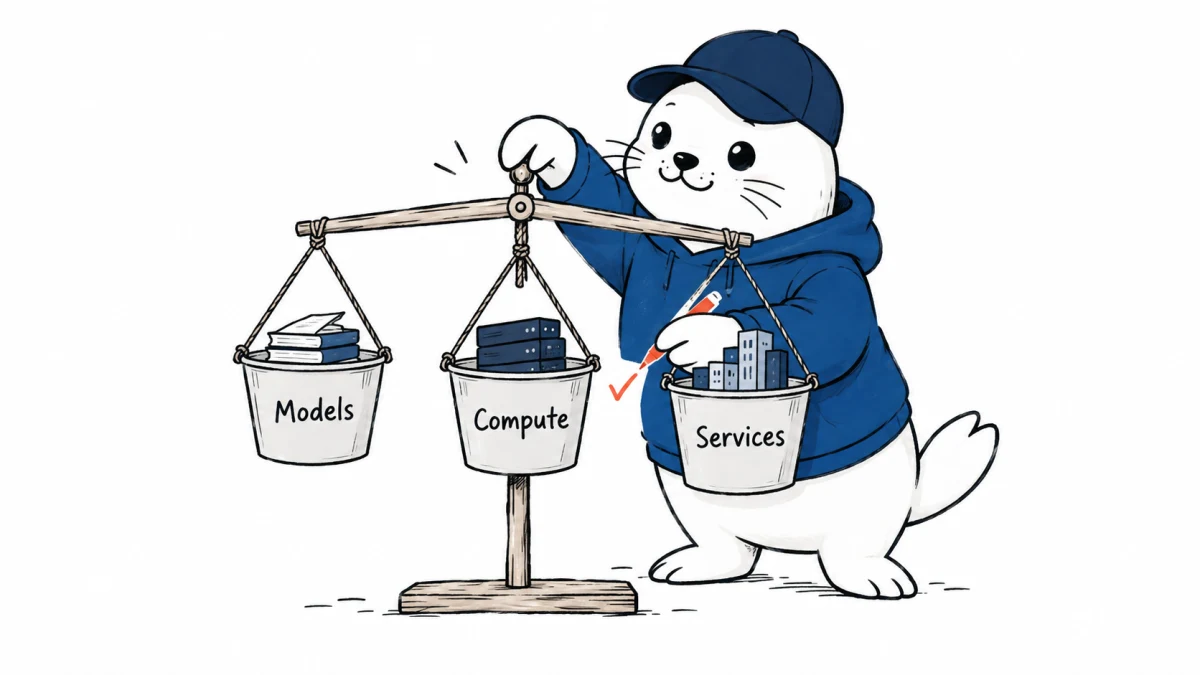
Mistral has raised €3 billion in a Series D at a post-money valuation above €21 billion. The headline is funding. The real bet is that a European AI company can own enough of the stack to give customers genuine deployment control.
The round was announced by Mistral on September 8, 2026. Samsung Electronics led it. Scaleup Europe Fund, managed by EQT, and existing investor PSG Equity co-led. Mistral describes it as the largest equity fundraising completed by a European technology company.
That last superlative comes from the company and should be read as a company claim. The confirmed numbers are still substantial: €3 billion raised and a valuation above €21 billion, three years after launch.
The funding round at a glance
| Item | Confirmed detail | Why it matters |
|---|---|---|
| Round | Series D, €3 billion | A large new capital base for research, infrastructure and sales |
| Valuation | More than €21 billion post-money | Investors are pricing Mistral as infrastructure, not only a model vendor |
| Lead | Samsung Electronics | Adds an industrial and device ecosystem relationship |
| Co-leads | Scaleup Europe Fund and PSG Equity | Combines European scale capital with an existing investor |
| Footprint | 20 countries and 125+ enterprise customers, according to Mistral | Commercial reach is part of the investment case |
Where Mistral says the money will go
Mistral names four uses: frontier research, training compute, infrastructure, and commercial expansion. These are connected. Better models require compute, but an enterprise cannot deploy a research result without regional infrastructure, support and a predictable operating layer.
The allocation is not disclosed. That is the first question to track. A €3 billion round can support a frontier lab, a cloud platform or an enterprise services business, but each path has different margins, hiring needs and capital intensity. Investors are backing Mistral to pursue all three.
What Samsung may gain from the bet
Mistral does not announce an exclusive product agreement in the funding post. It is therefore safer to describe Samsung as the lead investor, not as Mistral’s exclusive device or chip partner.
The strategic overlap is still clear. Samsung spans phones, memory, foundry capacity, appliances and enterprise hardware. A model supplier that emphasizes open weights and controlled deployment can matter across on-device inference, private infrastructure and industrial systems. That is an inference from the two companies’ positions, not a disclosed deployment roadmap.
Sovereign AI needs an operational definition
Mistral defines sovereignty across data, models, compute and production systems. Those categories are useful, but buyers should turn them into contract and architecture tests.
- Data: Can prompts, retrieved documents, logs and fine-tuning data remain inside the chosen region and organization boundary?
- Models: Can the customer inspect, adapt and run a pinned model version without a mandatory hosted endpoint?
- Compute: Can workloads move among approved providers or customer-controlled hardware with documented performance tradeoffs?
- Operations: Are updates, telemetry, incident response and access controls auditable?
- Exit: How long does it take to export artifacts and restore service elsewhere?
Open weights help with some of these tests, but they do not automatically provide portable infrastructure, compatible runtimes or an easy exit. Our Hugging Face neutrality test applies the same distinction between access to an artifact and control of the surrounding workflow.
A five-day sovereignty test for buyers
- Day 1: deploy one approved Mistral model in the preferred region and record every external dependency.
- Day 2: pin the exact weights, tokenizer, runtime and container, then reproduce the service from a clean environment.
- Day 3: run the same evaluation on a second supported compute target and compare latency, cost and output quality.
- Day 4: disable optional telemetry and inspect logs, credentials, update channels and support access.
- Day 5: export the full workload and estimate the time and work needed to operate it without the original managed layer.
What the announcement does not prove
The round does not by itself prove frontier model performance, attractive inference economics or freedom from vendor lock-in. It also does not disclose revenue, burn rate, ownership percentages, investor governance rights or the detailed capital budget.
Mistral reports operations in 20 countries and support for more than 125 enterprises, naming Airbus, ASML and HSBC. Those references establish commercial activity, but they do not reveal contract size, deployment scope or customer concentration.
My take: this is a full-stack execution bet
The most useful way to read the round is not Europe versus the United States. It is full stack versus model-only. Mistral is asking customers and investors to value research, compute, infrastructure and services as one controllable system.
The next evidence should be operational: new model releases, capacity brought online, regional availability, workload portability and enterprise adoption that survives a renewal cycle. Until then, €3 billion buys Mistral time and reach. It does not settle whether sovereign AI can become a durable commercial category.
Primary sources and related reading
- Mistral Series D announcement
- Mistral on regional inference and sovereign infrastructure
- Musthave.ai guide to AI cost controls and routing
Morocco's Maroc IA 2030 roadmap pairs a planned Mistral R&D laboratory with JAZARI institutes, sovereign infrastructure and public-service AI tools.
Checked September 8, 2026. Funding, valuation, investor and footprint statements are attributed to Mistral. Strategic interpretation and the sovereignty test are Musthave.ai analysis.