

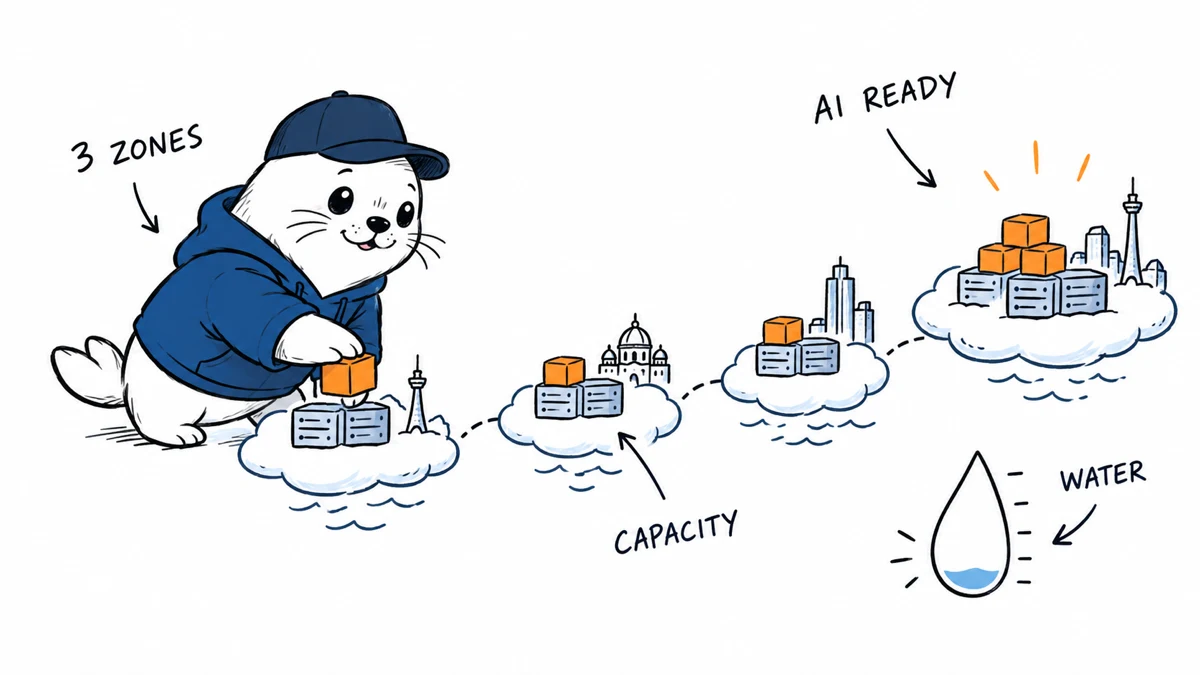
Microsoft says its fourth India cloud region is live in Hyderabad, with three availability zones and AI-ready infrastructure for India, Asia and the Global South.
Microsoft India South Central was announced as operational on September 21, 2026. Microsoft describes the Hyderabad region as a strategic hub and says more Azure and AI services will arrive progressively. The launch adds capacity and resilience options, but customers must verify service-by-service availability before planning a migration.
What is available and what is still rolling out
| Claim | Status in Microsoft’s announcement | Customer check |
|---|---|---|
| Hyderabad cloud region | Live | Subscription and service availability |
| Three availability zones | Announced for the region | Zone support for each selected service |
| AI-ready infrastructure | Available as regional capability | GPU model, quota and reservation options |
| Broader Azure and AI portfolio | Progressive rollout | Regional product page and deployment API |
| Water-efficient cooling | Company says effectively zero water for cooling | Facility scope and reporting methodology |
A fourth region changes architecture choices
A new region can shorten network paths, provide another data-location option and make multi-region resilience easier. It does not automatically improve every workload. Latency depends on user location and routing, while resilience depends on application design, data replication and service support across the chosen regions.
Teams should run measurements from their actual users and offices. Compare round-trip latency, data-transfer cost, recovery objectives and the availability of managed databases, model endpoints, observability and security services.
Three zones do not make an application highly available by themselves
Availability zones give architects separate physical locations inside a region. A workload becomes zone-resilient only when its compute, data and dependencies are distributed correctly. One single-zone database or third-party endpoint can remain the dominant failure point.
- Confirm that every critical Azure service supports zones in India South Central.
- Test failover instead of assuming a platform label proves it.
- Document recovery time and recovery point objectives.
- Keep deployment templates portable across approved regions.
- Include quota exhaustion in disaster tests.
AI-ready capacity needs quota and cost planning
Microsoft’s announcement positions the region for AI workloads, but AI-ready does not mean every accelerator is available on demand to every account. GPU type, capacity, quota, reservation term and model-service availability determine what a customer can deploy. Procurement should verify those fields before committing to a regional design.
Our AI cost-control guide explains how to place budgets and routing around variable model workloads. Regional capacity planning adds infrastructure reservations, data transfer and failover duplication to that cost model.
The water claim needs a precise reading
Microsoft says the new region uses cooling designed for effectively zero water consumption. This is a company statement about cooling operations, not proof that the entire cloud service has no water footprint. Hardware manufacturing, electricity generation and other facilities can still have environmental impacts. Sustainability comparisons should use the same scope, period and methodology.
Microsoft ties the region to a $20.5 billion commitment
The company places India South Central inside a previously announced $20.5 billion India investment commitment. That figure is a broader commitment, not the construction cost of this region alone. Readers should avoid collapsing the two claims into one facility budget.
A migration checklist
- List the exact Azure and AI services the workload needs.
- Check current regional and zone availability for each service.
- Request required compute and GPU quotas.
- Measure latency from production user locations.
- Review data-location, sector and contract requirements.
- Model transfer, replication and reservation costs.
- Deploy a non-production copy and run zone-failure tests.
- Set a rollback point before moving authoritative data.
Why this matters beyond India
Microsoft calls Hyderabad a hub for Asia and the Global South. The broader signal is that AI infrastructure competition is becoming regional: providers are pairing model access with local capacity, sovereign controls and workforce programs. Our Maroc IA 2030 analysis shows how the same capacity question appears in a national AI strategy outside the hyperscaler context.
Regional infrastructure can also change who can participate. Lower latency and local contracting may help regulated organizations, universities and startups that could not use a distant region efficiently. The benefit depends on affordable quotas, service breadth and skills, not the physical facility alone. Track customer-ready capacity and published service availability separately from investment announcements.
For policymakers, the next useful disclosures are energy source, operational water methodology, local supplier participation, workforce outcomes and the share of capacity available to domestic customers. Those measures connect a data-center announcement to economic and environmental results.
Primary source
The European infrastructure debate is also shifting: our guide to EU data center energy ratings explains the proposed electricity and water comparison system.
Checked September 22, 2026. Infrastructure, investment and sustainability claims are Microsoft-reported unless otherwise stated.