Microsoft’s newest internal AI case study contains real denominators, not only a transformation slogan. Those denominators also show why its headline results should not be treated as companywide proof.
In a September 17 retrospective, Microsoft AI transformation leaders reported more than 111 agents across selected cloud supply-chain workflows, a planning-cycle reduction from approximately 10 to under 2.5 business days across five monthly cycles, higher results in one selected sales cohort and a 35-day initial release from one nine-person team. Every result is company-reported.
Put every headline beside its denominator
| Headline result | Measured population and period | Boundary |
|---|---|---|
| 20% higher deal close rates and 9.4% higher revenue per account manager | Internal data on 687 Microsoft 365 Copilot sellers from January through June 2024, comparing regular users with low-usage sellers | Regular use meant daily use at least 50% of the testing period; this was not a randomized companywide study. |
| More than 111 supply-chain agents | Work led by a 150-plus-person cross-functional team from September 2025 through August 2026 | Agent count is deployment scale, not completed-work quality. |
| About 10 to under 2.5 business days | Five monthly planning cycles measured from April through August 2026 | The result is specific to selected cloud supply-chain workflows. |
| Five to seven days to hours, sometimes under 20 minutes | More than 20 demand-plan investigations per month | The endpoint was a human-validated explanation, not an unreviewed agent answer. |
| Initial release in 35 days | One nine-person cross-functional team in spring 2026 | Microsoft explicitly says this is not a companywide product-development benchmark. |
The supply-chain result began with simplification
Microsoft’s account says the team mapped and simplified end-to-end workflows before adding agents, then created a single source of truth. The agents span planning, sourcing, fulfillment and logistics. Within defined permissions and approval thresholds, some can help planners update or cancel purchase orders.
That sequence matters. An agent placed on top of inconsistent data and unnecessary approvals may make one step faster while creating a longer downstream queue. The case supports a workflow-redesign claim more strongly than a claim that installing an assistant causes a 75% improvement.
The sales comparison contains selection risk
The 687-seller analysis compared regular Copilot users with low-usage sellers. Higher-performing, more engaged or better-supported sellers may be more likely to use the tools frequently. Microsoft also describes peer-led huddles and specific Analyst, Deal and Researcher use cases, which means the intervention included workflow support, not only software access.
The results are still useful. They show the conditions under which Microsoft observed a positive association: a defined seller population, a usage threshold, targeted use cases and team learning. They do not isolate a causal model effect or guarantee the same lift in another sales organization.
The 35-day release is a greenfield case
A dedicated nine-person team of engineers, designers and product managers built the initial Copilot Cowork release in 35 days from formal kickoff. Microsoft presents the team as AI-first from day one, with broader roles for participants. That is valuable evidence for a greenfield operating model and weak evidence for the time needed to modernize a large legacy product with existing obligations.
A replication scorecard for another company
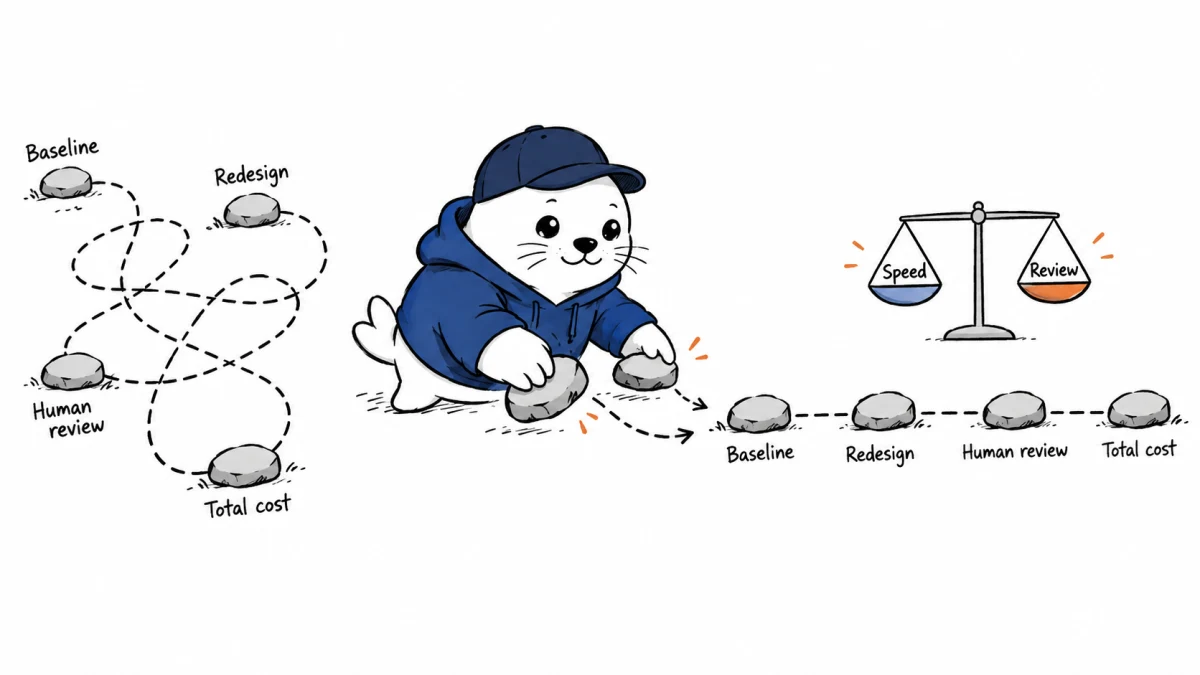
- Baseline: measure cycle time, queue time, error rate and cost before the change.
- Cohort: define who is included, who is compared and why.
- Workflow map: record removed steps, new data dependencies and approval gates.
- Acceptance: count outputs accepted unchanged, corrected or rejected.
- Repair time: include prompt correction, debugging, review and incident work.
- Failure severity: separate harmless drafting errors from purchase, security or customer-impacting mistakes.
- Human review: record which decisions require approval and how often reviewers override the agent.
- Total operating cost: include models, platform, integration, monitoring, data work, training and change management.
Do not count agents as employees or outcomes
More than 111 deployed agents indicates architectural scale. It does not mean 111 autonomous workers, 111 useful workflows or 111 full-time-equivalent jobs. One workflow may use multiple agents, and a single accountable planner may supervise many automated steps. Report useful tasks, accepted results and risk-adjusted outcomes alongside agent count.
The most transferable lesson is organizational
Microsoft says access and usage did not initially produce transformation even though tools were licensed to more than 200,000 people. The stronger cases began with a business outcome, process redesign, shared data, employee involvement and explicit human-control points. A manager-behavior correlation reported elsewhere in the article is also company research and should not be converted into a universal causal rule.
For procurement, ask a vendor to map its promised gain to the scorecard above. If the proposal has no baseline, no cohort definition and no repair-time measurement, a faster demo cannot establish business value.
Our production AI systems guide examines why model capability must be embedded in observable workflows. Microsoft’s case adds a useful enterprise lesson: the process and organization around the model determine whether a speed gain survives.
The practical verdict
Microsoft’s report is more informative than a generic productivity claim because it supplies team sizes, time windows and workflow limits in its notes. The strongest evidence concerns selected internal cases after deliberate workflow redesign. Treat the figures as a replication template, not a benchmark for every company. Preserve the baseline, cohort, review step and total cost before claiming the same result.
Primary source
Company-reported productivity figures become useful when teams can reproduce the measurement. Use the Ema workflow evidence checklist to separate agent activity from governed outcomes.
Checked September 18, 2026. All quantitative results are company-reported by Microsoft and have not been independently replicated. Evidence interpretation and the replication scorecard are MustHave.ai analysis.