Perplexity says GPT-6 Astra now writes communications, changes software, monitors production and tests end-to-end workflows with fewer check-ins. That is a meaningful production claim. It is also a governance claim, because the cost of a wrong answer changes when the model can alter a live system.
OpenAI published the Perplexity customer story on September 14, 2026. Perplexity describes using GPT-6 Astra for multi-step work that includes writing internal communications, modifying software, monitoring production, building test programs and checking complete workflows.
The work has crossed from drafting into changing
| Task | Failure consequence | Minimum control |
|---|---|---|
| Draft a communication | Incorrect or premature information | Human approval before sending |
| Change software | Regression or security defect | Branch isolation, tests and reviewed merge |
| Monitor production | Missed incident or noisy escalation | Defined thresholds and an on-call owner |
| Test end-to-end workflows | False confidence from incomplete coverage | Known failure fixtures and traceable results |
All four tasks can use the same model while requiring different permissions. A communication agent needs access to context and a draft destination. A production agent may see telemetry, deployment state and secrets. Combining them under one broad identity makes review harder and increases the blast radius.
Perplexity reports a 9 percent gain at 49 percent of the cost
Perplexity says Astra scored 9 percent higher than prior models on its hardest research benchmark while operating at 49 percent of the cost. These are company-reported results presented in an OpenAI customer story.
The public page does not disclose the benchmark sample, scoring rubric, model configuration, tool budget, failure distribution or raw results. The numbers are useful as a deployment signal, not as an independently reproducible ranking.
Fewer check-ins must not mean fewer controls
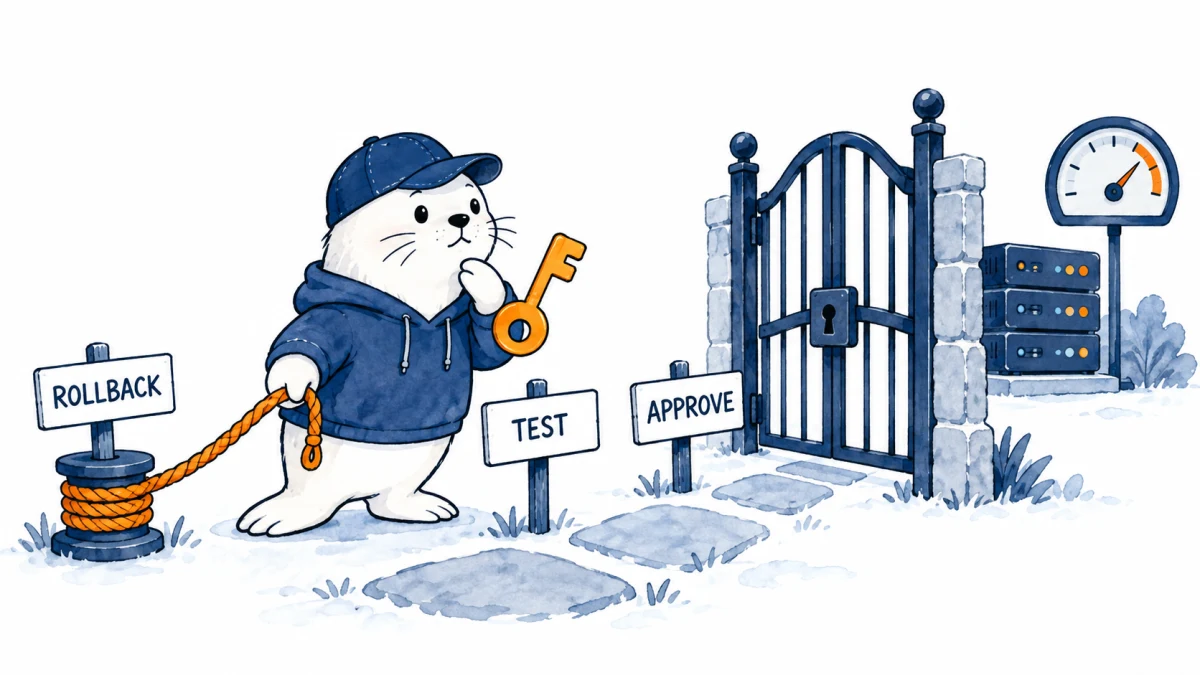
A check-in is an interaction pattern. A control is an enforceable boundary. An agent can ask a human fewer questions while still being limited by read-only credentials, change windows, spending caps, automated tests and a required approval at the production gate.
- Pre-authorize low-risk reads and reversible staging changes.
- Require explicit approval for customer-visible or irreversible actions.
- Record every tool call, input artifact and resulting diff.
- Stop automatically when observed state differs from the plan.
A safe pilot has three lanes
| Lane | Allowed action | Promotion rule |
|---|---|---|
| Observe | Read logs, metrics and code; propose a diagnosis. | Measure alert precision and missed incidents. |
| Rehearse | Apply changes in an isolated replica; run tests. | Compare against known failures and rollback drills. |
| Approve | Prepare a production change but do not execute it. | A named owner reviews the diff, tests and rollback plan. |
Only after the first three lanes produce reliable evidence should a team consider tightly scoped automatic execution. Even then, the first autonomous change should be small, reversible and observable.
The missing metric is cost per accepted outcome
Model cost is only one line in an agent’s bill. Tool calls, search, sandbox time, retries, monitoring and human review all contribute. A cheaper model run can be more expensive if it produces a change that a reviewer rejects or an incident that engineers must repair.
Track cost per accepted research answer, cost per merged change and cost per correctly resolved incident. Include human review minutes and rollback work. That denominator makes the claimed cost advantage comparable to a real production workflow.
Where this fits in the Astra stack
Our GPT-6 Astra pricing analysis explains how context length can change token economics. Our Codex versus Claude Code guide compares the execution harnesses around Astra and Claude Fable 5.1. Perplexity’s report adds an important data point: a customer is entrusting Astra with production-adjacent work, not only benchmark prompts.
The production verdict
Perplexity’s account suggests GPT-6 Astra can sustain longer operational loops with less supervision. It does not establish that broad production autonomy is safe for every team. The practical takeaway is to preserve approval, rollback and observability as agent capability rises, then judge the system by accepted outcomes rather than model-only scores.
Primary sources and evidence status
- OpenAI customer story: Perplexity improves accuracy with Astra
- OpenAI business models and deployment information
Perplexity effort controls now separate task effort from manual model choice, with service-managed routing from Light through Ultra.
Checked September 14, 2026. Workload descriptions, benchmark gains and cost claims are attributed to Perplexity through an OpenAI customer story. The benchmark details and raw results were not publicly disclosed on the cited page.