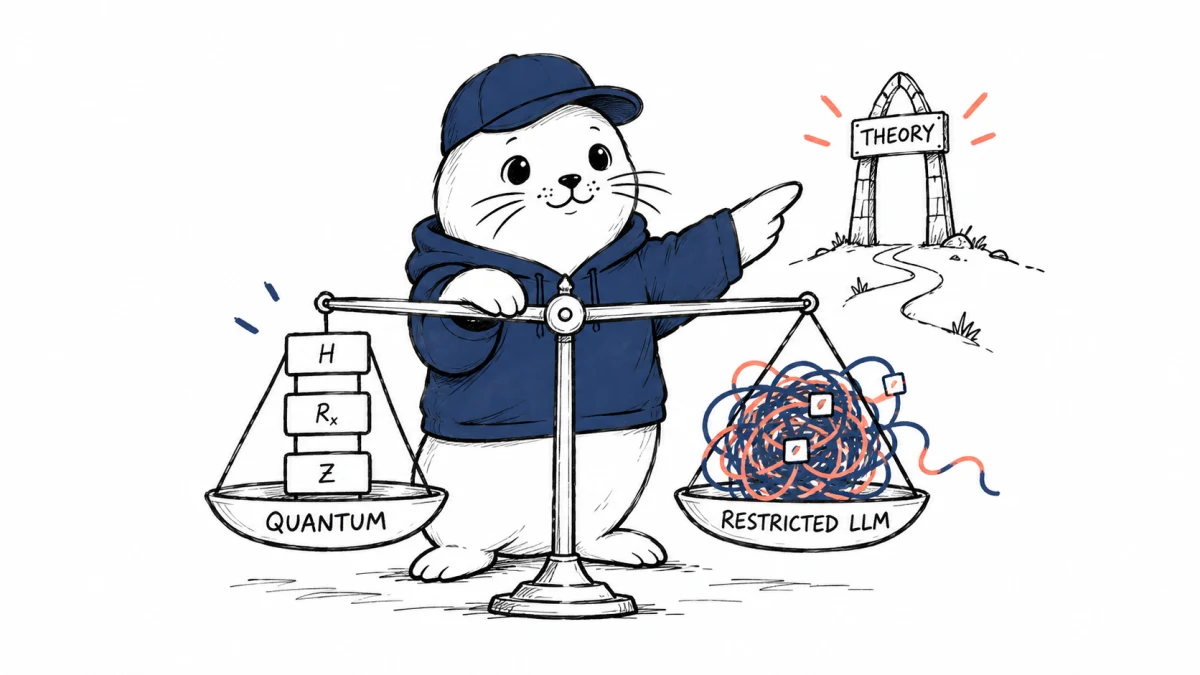
IBM researchers have published unconditional theoretical separations showing that shallow quantum circuits can solve two constructed tasks beyond the bounded language-model architectures analyzed in their paper. The result is mathematically meaningful, but it is not evidence that today’s quantum computers beat production LLMs on ordinary work.
IBM highlighted the research on September 15, 2026. The underlying paper, Separating quantum circuits from classical LLMs, was posted to arXiv in August by Srinivasan Arunachalam, Arkopal Dutt, Hari Krovi and Rik Sengupta. It studies one generation problem and one function-computation problem under explicit resource restrictions.
What quantum circuits and LLMs were actually compared
The quantum side uses low-depth circuit families. In the sampling result, the paper considers QNC0, constant-depth quantum circuits built from bounded fan-in gates. The classical opponent is not every possible LLM. It is a constant-round diffusion language model with shallow scheduling and denoising, even when given sublinear chain-of-thought and token revision or remasking.
The functional result compares a slightly deeper quantum construction followed by a classical AND gate with a constant-depth decoder-only transformer. The theorem says a transformer computing the constructed function would need polynomially growing width. Those resource bounds are the heart of the claim.
The paper proves two different separations
| Result | Quantum side | Restricted classical side | Claim |
|---|---|---|---|
| Distributional separation | Constant-depth bounded-fan-in quantum circuits | Constant-round diffusion language models with shallow schedules | The target distribution cannot be sampled within constant distance by the analyzed model |
| Functional separation | Very low-depth quantum circuits plus one classical AND gate | Constant-depth decoder-only transformers | A transformer needs width that grows as a polynomial power of input size |
A sampling problem asks a system to generate outputs from a target probability distribution. A functional problem asks it to compute the correct output for an input. Proving a separation in both regimes matters because modern language models perform both prediction-like and generation-like work.
Unconditional is important, but it does not mean universal
In complexity theory, an unconditional separation does not rely on an unproved assumption such as one complexity class being different from another. The authors construct tasks and prove a lower bound for the restricted classical model. That is stronger than observing a benchmark gap.
It is still model-specific. The theorem does not cover arbitrarily deep transformers, unlimited width, external tools, retrieval systems, unrestricted computation or every future LLM architecture. A headline that drops the word “restricted” changes the meaning of the research.
The result does not benchmark current quantum hardware
- No production chatbot was compared with a physical quantum computer.
- No common coding, search, reasoning or content task was shown to run faster.
- No cost, wall-clock latency or energy comparison was reported for deployed systems.
- The constructed problems are theoretical witnesses, not commercial workloads.
- Noise, error correction and hardware scale remain separate implementation questions.
IBM’s own explanation states that the findings are theoretical rather than immediately practical or implementable. It also notes that current LLMs run on far more mature and larger computational resources than today’s noisy, smaller quantum systems.
Why the bounded architecture still matters
Lower bounds often begin with restricted models because fully general classical computation can simulate arbitrary procedures when given enough resources. The research question is whether a shallow quantum process has a structural advantage over a classical architecture with bounded depth, rounds, scheduling and width.
The diffusion-language-model result is especially timely because it allows features associated with newer generation systems, including token revision and remasking, rather than comparing quantum circuits only with a static feed-forward baseline. The theorem still depends on the stated bounds, but the opponent is more expressive than a trivial classical circuit.
The next useful step is an empirical benchmark bridge
A proof can identify where an advantage must exist. A practical benchmark must translate that witness into circuits and classical baselines that real systems can run at informative sizes. That requires at least four layers of evidence.
- Publish reproducible task generators and scoring rules.
- Implement the quantum construction within realistic gate and noise budgets.
- Test stronger classical baselines, including deeper and wider models where feasible.
- Report accuracy, sampling distance, latency, energy and total system cost separately.
Our GPT-5.6 Sol quantum chip measurements analysis shows why laboratory AI assistance still needs expert interpretation. The Astra mathematics evidence review applies a similar discipline to theorem claims and verification packages.
A hybrid future is more plausible than a winner-takes-all story
IBM frames the work as a map of computational differences, not simply a contest. If future quantum processors handle a narrow sampling or search subproblem efficiently, a classical AI system could call that capability as one component. The useful design question would become where to place the quantum subroutine, how to verify its output and whether the end-to-end system beats a classical alternative.
The practical verdict
The new research is a genuine theoretical separation between shallow quantum circuits and specific bounded LLM architectures. It expands the formal study of quantum advantage into model classes inspired by transformers and diffusion language models. It does not establish a present-day product advantage, a general defeat of LLMs or a near-term replacement path.
Primary sources
- IBM Research: A theoretical separation between quantum computers and LLMs
- ArXiv: Separating quantum circuits from classical LLMs
Checked September 15, 2026. The theorem statements come from the paper and IBM’s explanation. Scope interpretation and benchmark recommendations are MustHave.ai analysis.