
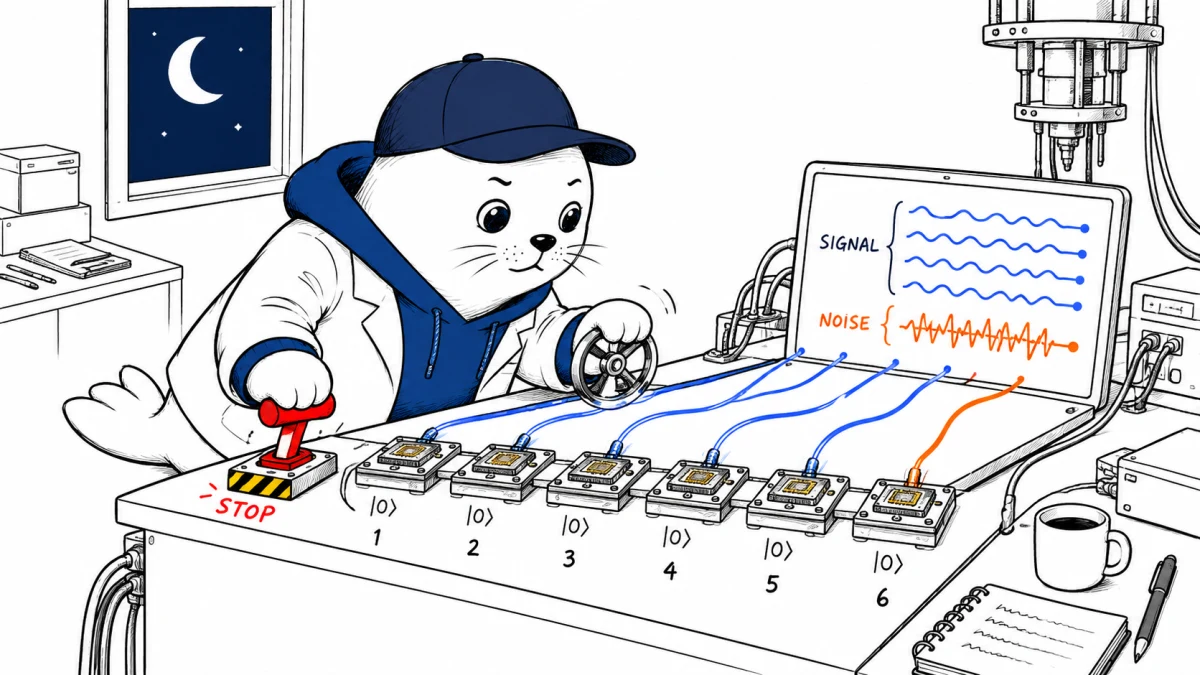
An AI agent ran routine measurements on a six-qubit chip for hours while the researcher worked elsewhere. When the signal became noisy, the lab still needed someone who knew what strange hardware looks like.
OpenAI published a case study on September 8, 2026, describing how an MIT Engineering Quantum Systems researcher connected GPT-5.6 Sol through Codex to laboratory control software. The agent chose measurement parameters, operated a superconducting chip, analyzed results, and decided whether to refine or save each measurement.
The experiment used a standard six-qubit chip
The EQuS group fabricates standard chips to benchmark its process. Characterizing one chip can take a researcher several days because measurements depend on earlier measurements. Resonance frequencies influence control settings, pulse calibration affects readout, and hardware properties can drift.
The researcher supplied Codex with task-specific skills that explained how to run and evaluate each experiment. This is an important detail. The agent was not dropped into an unknown lab and asked to discover quantum engineering from scratch. It received procedures, design targets, software access, and a bounded workflow.
Clear signals worked. Noisy signals changed the job
OpenAI reports that Codex completed a standard sequence with little intervention when the measurements were clear. It identified transition frequencies, calibrated control and readout pulses, and measured how long a qubit retained quantum information.
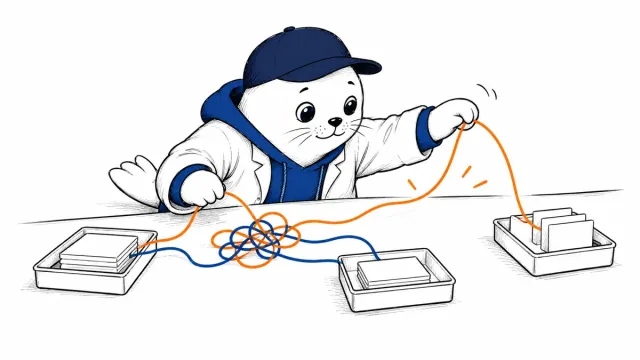
Weak or noisy signals were different. The agent took longer to find useful parameters and sometimes needed guidance from an experienced researcher. OpenAI also notes that an expert may identify the best calibration settings faster than the current agent.
That boundary is more informative than a generic claim of laboratory autonomy. Routine work with clean feedback is a candidate for delegation. Ambiguous physical behavior is where context, intuition, and responsibility return to the human.
The permission chain matters as much as the model
| Layer | Allowed responsibility | Required control |
|---|---|---|
| GPT-5.6 Sol | Reason over measurements and propose the next step | Bounded goals and explicit stop conditions |
| Codex | Use skills, write or run analysis, and call lab tools | Tool allowlist, logs, and scoped credentials |
| Control software | Translate approved requests into instrument commands | Parameter limits and hardware interlocks |
| Researcher | Define the experiment, handle ambiguity, and accept results | Review alerts, overrides, and final accountability |
A model can produce a reasonable next action and still be unsafe if the tool layer accepts unlimited voltage, frequency, duration, or repetition. Labs need deterministic limits below the agent. The model should not be the last protection between a bad inference and expensive hardware.
Safe stop conditions for a lab agent
- Stop when the signal-to-noise ratio falls outside the validated range.
- Stop after a fixed number of unsuccessful parameter sweeps.
- Stop when a proposed setting exceeds the instrument or device envelope.
- Stop when measurements contradict the expected physical model across repeated runs.
- Stop before any irreversible hardware, sample, or cryogenic-state change.
- Require a researcher to approve a new experimental objective or modified procedure.
The point is not to eliminate overnight work. It is to make overnight work boring in the best sense: bounded, logged, reversible where possible, and waiting for a person when reality stops matching the procedure.
What the case study proves and what it does not
The report shows a real integration between an agent workflow and laboratory software. It also documents a useful limitation. It does not provide a randomized comparison with human operators, a full cost account, a distribution of failed runs, or evidence that the workflow transfers to other chip designs and control stacks.
OpenAI’s recent AI research intern report and its oversight-gap discussion both make more sense beside this example. Model capability is only one variable. The rest of the system decides which mistakes remain suggestions and which become actions in the physical world.
A lab-agent evaluation template
- Select a routine workflow: use a task with known success criteria and repeatable measurements.
- Run a human baseline: measure expert time, elapsed time, retries, and result quality.
- Define the envelope: list every permitted command, parameter range, and hard stop.
- Inject difficult cases: include drift, weak signals, missing data, and contradictory readings.
- Measure intervention: record when the human stepped in and what information was missing.
- Audit the record: confirm that another researcher can reconstruct each decision from logs.
Without this baseline, “ran overnight” can hide time spent preparing skills, correcting failed measurements, or reviewing outputs the next morning. The useful metric is verified experiment progress per researcher hour, not agent runtime alone.
My verdict: routine autonomy is the credible win
The case does not show an AI scientist replacing a quantum researcher. It shows an agent taking on a chain of routine measurements while a researcher remains available for ambiguity. That is narrower, but it is also more believable and easier to evaluate.
Teams considering a similar integration should start with the cleanest repeatable task and design the stop layer before the prompt. If the agent cannot recognize when the signal has left its competence envelope, the experiment is not ready to run unattended.
Read the primary case study
- Read OpenAI’s quantum-computing experiment report.
- Compare the model and agent choices in our Codex versus Claude Code guide.
Checked September 9, 2026. Experimental outcomes are reported by OpenAI and the named MIT research group. No controlled cross-lab benchmark was available.