Update, August 14, 2026: GitHub is gradually adding Grok 4.6 to Copilot. The rollout reaches paid individual plans plus Business and Enterprise, but organization administrators must enable the model policy before members can select it.
Grok 4.6 reaches Copilot across editor, terminal, and cloud surfaces
GitHub lists VS Code, Visual Studio, JetBrains IDEs, Xcode, Eclipse, Copilot CLI, the GitHub cloud coding agent, and the Copilot app among the supported surfaces. Eligible plans include Copilot Pro, Pro+, Max, Business, and Enterprise. Business and Enterprise access is off until an administrator enables the policy.
GitHub says its internal testing found Grok 4.6 strong on terminal-based, longer-horizon work. It has not published a detailed evaluation package for that claim. The release uses usage-based billing at provider list pricing; xAI lists API rates of $2 per million input tokens and $6 per million output tokens.
Use the Copilot rollout as a second canary
The new surface makes the original article’s long-run test easier to run inside a real repository. Compare Grok 4.6 with the current approved Copilot model on the same tasks. Record accepted changes, review time, terminal corrections, restarts, premium requests, and any file that must be reverted.
Do not enable the organization policy only to increase adoption. Pair access with a repository canary and the review controls in our Copilot review-effort analysis.
Read GitHub’s official Copilot rollout notice and xAI’s Grok 4.6 Copilot announcement.
Grok 4.6 is built to stay useful after the impressive first answer, when an agent has accumulated tools, files, decisions, and opportunities to drift. That is also the point where its token price stops looking small.
Grok 4.6 launched on August 12 with a stated focus on long-running agents and more ambitious interactive and visual work. SpaceXAI says the model can research unfamiliar domains, work across codebases, build applications, and keep refining them through several rounds of feedback.
The model is available through the SpaceXAI API, Cursor, Grok Build, OpenRouter, Vercel, and Cloudflare. Standard pricing starts at $2 per million input tokens and $6 per million output tokens. A fast variant costs twice as much. Cursor and Grok Build are offering twice the included usage during the first week, but that launch promotion does not answer the production question: how much work survives a long trajectory without repair?
The launch claim is about endurance, not one response
SpaceXAI describes longer projects in which Grok 4.6 researches, structures an application, implements its core interactions, and iterates on feedback. The company also says it observed more self-testing and verification on longer trajectories. These are useful product claims, but the launch post does not publish a fixed horizon, intervention rate, tool-error rate, or failure distribution for those runs.
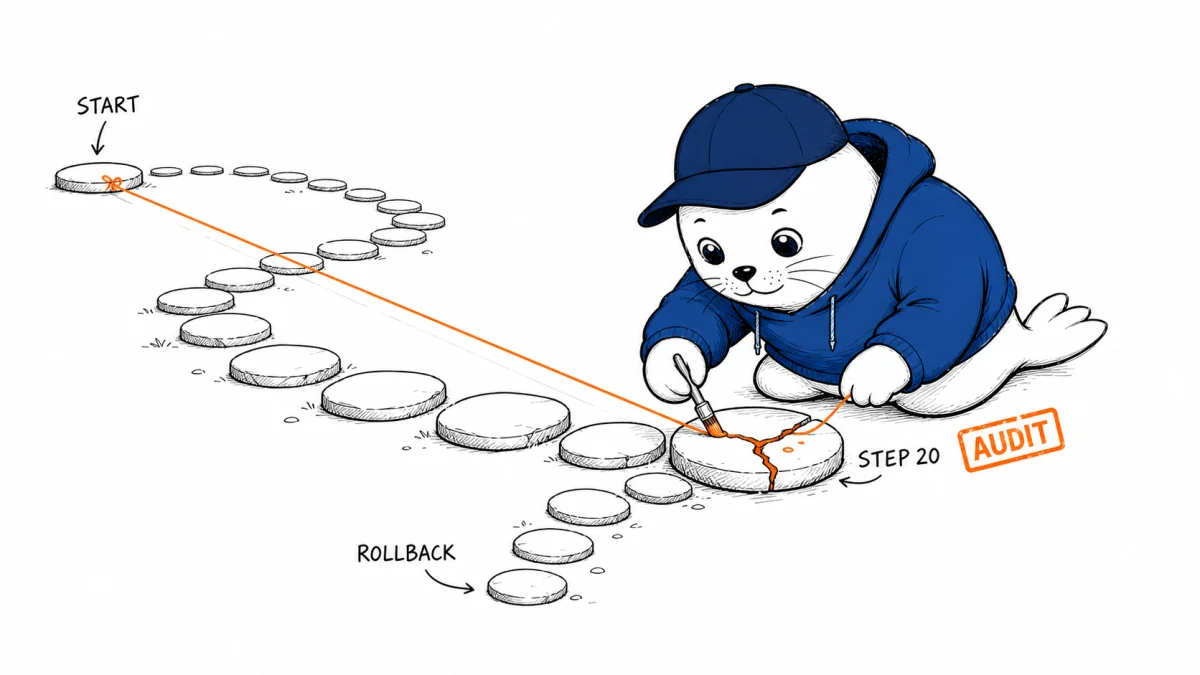
A builder should therefore test the trajectory, not just the final screenshot. Long-running agents can fail quietly: a stale assumption survives for twenty steps, a tool returns partial data, the context fills with obsolete plans, or a repair changes a previously correct file. A polished result can hide an expensive path.
Grok 4.6 pricing compounds inside the loop
At the standard API rate, a call with 100,000 input tokens and 20,000 output tokens costs $0.32: $0.20 for input and $0.12 for output. The same call on the fast variant costs $0.64. If an agent repeats that payload across five substantial turns, the simplified total becomes $1.60 or $3.20 before retries, tool traffic, or changing context.
| Illustrative workload | Standard Grok 4.6 | Fast variant |
|---|---|---|
| One 100K-input, 20K-output call | $0.32 | $0.64 |
| Five calls with the same token volume | $1.60 | $3.20 |
| Twenty calls with the same token volume | $6.40 | $12.80 |
Fast mode is not automatically a worse purchase. A shorter wait may help an interactive coding session, and faster feedback can reduce idle human time. It needs to earn the 2× rate through lower elapsed time or fewer abandoned and restarted runs. SpaceXAI’s launch page does not publish a latency guarantee for the fast variant.
The benchmark table is a test menu, not a verdict
SpaceXAI reports 61 on the Artificial Analysis Intelligence Index, matching the GPT-5.6 Sol Max figure shown in its launch comparison and sitting one point below Fable 5 Max. It also reports 69.9% on CursorBench 3.2, 65.9% on DeepSWE 1.1, 61.3% on FrontierCode 1.1 Extended, and 26% on Terminal-Bench 3.0.
| Provider-reported benchmark | Grok 4.6 result | Question to reproduce |
|---|---|---|
| AA Intelligence Index | 61 | Does broad reasoning hold on your task mix? |
| CursorBench 3.2 | 69.9% | Does the coding flow reduce accepted-review time? |
| DeepSWE 1.1 | 65.9% | Can the model repair repository-level issues without regressions? |
| FrontierCode 1.1 Extended | 61.3% | Does performance survive longer technical work? |
| Terminal-Bench 3.0 | 26% | Where do shell and environment interactions fail? |
The lowest-looking number is not necessarily the most important one, and the highest-looking number is not a deployment approval. Benchmarks use different tasks, harnesses, scoring rules, and tool environments. Pick the rows that resemble your workload, then recreate the failure conditions inside your own repository and permissions.
A long-run evaluation needs restart and audit evidence
I would give Grok 4.6 ten projects that take at least thirty consequential steps rather than fifty isolated prompts. Each project should contain a misleading clue, a failed tool call, a permission denial, a requirement change, and a checkpoint where the agent must summarize what it believes.
- Record the first plan. Compare it with the final artifact and note when assumptions changed.
- Count human interventions. A run is not autonomous if a reviewer quietly rescues it every few steps.
- Force one restart. Verify that state, pending work, and rollback instructions survive a fresh session.
- Score accepted work. Measure tests passed, review comments, reverted files, and unresolved risks.
- Price the whole trajectory. Include every retry, summary, tool result, and fast-mode call.
Our analysis of overnight agent handoffs explains why restartable state and a morning audit belong together. The Kimi K3 Copilot rollout pause shows why production behavior can reveal more than a leaderboard. If you are comparing the previous generation, start with our Grok 4.5 review.
The safety description still leaves procurement questions
SpaceXAI says Grok 4.6 received its widest predeployment testing suite plus postdeployment and third-party testing. The launch page does not include the detailed test results, evaluator identities, failure categories, or a separate model card. That does not invalidate the claim. It limits what a buyer can verify from the public package.
For an agent that can change code, contact services, or use credentials, ask for the evidence that matters to your boundary: tool authorization, prompt-injection resistance, sensitive-data handling, action monitoring, and recovery after a partial failure. Model safeguards and infrastructure controls should reinforce each other.
My verdict: canary the long run before buying speed
Grok 4.6 is priced competitively enough to deserve a serious agent test, and its launch emphasis is pointed at the part of agent work that often breaks after the demo. I would start with the standard endpoint, run production-shaped trajectories, and compare cost per accepted result with the model already in the stack.
I would pay for the fast variant only after latency shows up as the bottleneck. The important benchmark is not whether Grok 4.6 can begin an ambitious project. It is whether the project remains correct, inspectable, and recoverable when the twentieth decision depends on the first.
Read the primary source
- Read SpaceXAI’s Grok 4.6 launch post.
- Review the current SpaceXAI API documentation before integration.
How many steps can your current agent complete before a human has to reconstruct what it believes?
Checked August 13, 2026. Availability, prices, training description, benchmark figures, and safety claims come from SpaceXAI. Benchmark results are provider-reported. Cost examples are Musthave.ai calculations and exclude caching, discounts, retries, and tool-specific charges.