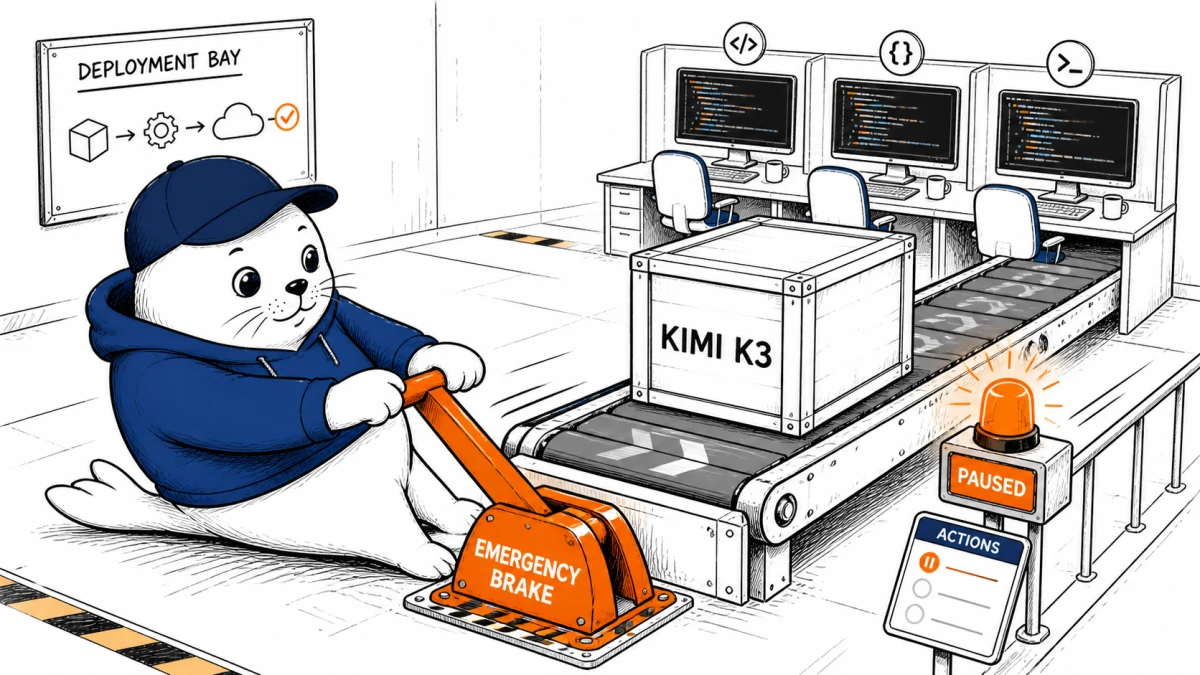
GitHub started rolling Kimi K3 into Copilot on August 6, then temporarily paused the rollout while it addressed an incident involving GitHub Actions. That sequence makes the availability status (not Moonshot’s benchmark table) the first thing a developer should check.
September update: Kimi K3 is now available on Amazon Bedrock
Amazon added Kimi K3 to Amazon Bedrock on September 18, 2026. The managed release supports text and image inputs, a context window of up to one million tokens, prompt caching, and both U.S. and global cross-region inference profiles. That gives teams a second practical evaluation route beyond GitHub Copilot and direct work with Moonshot’s published weights.
The Bedrock listing matters because deployment controls are part of the model decision. A team can test Kimi K3 behind AWS identity, logging and regional routing instead of standing up the 2.8-trillion-parameter mixture-of-experts system itself. Amazon’s model card identifies the model as active and documents its supported regions and inference-profile IDs.
Prompt caching is especially relevant for repository-scale work. Reusing a large stable context can reduce repeated input processing, but the saving depends on how much of the prompt stays identical and on Bedrock’s current pricing. Test with your own request traces rather than carrying GitHub’s earlier token-price example into AWS unchanged.
| Route | Best first test | Control to verify |
|---|---|---|
| GitHub Copilot | Developer tasks inside supported IDE and agent surfaces | Current rollout status, organization policy and credit accounting |
| Amazon Bedrock | Application or agent calls through AWS | Inference profile, region, caching behavior, logging and IAM scope |
Moonshot reports 2.8 trillion total parameters and a 2.5-times scaling-efficiency improvement from its architecture. Those remain company claims, not a guarantee about latency, cost or task quality in your account. The useful next step is a matched evaluation: same prompts, same acceptance tests, same human review, and separate cost records for each serving route.
Read Amazon’s Kimi K3 availability announcement and the Bedrock model card before choosing a region or inference profile.
GitHub put Kimi K3 in Copilot, then paused the rollout
GitHub’s August 6 Copilot announcement said Kimi K3 was rolling out to Copilot Pro, Pro+, Max, Business, and Enterprise. An editor’s note on the same announcement says the rollout was temporarily paused while GitHub mitigated an incident with GitHub Actions.
Those are two verified facts. They do not establish that Kimi K3 caused the Actions incident, and GitHub did not make that attribution. The safe operational reading is simpler: the model was announced, the rollout was paused, and teams should confirm current availability before changing a workflow or promising access to users.
Status check
What is live, what is paused, what is unknown
Confirmed
GitHub announced Kimi K3 for individual and organization Copilot plans.
Temporarily paused
GitHub added an editor's note while it mitigated an incident involving GitHub Actions.
Not established
GitHub has not said that Kimi K3 caused the Actions incident.
The model is much more than a long context window
Moonshot AI describes Kimi K3 as an open-weight, native multimodal mixture-of-experts model with 2.8 trillion total parameters. Its official repository lists 104 billion activated parameters, 93 layers, 896 experts, and 16 selected experts per token. It accepts text and images and supports a 1,048,576-token context window.
The architecture matters because "2.8 trillion parameters" can sound like every request exercises the entire model. It does not. Kimi K3 routes each token through a sparse subset of experts. Moonshot says its Stable LatentMoE design improves overall scaling efficiency by about 2.5 times over Kimi K2; that is a company-reported architecture result, not an independently reproduced serving guarantee.
Kimi K3 also differs from the older article this update replaces. It uses Kimi Delta Attention and gated multi-head latent attention, not the "Kimi-Linear" explanation previously attached to this page. The weights are already published under the Kimi K3 License; they are not merely promised for a later release.
Copilot is the practical route for most developers
GitHub said it would host Kimi K3 on Fireworks AI and expose it through the model picker in Visual Studio Code, Visual Studio, Copilot CLI, the Copilot cloud agent, the Copilot app, github.com, GitHub Mobile, JetBrains IDEs, Xcode, and Eclipse. The availability note now takes priority: a listed surface does not guarantee that the paused rollout has reached your account.
For Copilot Business and Enterprise, Kimi K3 is off by default. An administrator must enable its policy. GitHub explicitly recommends reviewing open-weight models against security, compliance, and data-governance requirements before enabling them. That review should include data routing, retention, provider hosting, model licensing, and which repositories can send context.
Self-hosting remains possible in principle because the weights are available, but a 2.8-trillion-parameter model is not a casual workstation install. Most teams will evaluate it through a hosted service first. Our model-selection guide explains why a repeatable task set is more useful than choosing from a launch leaderboard.
What GitHub’s list pricing means for a coding request
GitHub listed Kimi K3 at $3 per million input tokens, $15 per million output tokens, and $0.30 per million cached input tokens. Those rates make output the expensive part of a request. A long prompt is not free, but asking the model to produce thousands of tokens repeatedly can dominate the bill.
Simple calculation
A 10K-input, 2K-output request at list price
Illustrative token math, not a prediction of the credits shown on your GitHub bill.
| Scenario | Input | Output | Total |
|---|---|---|---|
| No cached input | 10K × $3/M = $0.0300 | 2K × $15/M = $0.0300 | $0.0600 |
| 80% input cached | 2K fresh + 8K cached = $0.0084 | 2K × $15/M = $0.0300 | $0.0384 |
At those assumptions, 100 requests would be $6.00 without caching or $3.84 with 80% of the input billed at the cached rate.
The calculation uses GitHub’s published per-token rates. Actual Copilot charges can be presented through AI credits, included usage, budgets, and product-specific accounting. Check the billing page for the plan you operate rather than treating this table as an invoice simulator.
Moonshot’s benchmark table is a test plan, not a verdict
Moonshot reports competitive results across coding, agentic work, long-context research, office tasks, and multimodal benchmarks. It also publishes unusually useful caveats: models were paired with different agent harnesses, several scores came from external leaderboards, some tasks used tools, and some comparison models triggered refusals or fallbacks.
Those details are why one rank cannot settle a buying decision. Harness choice, repository shape, tool permissions, latency, output length, and retry behavior can move the result that matters to your team. A model that wins one terminal benchmark may still be the wrong reviewer for a regulated repository or the wrong agent for an overnight migration.
The useful part of the release is the breadth of tasks it invites teams to test. Pair Kimi K3 with the same issues, tests, tool permissions, and acceptance criteria you use for another model. Then compare task completion, human correction time, token cost, and rollback frequency. Our report on overnight coding-agent handoffs provides a practical review pattern.
A five-step rollout after GitHub resumes access
Admin preflight
Enable slowly, measure the handoff
01
Verify the pause is over.
Check GitHub's changelog and your model picker before announcing availability.
02
Review routing and license.
Document Fireworks hosting, data controls, Kimi's license, and repository eligibility.
03
Start with read-only tasks.
Use code explanation, test planning, and review before granting write or deployment permissions.
04
Cap sessions and spend.
Set an AI-credit budget and record prompt, output, cache use, retries, and tool calls.
05
Require a replayable review.
Keep tests, diffs, logs, and a rollback path for every consequential change.
My verdict: the pause belongs in the product evaluation
Kimi K3 is a serious open-weight release: native multimodality, a million-token context window, sparse 2.8-trillion-parameter architecture, published weights, and a broad agentic evaluation. GitHub’s planned Copilot integration could make it accessible to far more developers than self-hosting ever will.
But the first builder decision is not whether one benchmark beats another. It is whether the model is currently available, where requests are processed, what the session costs, and whether your review system can catch a bad change. The temporary pause is not a footnote to hide. It is part of the operational evidence.
Go deeper
- Read GitHub’s Copilot announcement and editor’s note.
- Inspect Moonshot AI’s Kimi K3 repository and technical report.
- Review the official Kimi K3 model page and weight files.
- Read the GitHub Copilot community discussion as reaction, not product documentation.
Would you test Kimi K3 first on code review, issue implementation, or an overnight agent, and what evidence would make you keep it enabled?
Checked August 6, 2026. GitHub’s changelog is the source of truth for Copilot availability and list pricing. The pause is confirmed; a causal link between Kimi K3 and the GitHub Actions incident is not. Architecture and benchmark claims are attributed to Moonshot AI. Cost examples are Musthave.ai calculations from GitHub’s published rates.