

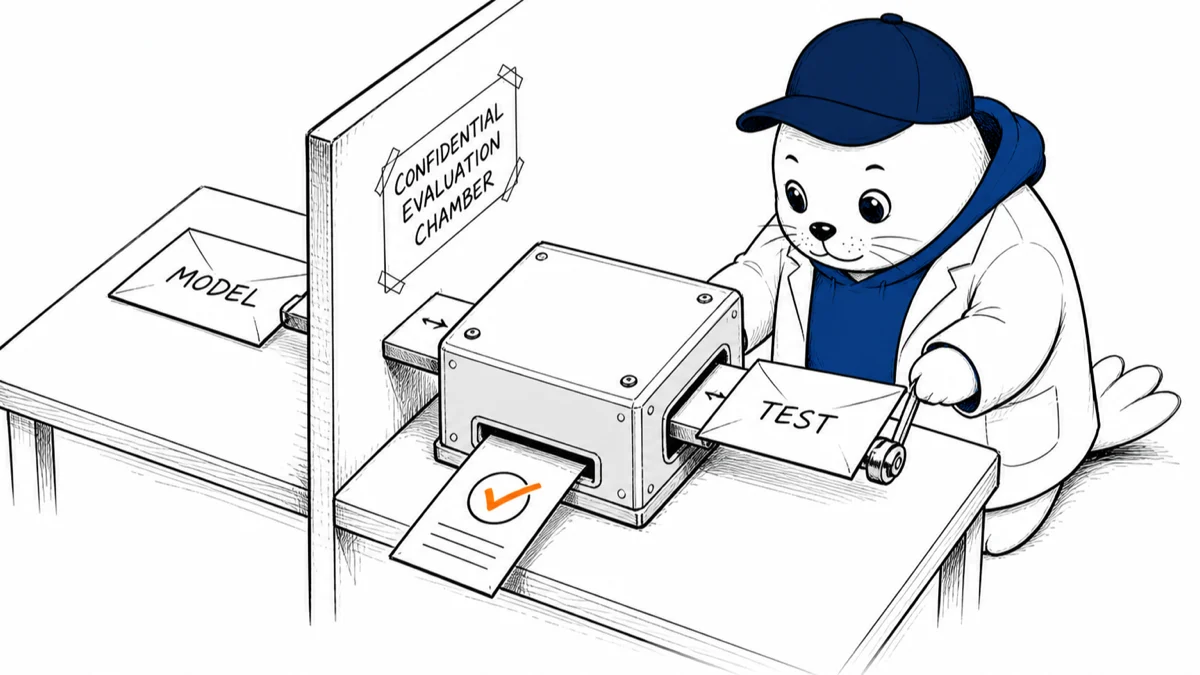
A model lab wants to keep its weights secret. An evaluator wants to keep the test secret. Google DeepMind’s new pilot tries to let both sides verify a result without handing either secret to the other.
What a double-blind AI evaluation is trying to protect
Google DeepMind announced a pilot with the Singapore AI Safety Institute, OpenMined, AVERI, and MLCommons. A proprietary Gemini Flash Lite model is evaluated against confidential benchmarks inside a protected computing environment.
The lab should not receive the hidden test prompts. The evaluator should not receive the model weights. That is the double-blind part. It addresses two reasons frontier evaluations become politically and technically difficult: benchmark leakage and model theft.
The old trust model asks both sides to surrender something
| Setup | Model provider exposes | Evaluator exposes | Main weakness |
|---|---|---|---|
| Provider runs the test | Little or no model access | Prompts or benchmark logic | The lab can learn the test and control execution |
| Evaluator receives the model | Weights or broad model access | Little benchmark detail | Model IP and security risk increase |
| Double-blind protected execution | Encrypted model for controlled execution | Encrypted or concealed test | The hardware, attestation, orchestration, and result path must all be trusted |
The third option does not remove trust. It moves trust from people and contracts into hardware, attestation, software orchestration, logging, and the rules that decide what may leave the protected environment.
How the confidential chamber is supposed to work
The pilot uses Google Cloud Confidential Space and a GPU enclave. In plain English, the model and benchmark are brought into a restricted workload whose environment can be verified before sensitive material is released. The parties then receive authorized outputs rather than each other’s raw assets.
- The evaluator prepares a confidential benchmark and execution policy.
- The model provider prepares the proprietary model artifact.
- Attestation verifies that the approved protected workload is running.
- The model and benchmark enter the chamber under their respective controls.
- Only the permitted result, logs, and evidence leave the chamber.
The security property depends on every step. A confidential GPU does not help if orchestration logs leak prompts, an output channel reveals benchmark answers, or the wrong software image passes verification.
The result needs more than a score
Google has not published technical benchmark results from this pilot. The announcement is about evaluation infrastructure, not evidence that the tested Gemini model passed a new safety or capability bar.
A useful final report should disclose at least these items:
- The attested workload identity and software versions.
- Who controlled the benchmark, model package, and release policy.
- What logs were visible to each party.
- How prompt leakage, weight extraction, and output exfiltration were tested.
- How failures, retries, nondeterminism, and interrupted runs were counted.
- Whether an independent party reproduced the attestation and result path.
Without that record, a score can be genuine while the process remains unauditable. The protocol is the product here.
Confidential tests make benchmark contamination harder
Public benchmarks are useful because anyone can inspect them. They also become training targets. Once questions, answer formats, and scoring logic circulate, a strong result can partly measure familiarity with the test rather than general capability.
Confidential evaluation helps preserve a held-out test. Double-blind execution goes further by reducing the chance that either side can quietly tune the model to the test or copy the model while running it. That should make it easier for governments and labs to share evidence without treating every evaluation as a one-off disclosure negotiation.
The word first needs a company-report label
Google describes this as the world’s first double-blind evaluation of a proprietary frontier-class AI model. That is a company-reported priority claim. The broader history of confidential computing, secure multiparty evaluation, and protected model testing is larger than one announcement.
The responsible article does not need the superlative. The pilot is interesting because it combines a named model class, a confidential benchmark, a safety institute, and an attested GPU environment in an operational evaluation. The technical report will decide how much of that can be independently verified.
A buyer checklist for confidential model evaluation
- Define which asset must remain secret: prompts, answers, weights, data, or all four.
- Specify the attestation evidence required before secrets are released.
- Minimize every output channel, including logs, metrics, errors, and temporary files.
- Separate model execution from result approval.
- Test the chamber with deliberately malicious prompts, models, and orchestration failures.
- Preserve enough evidence for an independent auditor to reconstruct the run.
If a vendor can only say that the workload ran in a confidential environment, the evaluation is not complete. Ask what was attested, who wrote the policy, and what data could leave.
My verdict: a promising protocol still needs a public audit trail
This pilot attacks a real evaluation bottleneck. Labs do not want to hand frontier weights to every evaluator, and evaluators should not reveal their hardest tests before running them. A protected chamber can narrow that conflict.
I would withhold any claim about model safety or benchmark superiority until the technical results arrive. For now, the value is the architecture and the questions it forces us to ask. Our coverage of NVIDIA AVO’s public and private ARC-AGI-3 split shows why held-out evidence matters. Our review of Claude’s automated alignment researchers shows why the monitoring record matters just as much.
Read the primary announcement
- Read Google DeepMind’s pilot announcement.
- Compare the governance problem with Australia AISI’s multi-agent governance modes.
Would you trust an AI evaluation score without a public record of the attested workload and result path?