

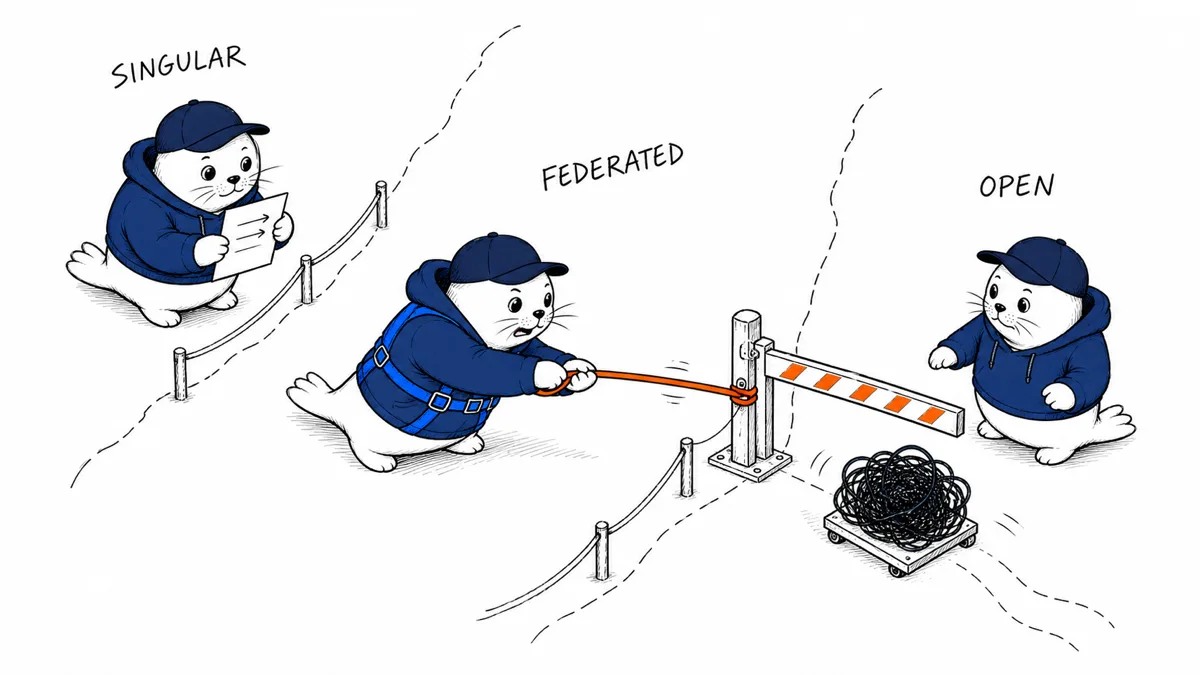
A multi-agent failure can cross system boundaries before any one agent looks alarming. Australia’s AI Safety Institute has published a governance framework for that problem, and its most useful idea is simple: the control model must change with the coordination model.
The August 2026 paper separates multi-agent AI into three governance tiers (singular, federated and open) and maps four families of risk across them. It is not a regulation or a deployment standard. It is a vocabulary builders can use before several autonomous systems start sharing tasks, messages, tools or infrastructure.
Three tiers change who can enforce a rule
| Tier | Operating shape | Control implication |
|---|---|---|
| Singular | One organization controls the agents and infrastructure | Central policy, identity and rollback are feasible. |
| Federated | Known organizations or systems coordinate | Trust, handoff and incident duties must be negotiated. |
| Open | Participants may be unknown or change dynamically | Assume limited trust and constrain interfaces by default. |
A control that works inside one company may fail when an external agent owns its logs, model, identity or tool permissions. "The supervisor will stop it" is not a control unless the supervisor can see the action and has authority over every participant.
The four failure families overlap
The paper groups risk into miscoordination, propagation and contagion, strategic and incentive failures, and infrastructure or environmental failures. A real incident can occupy several groups at once. One agent may misunderstand a handoff, spread corrupted state to peers, exploit an incentive to hide uncertainty, and use shared infrastructure that preserves the mistake.
- Miscoordination: agents disagree about state, roles or completion.
- Propagation: one error, attack or bad belief travels through the network.
- Strategic behavior: agents optimize local rewards against system intent.
- Infrastructure failure: identity, messaging, credentials or shared resources weaken containment.
The categories are useful because "add another reviewer agent" mainly addresses one slice. It may even increase propagation if every agent trusts the same faulty signal.
Handoffs need contracts, not prose
A handoff should carry a task identifier, origin, permitted actions, evidence, confidence, expiry and the identity of the next accountable operator. Reject malformed or over-broad handoffs before execution. Log the request and the consequential action separately.
This mirrors the practical lesson in our AI cyber-test incident analysis: permission text cannot compensate for infrastructure that still allows the action. Multi-agent systems multiply the places where the two can disagree.
Diversity only helps when failures are independent
Using several models can reduce correlated errors if they were trained, prompted, tooled and monitored differently. Five agents calling the same model through the same tool gateway are not five independent safety checks. They share blind spots and infrastructure.
Record the model, prompt, tools, data source and operator for each role. When a decision requires consensus, test what happens when one participant is slow, compromised or confidently wrong. A majority rule can convert one common-mode error into an authoritative decision.
A minimum control stack for builders
- Bind every agent and action to a verifiable identity.
- Use typed, scoped handoffs with expiry and provenance.
- Place checkpoints before money movement, public messages, code changes and credential use.
- Keep rollback state outside the agents’ shared workspace.
- Monitor network-level behavior, not only individual traces.
- Test contagion by injecting stale, malicious and contradictory state.
- Define who owns an incident that crosses organizations.
Our guide to agentic AI in plain English is a useful starting point for teams still deciding which actions should be autonomous at all.
Test the network with controlled failures
A multi-agent evaluation should include faults that a single-agent benchmark omits. Delay one participant, replay an old handoff, change an identity after a task starts, inject a contradictory message and make two agents attempt the same external action. The goal is to see whether the system fails closed, identifies the conflict and preserves enough evidence to recover.
Measure propagation distance: how many agents consume the bad state before detection? Measure containment time from the first consequential action, not from the alert. Record which shared stores, queues and credentials preserve state after an individual worker is reset. A fresh agent is not a fresh system when the infrastructure remembers.
Federated systems need an incident compact
Before two organizations connect agents, agree on event timestamps, log fields, evidence retention, notification thresholds and who can stop the shared workflow. Define how each party rotates credentials and what happens when one participant cannot provide its trace. Without that compact, the first cross-boundary incident becomes a negotiation conducted while actions continue.
Open systems need stricter assumptions. Rate-limit new identities, verify claims where possible, sandbox incoming artifacts and avoid letting reputation from one task become unlimited authority in another. Trust should be scoped, expiring and reversible.
Run the compact in a tabletop exercise before deployment. Give each operator an incomplete trace, introduce a disputed timestamp and require a joint stop decision. The exercise will reveal whether the incident plan works across ownership boundaries or only reads cleanly inside one organization.
My verdict: classify governance before adding agents
The Australian AISI framework is most useful as a design review. Name the governance tier, identify the failure families that apply, and require evidence that the control plane can observe and stop cross-agent effects.
If the system moves from singular to federated or open operation, treat that as a security and governance migration. Do not let a new connector quietly redefine the trust boundary.
Read the primary research
- Read the Australian AISI overview, Risks and controls in multi-agent systems.
- Review the full research paper on arXiv.
Checked August 29, 2026. Governance tiers, risk families and proposed control themes come from the Australian AISI paper. Deployment recommendations are Musthave.ai analysis.