
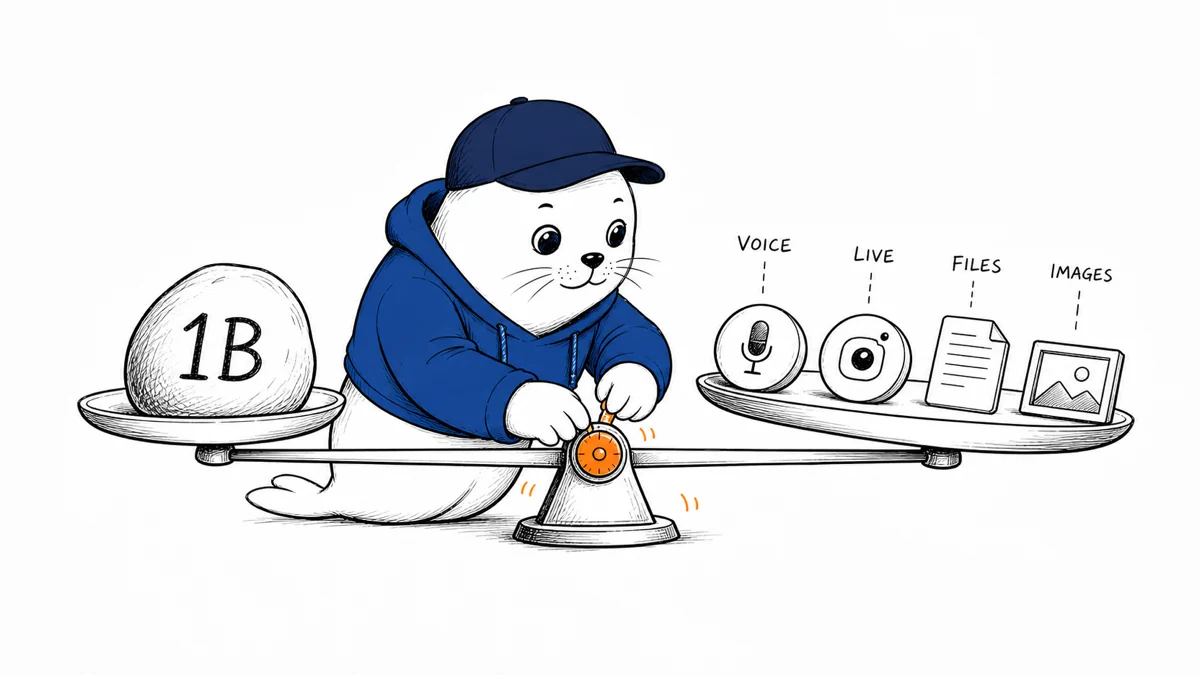
Google says the Gemini app has crossed one billion monthly active users. The round number is impressive. The more useful signal for builders is how those people are interacting: voice, camera, screen sharing, attachments, images, and actions across apps.
The Gemini 1 billion monthly users milestone arrived on August 11, less than three weeks after Google reported 950 million monthly active users during its Q2 earnings call. That is an increase of at least 50 million, or about 5.3%, between the two company updates.
That calculation is simple; its meaning is not. Google has not published a retention cohort, paid-user split, satisfaction score, or common methodology for every figure in the announcement. The numbers show distribution and activity as Google defines them. They do not prove that one billion people use Gemini every day or pay for it.
The billion-user claim is a company-reported milestone
Google calls Gemini the fastest-growing product in its history. In the July 22 earnings remarks, CEO Sundar Pichai said the app had 950 million monthly active users and that daily active users had tripled over the preceding year. The August post moves the monthly figure past one billion and adds behavior data from several surfaces.
The comparison is useful because the two figures come from the same company and refer to the Gemini app. It still needs a label: the 5.3% increase is a Musthave.ai calculation based on Google’s rounded public numbers. It is not an independently audited growth rate.
| Google-reported signal | What it suggests | What it does not prove |
|---|---|---|
| More than 1B monthly active users | Very broad distribution | Daily use, retention, or paid conversion |
| 63% talk directly to Gemini | Voice is a mainstream input | Voice-only share or task success |
| 1 in 5 Gemini Live interactions goes beyond voice | Camera and screen sharing have meaningful use | A fifth of all Gemini users use Live |
| 38% of school requests include an attachment | Files matter in education workflows | The share of all requests or all students |
| 150M+ images generated daily | Creative output has large volume | How many are kept, published, or made by unique users |
Voice is becoming an input layer, not a novelty
Google says 63% of users talk directly to Gemini, including an increasing number of voice-only users. It also says busy parents are 43% more likely to use voice for everyday tasks. The second figure is relative, and the announcement does not publish the baseline, so it should not be converted into an absolute share.
For product teams, the direction still matters. A feature designed only for carefully typed prompts is leaving a large part of the interaction model unused. Voice input needs interruption handling, concise confirmations, a visible record of what the system heard, and a safe handoff to touch when an action becomes consequential.
This matters even more as Google replaces older voice workflows. Our guide to the Google Assistant shutdown and Gemini migration explains why a voice interface change can break routines that looked stable.
Gemini Live is moving from conversation to shared context
One in five Gemini Live interactions goes beyond voice, according to Google. Users are turning on a camera or sharing a screen for real-time help. That can make an assistant more useful because the user no longer has to describe every object, error message, or interface state.
It also changes the privacy surface. A camera can capture people and locations outside the task. A shared screen can reveal credentials, customer data, private messages, or unrelated tabs. Builders should make capture state obvious, keep the shared region narrow, and let the user stop or redact context without ending the whole session.
The camera button is the easy part. The product work is a controlled context window: what the model can see, when it can see it, how long that context survives, and what it may do with the result.
Attachments are part of the learning workflow
Google says 38% of school requests include an attachment. The denominator is school requests, not all Gemini prompts. Within that scope, the figure is still large enough to reject the idea that learning assistants are mainly chatbots answering isolated questions.
A student may upload a worksheet, photo, diagram, PDF, or draft. The useful response should point to the supplied material, distinguish what came from the file from what came from the model, and avoid inventing a missing page or unreadable detail. Our overview of Gemini’s learning loop shows how audio, study guides, and source material are converging into one workflow.
Image volume is huge, but volume is not usefulness
Gemini now generates more than 150 million images each day, Google says. That is evidence of scale, not a quality score. The announcement does not tell us how many images are saved, edited, published, regenerated, or produced by unique users.
Creative teams should measure accepted outputs rather than generations. A practical ledger tracks first-pass acceptance, correction rounds, text accuracy, subject consistency, rights review, and time to a usable asset. Our hands-on comparison of Midjourney, ChatGPT Images, Gemini, and Ideogram separates those jobs instead of declaring one universal winner.
Actions across apps make distribution operational
Google says Gemini on Android can automate actions across more than 40 popular apps, including booking rides and reserving tables. It also reports more than 100 million active users on iOS and says macOS power users prompt about twice as frequently as users on other surfaces.
These figures describe different populations, so they should not be combined into one funnel. Together they show the distribution strategy: Gemini is not confined to a destination chat app. It reaches users through voice, live context, files, creative tools, mobile actions, and desktop sessions.
That favors products that can accept structured context and produce reviewable actions. It also raises the cost of a mistake. When an assistant can move from an answer to a booking or message, confirmation, receipts, undo, and permission scope become product features.
Five builder decisions hidden inside the milestone
- Support more than text. Prioritize the input modes your users already have: voice, images, screen context, and files.
- Keep provenance visible. Show which answer came from an attachment, live camera frame, app data, or model inference.
- Design the confirmation. Make actions reviewable before they send, spend, publish, book, or delete.
- Measure accepted outcomes. Count successful tasks and usable creative outputs, not prompts or generations alone.
- Segment the denominator. Voice users, school requests, Live interactions, image jobs, iOS users, and app actions are different cohorts.
What the milestone cannot tell us
Monthly active users do not reveal frequency, retention, willingness to pay, or satisfaction. A user who opens Gemini once can belong to the same monthly total as someone who uses it all day. The August post also presents rounded figures and several behavior statistics without a shared public methodology.
The responsible reading is therefore narrow. Google has built one of the world’s largest AI assistant distributions, and its own data says multimodal inputs are a material part of that use. Product-market fit for a particular workflow still has to be measured locally.
My verdict: build for the input mix, not the billion
The Gemini one-billion milestone matters because distribution can turn a new interaction pattern into a default quickly. The clearest signals are not the ranking claim or the round number. They are the evidence that people speak, show, share, attach, generate, and ask the assistant to act.
I would use those signals to redesign one real workflow around multimodal context and a strong confirmation step. I would not use them to claim that every user is retained, satisfied, or ready to pay. Scale changes the opportunity. It does not remove the need for a good denominator.
Read the primary sources
- Read Google’s one-billion Gemini app update.
- Compare Google’s Q2 2026 earnings remarks, which reported 950 million monthly active users on July 22.
Which part of your product still assumes every useful prompt begins at a keyboard?
Checked August 14, 2026. Adoption and behavior figures are company-reported by Google and have not been independently audited by Musthave.ai. The 50 million and 5.3% comparisons are Musthave.ai calculations using Google’s rounded 950 million and one-billion monthly figures. Statistics in the August post use different scopes and should not be combined into a single user funnel.