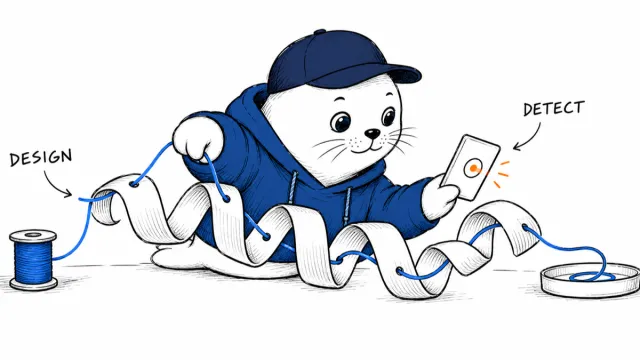

Watch what Google is actually building and a pattern jumps out: it doesn’t just want to answer your questions, it wants to own how you learn, from the first summary to the final self-quiz. And it’s assembling that entire loop inside NotebookLM and Gemini, piece by piece. Here’s what’s there and how to use it.
The strategy hiding in the features
Individually, these look like neat tricks. Together, they’re a land grab for your learning. Think about the steps you go through to actually understand something: gather sources, digest them, review the key points, and test whether it stuck. Google is now building a tool for every one of those steps, grounded in your material, not the open web.
That grounding is the strategic core. Because these tools work from the documents you provide, they hallucinate far less and cite where each claim came from. That makes them trustworthy enough to actually study from, which is exactly what turns a novelty into a daily habit.
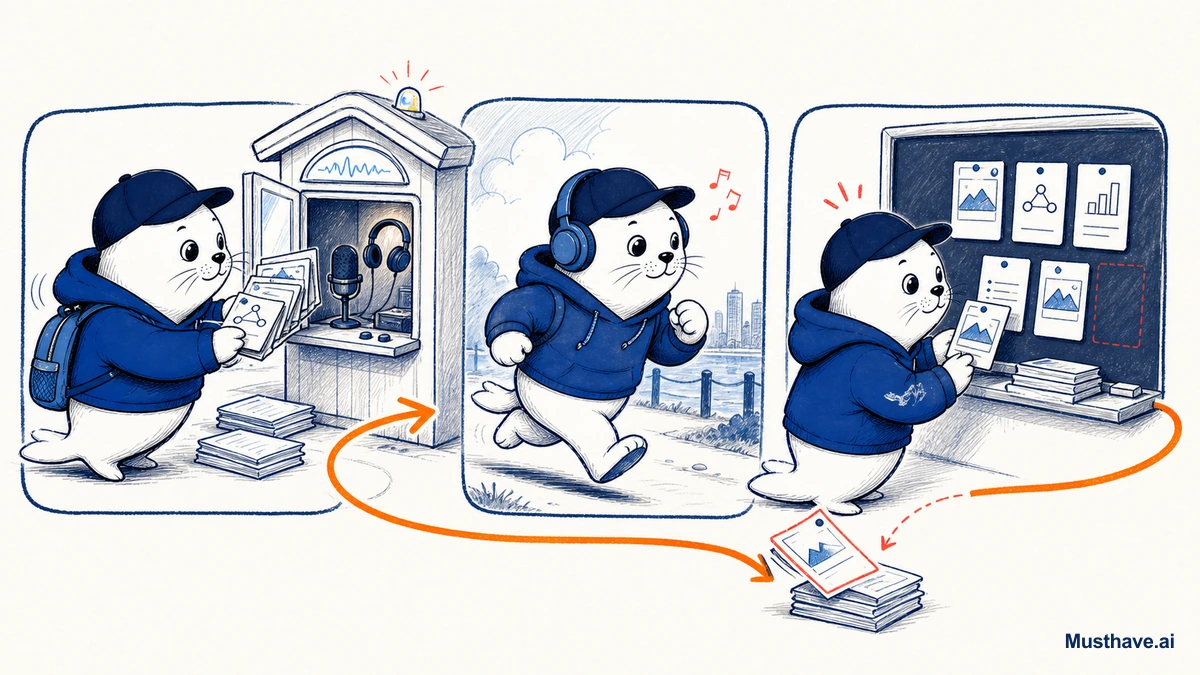
Audio Overviews: your material as a podcast
The feature that hooked everyone is Audio Overviews. Feed in your sources and it generates a natural-sounding conversation about them, a two-host “Deep Dive” that unpacks and connects ideas, or “The Brief,” a single-speaker summary in under two minutes. There are even “Critique” and “Debate” formats now.
The genius is the format shift. Turning a dense stack of notes into a podcast you can absorb on a commute meets your brain where it already is. And a newer interactive mode lets you join the conversation with your voice, interrupt the hosts, ask them to explain something differently, and get answers still grounded in your sources.
Video Overviews and the study toolkit
Google didn’t stop at audio. Video Overviews turn your sources into narrated explainer videos, with cinematic versions adding animation and richer visuals, a gift for visual learners. And underneath the flashy stuff sit the workhorses: study guides and mind maps generated straight from your material, plus an upgraded studio that lets you keep several of these outputs in one notebook and multitask between them.
That’s the full learning loop in one place: read it, hear it, watch it, map it, quiz yourself on it.
And it feeds the whole Gemini ecosystem
Here’s where the strategy clicks shut. You can now mount your NotebookLM notebooks directly into the Gemini app and ask questions that span several of them at once, with Gemini synthesizing across everything. So your carefully-built knowledge base doesn’t stay siloed, it becomes part of the assistant you use everywhere. Google isn’t building a study app; it’s making your learning a permanent, connected part of its ecosystem.
How to actually use it
Skip the strategy talk and just try it, it’s genuinely useful and free to start.
- Students: load your notes and readings, generate a study guide and an Audio Overview, and review hands-free before an exam.
- Professionals: drop in reports or documentation and get a briefing you can trust, with citations.
- Anyone with a scary PDF: the manual, the contract, the dense guide you keep avoiding, let it explain the thing to you.
Create a notebook, add three or four real documents, and generate an Audio Overview. Ten minutes in, you’ll feel whether it fits how you learn.
The honest caveat
One reminder: grounded doesn’t mean infallible. It’s far more reliable than a model riffing from memory, but for anything high-stakes, still check the cited source yourself. Used that way, this is one of the most genuinely useful things Google has shipped, and yes, it also happens to make Google the place where your learning lives. Convenient for you, strategic for them. Both can be true.
A four-step study routine that actually works
Here’s a concrete routine that turns NotebookLM from a novelty into a study system. Step one: dump all your sources for a topic into one notebook. Step two: generate a study guide and read it to get the shape of the material. Step three: generate an Audio Overview and listen to it on a walk or commute, passive review that sticks. Step four: use the chat to quiz yourself, asking it to test you on the hard parts and explain anything you miss, with citations. Gather, digest, review, self-test, the full learning loop, grounded in your own material instead of the open web.
Would you actually study from an AI-generated podcast of your own notes? Tell me what you’d load in first in the comments.
Verification sources and related guides
Primary reference: Google NotebookLM Help. This is an official provider source. Treat performance, adoption, and product claims as company-reported unless the article identifies an independent check.