
Gemini 3.8 Flash looks like an easy model-ID swap. The introductory API price is unchanged from 3.7 Flash, the context window is still just over one million tokens, and Google calls the release production ready. The surprise is hiding in completed-task cost, not the price table.
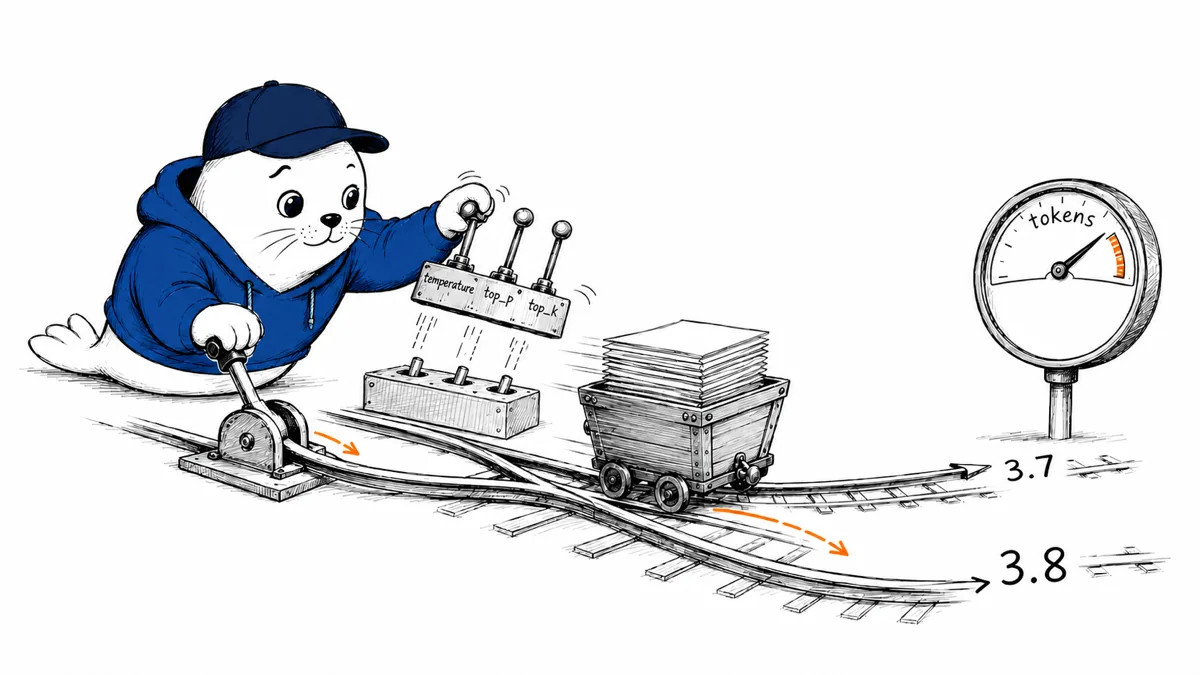
Google says the new model can spend more tokens by design on longer and more difficult jobs. It also rejects several controls that older integrations may still send. A migration can therefore fail in two different ways: the request breaks, or it succeeds while consuming more reasoning than your budget expected.
Google introduced Gemini 3.8 Flash on September 2, 2026, alongside a restricted Gemini 3.8 Flash Cyber variant for trusted defensive-security work.
The price stayed still while the model changed
| API item | Through Dec. 31, 2026 | From Jan. 1, 2027 |
|---|---|---|
| Input, per 1M tokens | $0.75 | $1.50 |
| Output, per 1M tokens | $3.75 | $7.50 |
| Input context | 1,048,576 tokens | |
| Maximum output | 65,536 tokens | |
The unit price matches the introductory 3.7 Flash rate. That does not make the models cost-equivalent. If a job used 20,000 input tokens and 4,000 output tokens on both models, the introductory token charge would be about 3 cents. If 3.8 uses 8,000 output tokens to finish the same job, that example rises to about 4.5 cents before caching, tools, or grounding.
The numbers are small in one run and meaningful at scale. At 100,000 runs, the extra 1.5 cents becomes $1,500. This is why I would track cost per verified completion, not cost per million tokens. Our earlier review of Gemini 3.7 Flash retry cost reached the same conclusion from the other direction: a cheaper run is not cheaper when it needs repair.
The migration guide contains breaking changes
Google’s latest-model guide is more useful than the benchmark chart. It lists request fields that should be removed rather than carried forward.
| Old integration choice | Gemini 3.8 Flash action | Failure to test |
|---|---|---|
| temperature, top_p, top_k | Remove them | Request rejection or unintended behavior |
| thinking_budget | Use thinking_level | Invalid configuration |
| minimal reasoning | Choose low, medium, or high | Unsupported setting |
| candidate_count | Remove it | Unsupported multi-candidate request |
| Prefilled model turn | Remove it | Conversation-format error |
| Empty final user turn | Send a non-empty turn | Request validation failure |
Do this in a compatibility branch. Log the HTTP status, finish reason, tool calls, reasoning level, input tokens, output tokens, wall time, and verifier result for both models. A successful 200 response is only the first check.
Benchmark wins are company-reported, not your workload result
Google reports gains across coding, finance, legal tasks, and a 54.9% score on Humanity’s Last Exam Verified. Those figures describe Google’s evaluation setup. They do not tell you whether the model follows your schema, recovers from your tool errors, or stops before wasting another 20,000 tokens.
Gemini 3.8 Flash supports functions, structured output, code execution, file search, URL context, Google Search and Maps grounding, plus a preview of computer use. That breadth makes system testing more important. Our report on Gemini Managed Agent hook failures is a useful reminder that model quality and control-plane reliability are separate questions.
Flash Cyber belongs in a separate access policy
Gemini 3.8 Flash Cyber uses the same core model with more permissive cybersecurity mitigations. Google is not opening it as a normal public endpoint. Access goes through Fairwind for selected government teams, critical-infrastructure defenders, and software maintainers.
Google reports internal and partner improvements in vulnerability research and patching. These are company-reported results. The public record does not turn them into a blanket claim that the model is safe for unrestricted offensive work. If your team gains access, keep its credentials, network routes, audit trail, and approval path separate from ordinary application traffic.
My migration test uses ten repeated jobs
- Choose ten production jobs with a machine-checkable finish line.
- Run each job on 3.7 and 3.8 with the same tools, data, timeout, and retry policy.
- Use low reasoning first, then raise it only where quality misses the verifier.
- Repeat each job enough times to expose variance and false completion.
- Compare verified completion rate, total tokens, latency, retries, human repair minutes, and final cost.
A model wins an assignment only when the whole trajectory improves. The Musthave.ai model selection guide explains how to turn that result into a routing decision instead of a site-wide migration.
Set an explicit rollback threshold before the test begins. For example, stop the traffic shift if verified completion falls by more than two percentage points, median output tokens rise by 25%, or tool errors exceed the 3.7 baseline. A prewritten threshold prevents a few impressive answers from overruling the aggregate result.
Keep prompts and fixtures versioned. If the evaluator, tool schema, or source data changes between runs, you are no longer measuring the model migration. You are measuring several changes at once.
My verdict: migrate the request schema before the traffic
Gemini 3.8 Flash is worth testing now. It is generally available, broadly multimodal, and priced aggressively through the end of 2026. The safest first step is boring: clean the request schema, capture token and tool traces, and move a small percentage of traffic.
Do not approve the migration because the unit price stayed flat. Approve it when the model completes your work with fewer repairs at a cost you can explain.
Read the primary documentation
- Read Google’s Gemini 3.8 Flash and Flash Cyber announcement.
- Review the Gemini 3.8 Flash model specification.
- Follow Google’s latest-model migration guidance.
- Check the current Gemini API pricing page.
Checked September 2, 2026. Prices, limits, compatibility changes, features, and benchmark figures come from Google. Benchmark and partner-performance numbers are company-reported. Cost examples and the migration test are Musthave.ai calculations and analysis.