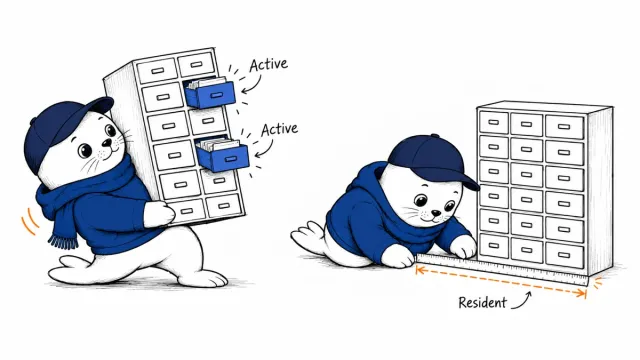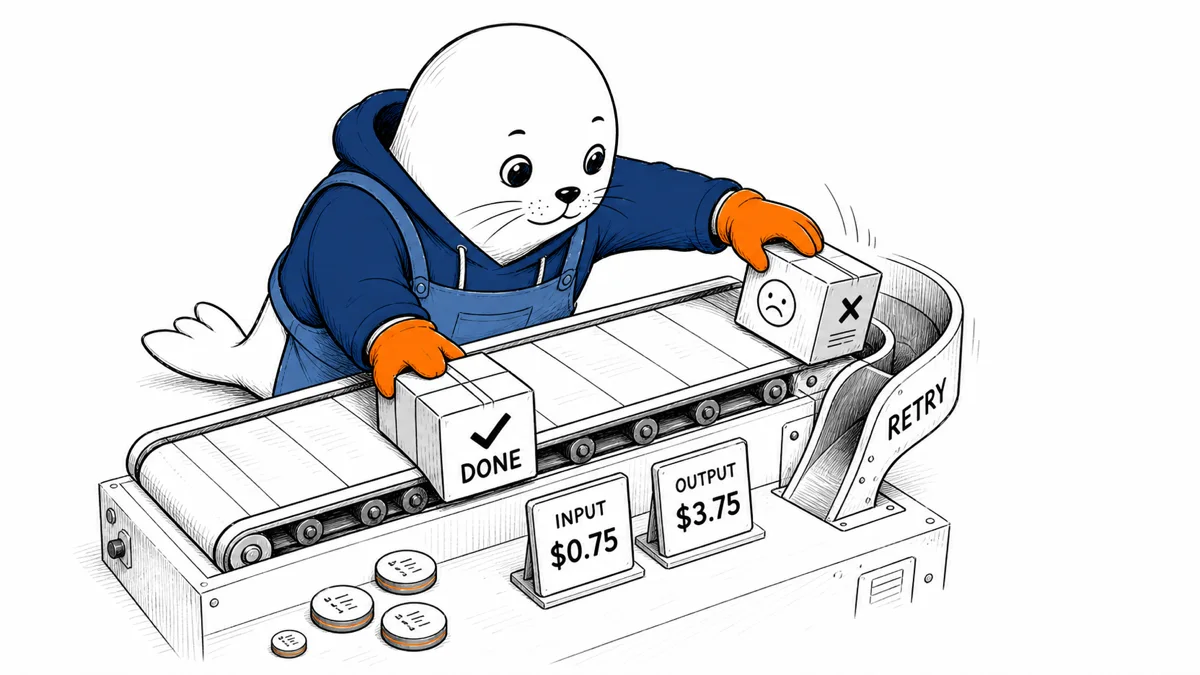
The cheapest model on a routing chart can become expensive when an agent needs a second, third, or fourth attempt.
Google launched Gemini 3.7 Flash on August 13 as its new Flash model for coding and agent work. Through the end of 2026, Google lists an introductory API price of $0.75 per million input tokens and $3.75 per million output tokens. The company also reports meaningful gains over Gemini 3.6 Flash across five coding, web-development, document, and automation evaluations.
Those are useful launch facts. They are not a production bill. Builders still need to measure how many attempts, tool calls, and output tokens it takes to produce work that can actually ship.
The launch price is simple; the workload bill is not
At the introductory rate, a request with 10,000 input tokens and 2,000 output tokens costs about $0.015: $0.0075 for input and $0.0075 for output. Ten thousand identical requests would therefore cost $150 before caching, tools, retries, or any other platform charges.
| Meter | Introductory price | Example usage | Example cost |
|---|---|---|---|
| Input | $0.75 / 1M tokens | 10,000 tokens | $0.0075 |
| Output | $3.75 / 1M tokens | 2,000 tokens | $0.0075 |
| Total | Not applicable | One 12,000-token request | $0.015 |
Google says the introductory price runs through the end of the year and is half the original Gemini 3.6 Flash price. Treat that deadline as a budgeting boundary. A workflow that only works at the promotional rate needs a second cost model before 2027.
Google reports gains across five different workloads
Google’s launch table compares Gemini 3.7 Flash with Gemini 3.6 Flash. These are company-reported results, and each benchmark measures something different. They should guide a test set, not replace one.
| Evaluation | Gemini 3.6 Flash | Gemini 3.7 Flash | Reported change |
|---|---|---|---|
| FrontierCode 1.1 Main | 34.4% | 43.6% | +9.2 points |
| DeepSWE v1.1 | 49.0% | 65.3% | +16.3 points |
| WebDev Arena | 1538 Elo | 1588 Elo | +50 Elo |
| GDP.pdf | 22.0% | 34.0% | +12.0 points |
| AutomationBench | 17.0% | 30.4% | +13.4 points |
The broad direction is more interesting than any single score. Coding, repository work, web development, document handling, and automation all moved upward in Google’s tests. That makes Gemini 3.7 Flash a credible candidate for a mixed agent queue, provided the queue resembles the work you actually run.
A more diligent agent can spend more to finish
Google describes the model as more diligent and better at instruction following and tool use. That can improve completed work, but it can also mean longer reasoning, more tool calls, or more output. The lower token rate does not guarantee a lower cost per accepted task.
This is the same distinction we use in our guide to choosing an AI model without losing a weekend to benchmarks: quality, latency, and cost have to be measured on one production-shaped task set. A model that saves 40% per attempt but needs twice as many attempts did not save money.
Retries can erase the headline saving
Consider a simplified queue that needs 10,000 accepted results. If every attempt uses the same 10,000 input and 2,000 output tokens, the retry rate changes the bill quickly.
| First-pass acceptance | Attempts needed for 10,000 accepted jobs | Estimated token cost |
|---|---|---|
| 100% | 10,000 | $150.00 |
| 95% | 10,526 | $157.89 |
| 90% | 11,111 | $166.67 |
| 80% | 12,500 | $187.50 |
The useful metric is therefore cost per accepted job. Log the initial request, every repair attempt, tool usage, final acceptance decision, and elapsed time. Our review of provider and endpoint variance explains why the same model name is not enough evidence when the serving path changes.
The rollout reaches APIs, Android Studio and Gemini Spark
Google says Gemini 3.7 Flash is available through the Gemini API in Google AI Studio and Android Studio, in Google Antigravity, and through the Gemini Enterprise Agent Platform and Gemini Enterprise app. The company is also making it the first model in Gemini Spark for Google AI Pro and Ultra subscribers across more than 160 countries.
Google also says the release includes updated safeguards for chemical, biological, radiological and nuclear risks and for cyber offense. The linked model card is the place to inspect those evaluations and limitations before using the model in a sensitive workflow.
Use a four-part acceptance test before routing traffic
- Build a real task set. Use repository fixes, document extraction, browser work, and automation steps from your own queue.
- Hold the budget constant. Give each candidate the same tool permissions, stop rules, retry allowance, and maximum output.
- Score accepted work. Count correct outcomes, reviewer interventions, retries, latency, and total tokens rather than the first response alone.
- Keep a fallback. Route security-sensitive, ambiguous, or repeatedly failing work to a stronger model or a person.
For a broader routing framework, compare this release with our practical analysis of DeepSeek V4 Pro’s peak and off-peak pricing. Different price schedules reward different queue designs.
My verdict: test it as a workhorse, not a bargain
Gemini 3.7 Flash deserves a place in a production bake-off. Google’s reported gains are broad, the introductory price is aggressive, and the rollout reaches the surfaces builders use. But the buying decision should wait for one number Google cannot publish for you: the cost of an accepted result in your system.
Read the primary record
- Read Google’s Gemini 3.7 Flash announcement.
- Review the Gemini 3.7 Flash model card.
- Check the Gemini API model guide before deployment.
Published August 13, 2026. Prices, availability, benchmark values, and safety statements are attributed to Google. Cost examples and percentage-point changes are Musthave.ai calculations.