

Anthropic has published unusually specific numbers about AI inside its own frontier lab. The numbers are useful, but only after their denominators are restored.
In an August 2026 snapshot, Anthropic AI R&D measurement classified Claude as the lead contributor on 26% of covered work and as a collaborator or lead on more than 90%. Anthropic also reports approximately 30,000 agents active concurrently on a covered internal platform and online monitoring across more than one billion August decisions.
Read the reported numbers with their scope
| Reported figure | What it measures | What it does not establish |
|---|---|---|
| 26% | Covered AI R&D work where Claude is classified as lead | 26% of all company work or full task autonomy |
| More than 90% | Covered work where Claude collaborates or leads | Independent completion without human contribution |
| About 30,000 | Concurrent agents on one covered internal platform | Unique agents, useful completions or total company agent activity |
| 0.002% | Share of more than one billion monitored decisions that were blocked | The total harmful-attempt rate or false-negative rate |
| 6% and 12% | Safety compute in one July week, overall and within AI-driven AI R&D | A stable annual budget share |
Lead, collaborate and autonomy are different categories
The most important sentence in Anthropic’s report may be the absence of a fully autonomous measured subset. A model can lead a task while a human chooses the problem, supplies context, reviews intermediate work or approves the final result. Combining collaboration and lead work into a figure above 90% demonstrates broad participation, not broad independence.
A useful disclosure therefore needs a task unit. Is the unit a code change, an experiment, a document, a decision, an hour of work or a project milestone? Without that unit, percentages can be compared inside one methodology but not safely compared across labs.
The agent count is a concurrency measure
Approximately 30,000 concurrently active agents sounds like a workforce number, but concurrency is infrastructure load. One durable task may spawn multiple agents, retries or short-lived branches. The operational questions are how many tasks completed, how many required correction, what resources were consumed and which failures escaped monitoring.
A low block rate needs a denominator and a detection model
Anthropic says online monitoring covered all actions on the platform and blocked 0.002% of more than one billion August decisions. That indicates broad monitoring coverage on the platform. It does not reveal how many unsafe decisions were missed, how many blocks were false positives or how severe the blocked events were.
- Publish the policy categories that can trigger a block.
- Report precision and recall from audited samples where feasible.
- Separate connection, planning, tool-use and output decisions.
- Describe appeals, overrides and post-incident review.
- Disclose which internal platforms are outside the measurement.
Compute allocation is a snapshot, not a permanent ratio
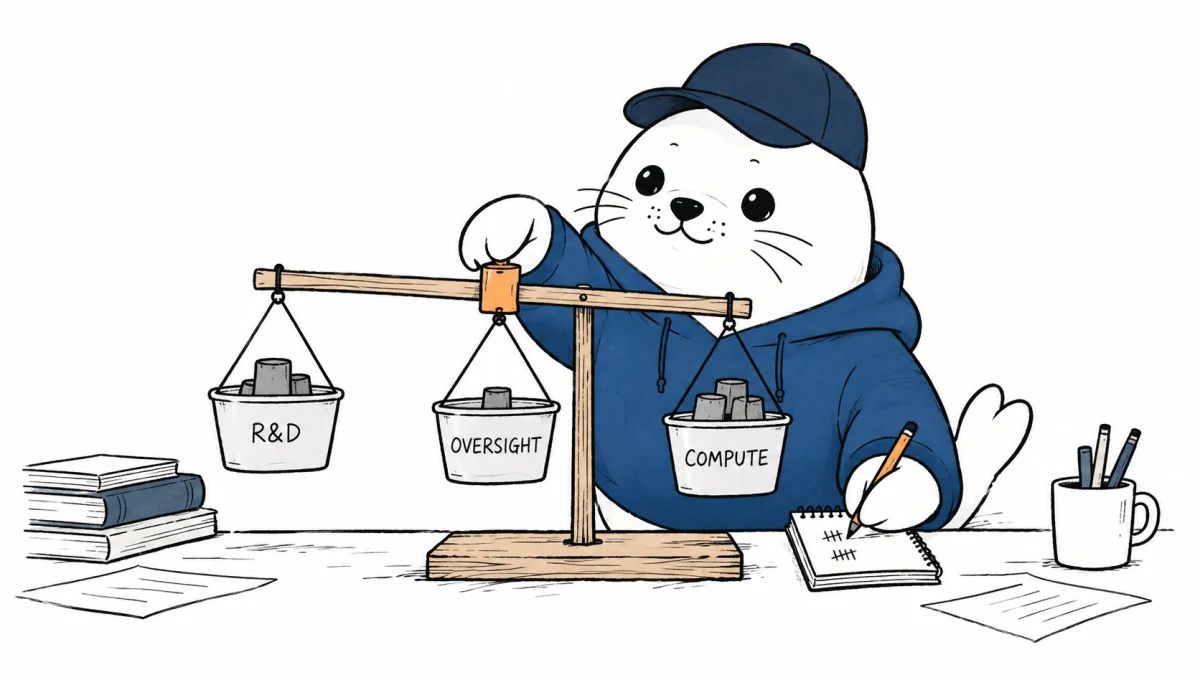
Anthropic reports that about 6% of AI R&D compute in a one-week July snapshot went to safety, rising to about 12% within AI-driven AI R&D. Both figures can be true because the second uses a narrower denominator. Neither should be described as an annual spending commitment without a longer time series.
The proposed transparency framework is the real product
Anthropic groups disclosure around AI-led AI R&D, oversight of internal agents and compute allocation. That structure is more valuable than a single automation percentage because it connects capability, operational scale and safety resources. The company also proposes external verification, but the checked figures remain company-reported and use Anthropic-designed classifications.
Our earlier analysis of Anthropic’s frontier-development pacing proposal explains why embedded evaluators matter. The Claude workplace creation guide shows a much lower-risk surface where adoption can be judged through accepted artifacts instead of frontier-lab automation claims.
Five fields every frontier lab should publish
- The unit of work and inclusion criteria.
- The autonomy taxonomy and examples at each level.
- The platforms, dates and teams covered.
- Monitoring error analysis, not only blocked-event counts.
- Independent verification status and the verifier’s access.
The practical verdict
Anthropic’s disclosure is a useful move toward measurable frontier-lab transparency. The 26% figure is not a claim that Claude autonomously performs one quarter of all research, the 30,000 figure is not a headcount and the 0.002% block rate is not a complete safety score. The report becomes most valuable as a proposed measurement framework that other labs and external verifiers can challenge.
Primary source
Checked September 18, 2026. Every quantitative result above is company-reported. Methodology interpretation and recommended disclosure fields are MustHave.ai analysis.