

Noetive has emerged from stealth with a $41 million seed round to build AI systems for the physical economy. The funding and investor roster are concrete. The product, customer results and technical performance remain mostly undisclosed.
The company says Eclipse led the round, with participation from Craft Ventures, The Westly Group, Swish Ventures, Factory, Incite, Gigascale Capital, Operator Partners and Liquid 2 Ventures. Noetive is working with a curated group of design partners across physical industries, but it has not named public customers or released pricing and benchmark data.
Start with what Noetive has actually confirmed
| Claim | Evidence status | What is missing |
|---|---|---|
| $41 million seed round | Announced by Noetive with named investors | Public financing documents were not cited |
| AI for physical industries | Core company positioning | A generally available product specification |
| Curated design partners | Company says programs are active | Named customers and measured outcomes |
| Self-improving systems | Product vision | Technical evaluation and safety boundaries |
| Intelligence of record | Strategic category claim | Proof that it becomes the authoritative operating layer |
The physical economy is not one software market
Factories, construction sites, warehouses, energy systems and logistics networks all connect digital plans to expensive physical outcomes. They differ in sensor quality, regulation, equipment age, failure cost and how quickly a human can intervene. A platform that serves this market has to adapt to local constraints without hiding uncertainty behind a single automation score.
Why world models are attractive here
Noetive describes a path toward systems that learn how a physical operation changes over time, predict consequences and improve decisions from feedback. In principle, a world model can help schedule equipment, detect process drift, simulate alternatives and identify a plan that satisfies cost, safety and throughput constraints.
The hard part is closing the loop. Feedback from the physical world can arrive late, reflect hidden causes or reward behavior that raises long-term risk. “Self-improving” therefore needs explicit limits: who approves a policy change, what data qualifies as evidence, how a new policy is tested, and how the system returns to a known safe state.
What $41 million can buy before scale
- Deep integrations with industrial data, planning and control systems.
- Simulation and evaluation environments for rare, costly failure cases.
- Field teams that can map workflows with design partners.
- Security, compliance and audit controls for operational deployments.
- Model and systems engineering that can run under latency and connectivity constraints.
The size of the round reflects the cost of building around real operations, but capital is not a substitute for repeatability. The important funding milestone will be whether one deployment pattern transfers across sites without rebuilding the system from scratch.
Five proof points to watch next
- A named workflow with a baseline and measured economic outcome.
- A clear division between recommendation, simulation and autonomous control.
- A description of the data sources, update frequency and missing-data behavior.
- A safety case that covers rollback, human override and distribution shift.
- Evidence that the same product works across more than one customer environment.
How Noetive differs from model-first startups
Noetive is selling an operational thesis rather than a public foundation model. That is different from TypeSafe Jev's typed decision model, which exposes a defined model interface, benchmark method and price. It also differs from infrastructure stories such as NVIDIA DSX, where a named deployment supplies at least one measured power and throughput result.
The information-of-record ambition
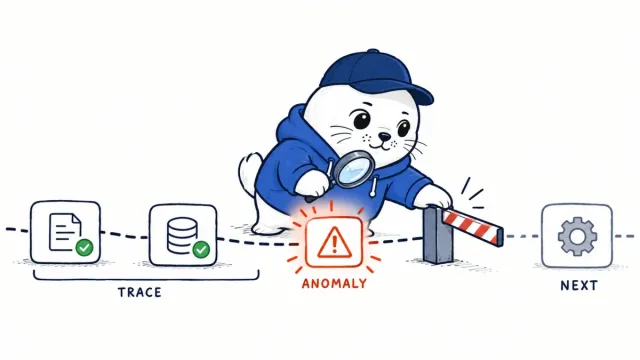
Noetive wants to become an “intelligence of record” for physical operations, analogous to how a system of record stores authoritative business data. To earn that position, its recommendations must be traceable to source data, constraints, model versions and approvals. Without lineage, an intelligence layer becomes another dashboard whose answers cannot safely control real work.
The practical verdict
Noetive has enough capital and industrial backing to pursue a difficult market, and design partnerships are the right starting point. The announcement does not yet show which product has been built or whether the system improves a physical operation. The company becomes a reference case when it publishes a bounded workflow, independent customer result and safety model that others can evaluate.
Primary source
Checked September 16, 2026. Funding, investor, product and design-partner statements are company reported. Noetive has not publicly disclosed customer names, pricing or independent technical evaluations.