

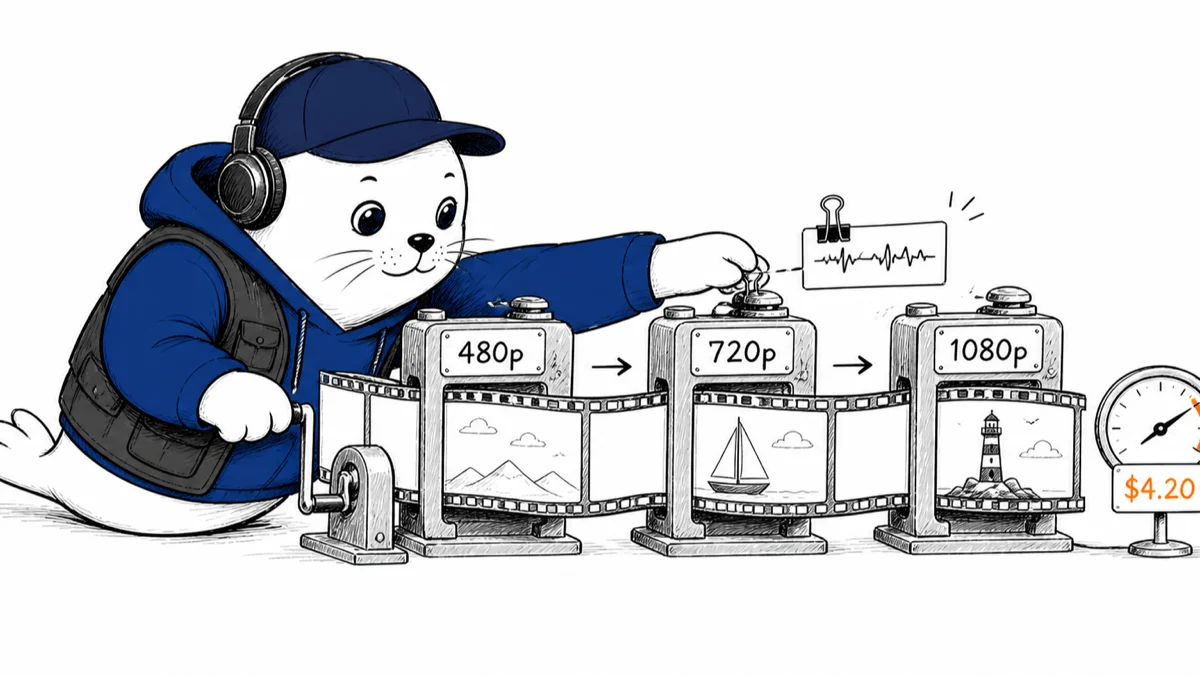
Wan 3.0 can turn one API request into a 30-second 1080p video with dialogue, music, and reference media. At Alibaba’s promotional rate, that request costs about $4.20. The usable clip will usually cost more.
Wan 3.0 is a production API, not an open-weight release
Alibaba Cloud Model Studio has made Wan 3.0 generally available through its API. The official release covers text-to-video, reference-driven generation, editing, extension, native sound, and clips from 2 to 30 seconds at 30 frames per second.
That availability needs a careful label. The official Wan Hugging Face organization does not currently publish Wan 3.0 weights. Builders can use the hosted API, but they should not describe this release as open source or assume they can run the same model locally.
The reference budget changes the workflow
The documentation allows a broad multimodal package: up to 10 images, 5 videos, and 5 audio clips, subject to the documented file, duration, and total-input limits. Wan 3.0 can also work with first and last frames, edit an existing clip, or extend a sequence.
This is the part I find more useful than another benchmark chart. A creator can provide a character reference, a location, a movement example, and an audio cue in one job. The model has more evidence to follow, but every reference also introduces a new way to create conflict.
- Use one image to lock the character’s face and clothing.
- Use a second image only when the environment or product needs its own reference.
- Add a motion video when the movement is hard to describe, not as decoration.
- Use audio references to define rhythm or voice intent, then verify rights and timing separately.
- Remove any reference that competes with the primary subject.
A 30-second clip costs $1.05 to $4.20 before retries
| Resolution | Promotional rate per second | 30-second request | Published list rate per second |
|---|---|---|---|
| 480p | $0.035 | $1.05 | $0.05 |
| 720p | $0.07 | $2.10 | $0.10 |
| 1080p | $0.14 | $4.20 | $0.20 |
The headline cost is only the first successful API response. If a usable 1080p result takes four attempts, generation alone becomes $16.80 at the promotional rate. Add human review, editing, caption correction, storage, and delivery, and the commercial cost is higher again.
Cost per accepted clip = request cost × attempts per accepted clip + review and post-production cost.
Track attempts per accepted clip by workflow. Product shots, dialogue scenes, character continuity, and abstract motion will not have the same acceptance rate.
720p is the sensible default test
An independent hands-on review from Deep Dream Generator used 11 original generations and described 720p as the practical quality and cost balance. That is useful evidence, but it is still one platform’s test with a limited sample. It does not establish a universal quality winner.
I would begin at 720p for prompt, reference, timing, and audio tests. Move to 1080p only after the shot recipe is stable. Paying the highest rate while the prompt is still changing is the video equivalent of printing every rough draft on expensive paper.
Runway gives developers a second route
Runway’s developer API added Wan 3.0 on August 26 under model ID wan3. Its changelog lists up to 30-second generation and resolution-based credit rates: 5 credits per second at 480p, 10 at 720p, and 20 at 1080p.
That can simplify a multi-model production stack if you already use Runway’s API, but credits make cost comparison less obvious. Convert credits into the dollar cost of your actual account before choosing the route. Also compare queue behavior, available reference inputs, retention, and failure handling rather than assuming the same model name means the same complete service.
Region and output lifetime are production requirements
Alibaba’s sample documentation uses the Singapore region and warns that the endpoint, API key, and workspace must belong to the same region. Availability varies by model and geography. Check the model table for the region you plan to use before building the integration.
Generated output URLs remain valid for 24 hours. Download accepted assets into your own controlled storage as part of the job. A production workflow that leaves the final video on a temporary URL is incomplete.
Store the prompt, reference file hashes, model route, region, request ID, output, and reviewer decision together. That record turns a good clip into a reproducible production asset instead of a lucky generation nobody can explain.
A six-shot acceptance test
- A single subject walking across a stable background.
- The same character speaking one short line with native audio.
- A product interaction with one image reference.
- A camera move guided by a short motion reference.
- A first-frame and last-frame transition.
- An edit or extension of a clip you already approved.
For every shot, record request cost, latency, accepted duration, identity consistency, text errors, audio timing, and whether post-production repaired or rejected the output. That evidence will tell you more than a demo reel.
My verdict: buy references and retries before 1080p
Wan 3.0 is interesting because it packages longer video, native audio, and a large reference set into one production API. The obvious mistake is to start at maximum resolution and judge the service from one prompt. Stabilize the reference package at 720p, measure retries, then decide whether 1080p earns its higher cost.
Compare this workflow with our coverage of Gemini Omni 1.1 Flash video migration and EVOKE’s external video memory. For image-first creative work, our Midjourney, ChatGPT Images, Nano Banana, and Ideogram comparison covers a different production decision.
Read the documentation
- Review Alibaba Cloud’s Wan 3.0 release page.
- Check the Wan 3.0 generation guide and regional model table.
- See Runway’s API changelog.
- Read the independent 11-generation test with its stated scope.
Which six shots would you use to decide whether Wan 3.0 belongs in your production stack?