

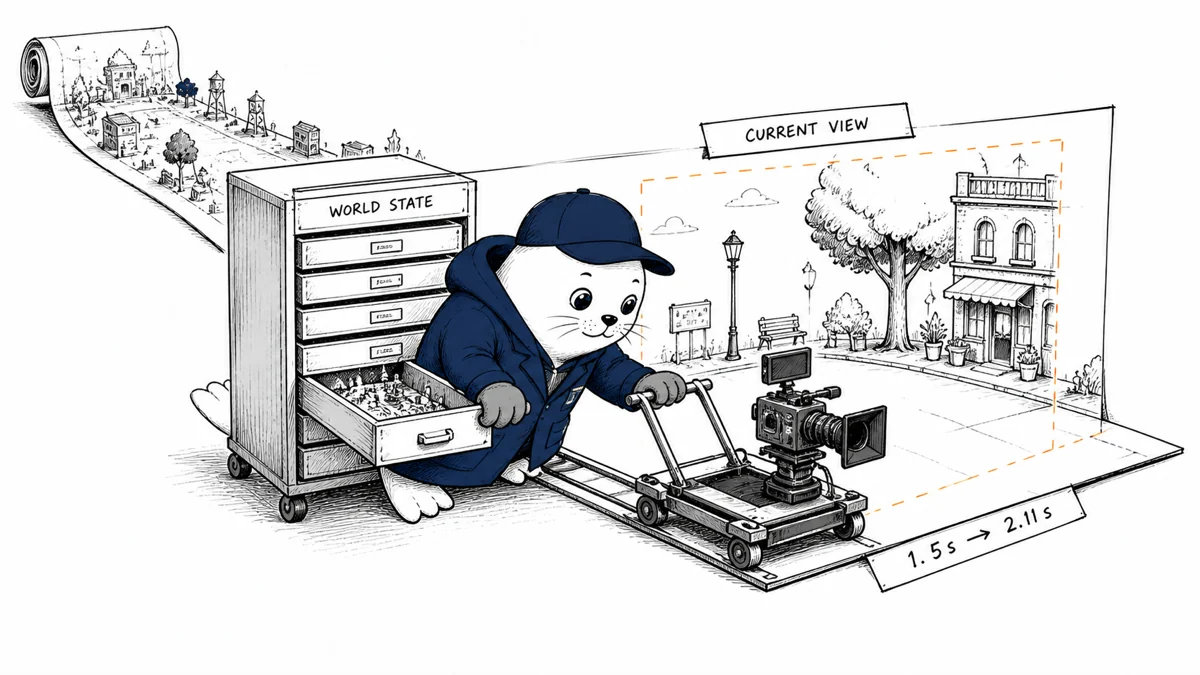
Long video generators usually face an ugly choice: keep feeding the model more history, or let the world forget itself. Alaya-EVOKE proposes a third route, store the world outside the active context and retrieve only what the current view needs.
What the EVOKE world model changes
Researchers introduced Alaya-EVOKE on August 13, 2026 as an open-ended video-generation system built around an external, recurrent world state. Instead of forcing every earlier frame into an expanding attention window, the EVOKE world model writes observations into persistent state and retrieves relevant information for the view being generated.
The claimed benefit is bounded active context without throwing away the longer history. A door passed several minutes ago, for example, does not need to occupy every subsequent computation. Its state can live outside the immediate window and return when the camera sees that part of the world again.
External memory changes the scaling question
A conventional long-context approach makes generation increasingly expensive as the sequence grows, or compresses the past until useful detail disappears. EVOKE reframes the problem: how much information must remain in active context, and how accurately can the system update and retrieve the rest?
That is a systems idea as much as a model idea. The quality of the generated future depends on memory writes, view-conditioned retrieval, and correction when the stored world conflicts with a new observation. A bounded context is valuable only if the external state preserves the facts the camera will need later.
The paper compresses a longer teacher into a shorter student
The authors describe a 30-second distribution-matching objective under self-forced rollout. They distill the behavior into a three-step student and report that the student runs without classifier-free guidance.
That training design targets a familiar failure: a model can look good when conditioned on clean reference history and drift when it must consume its own generated frames. Self-forced rollout makes the student train against the kind of imperfect history it will encounter during generation. The paper’s experiments are evidence for the research setup; they are not yet evidence that an independent production pipeline will reproduce the same trade-offs.
The speed claim is close to playback, not faster than it
At 384×640 resolution on one NVIDIA H200, the authors report generating a 1.5-second video chunk in 2.11 seconds. That makes the headline speed easier to interpret.
Musthave.AI’s calculation divides 2.11 seconds of computation by 1.5 seconds of generated video. The result is about 1.41 seconds of compute per second of video, or roughly 0.71× real-time throughput. In other words, the reported run is around 40.7% slower than playback wall clock at that resolution.
That is still notable for an open-ended research system with persistent state. It should not be translated into a consumer-product latency claim. End-to-end service time would also include input processing, scheduling, safety checks, encoding, storage, and any retries.
Benchmarks support the paper’s claim, with familiar limits
The authors report state-of-the-art results on WBench and competitive performance on VBench-Long and VBench-2.0. Those benchmarks help compare consistency and video quality under defined conditions. They do not fully test whether a generated world remains editable, controllable, physically coherent, or useful across an unpredictable production session.
We would want independent runs, longer horizons, prompt-by-prompt failure analysis, and tests that deliberately revisit old objects after many scene changes. The key question is not only whether the video looks smooth. It is whether the retrieved state preserves identity, geometry, and causal changes when the camera returns.
Four tests would reveal whether the memory is useful
- Leave and return: move away from a room, alter something elsewhere, then revisit the first room and check object identity and layout.
- Persistent change: break, move, or remove an object and verify that the state survives multiple generated chunks.
- Conflicting observation: show new evidence that contradicts memory and measure whether the system corrects rather than doubles the object.
- Memory pressure: populate the world with many distinct entities and measure which details disappear as the state grows.
These tests would complement conventional visual benchmarks with a direct audit of the architecture’s core promise. They also separate world persistence from camera smoothness, which can look convincing while state quietly drifts.
What builders can use now
No public code or model weights were located with the paper, so this is not a drop-in stack. The immediate value is the architecture pattern: keep a compact working context, persist structured world state, retrieve by the current view, and test state corrections explicitly.
That pattern belongs beside the production choices in our 2026 generative-video stack. It also explains why polished clips in Google Flow and the wider video race are only part of the problem. A usable world generator needs memory, control, editability, and predictable cost across time.
My verdict: the memory boundary is the real contribution
EVOKE does not prove that endless, production-ready worlds have arrived. It offers a credible answer to a more precise question: how can a video model keep a persistent world without carrying the entire visual past in its active context?
The external world state is the idea worth watching. If later work reproduces the speed, exposes the memory, and survives deliberate revisit tests, the architecture could shift long video from "remember more frames" toward "maintain a world." Until then, treat the results as promising author-reported research.
Read the research
- Read the Alaya-EVOKE paper and abstract.
Source note: architecture, benchmark, resolution, hardware, and timing claims are attributed to the authors. The 1.41 seconds-per-second and 0.71× figures are Musthave.AI calculations from the reported 2.11-second generation time for a 1.5-second chunk.