Cursor did not enter India with a coupon code. It changed the price, currency, payment rail, and usage tier together. That is a much more serious localization test.
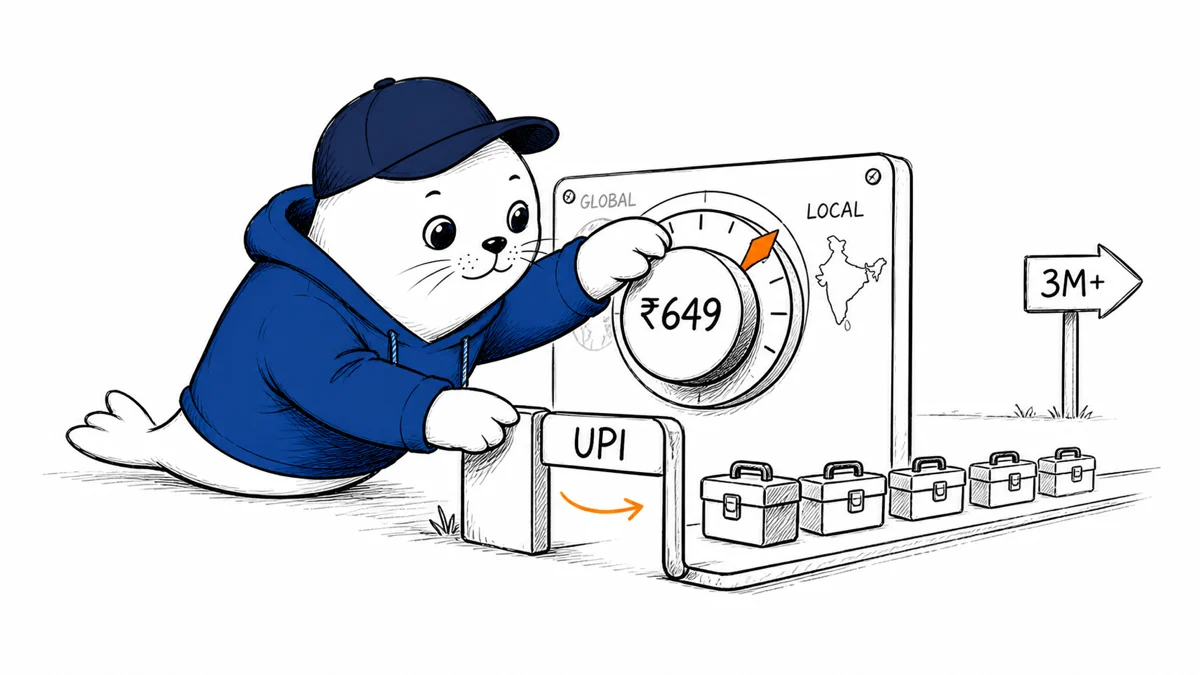
Cursor Start India launched on July 28 at ₹649 per month, tax included, with payment by UPI or card. Cursor says the plan includes Grok 4.5, Composer, more agent requests than Free, always-on cloud agents, iOS access, plugins, MCP servers, hooks, and skills. It sits between Free and Pro.
The launch matters beyond one coding tool. Many AI companies translate a landing page and keep a US price, US payment habits, and US-sized usage assumptions. Cursor changed four parts of the offer at once. Founders considering geographic pricing should study the bundle, then measure whether local adoption produces healthy retained margin rather than cheap but expensive-to-serve accounts.
What Cursor actually launched
| Offer field | Published detail | What it changes |
|---|---|---|
| Price | ₹649 per month, tax included | Customers see a local, final monthly amount |
| Payment | UPI, credit card, or debit card | Checkout matches common local payment behavior |
| Position | Between Free and Pro | Heavy Free users gain a paid step before the full plan |
| Usage | More agent requests than Free; described as generous rather than unlimited | The plan can target regular builders without promising an open meter |
| Product surface | Desktop, web, iOS, CLI, cloud agents, plugins, MCP, hooks, and skills | The local tier is part of the current product, not a stripped trial |
There is one important limitation in the announcement: Cursor does not publish an exact request allowance on the blog post. "Generous access" is a positioning phrase, not a measurable quota. A buyer still needs the live pricing page and dashboard to understand the practical ceiling.
The market signal is company-reported, but specific
Cursor says its Indian user base tripled in a year to more than three million developers, making India its third-largest market. The company also says Indian developers run more agent requests per developer than users in any other market.
Those figures were not independently audited in the launch post, so they should be treated as company-reported metrics. They still explain the product decision. Cursor was not testing local pricing in a market with uncertain interest. It was trying to convert a large, unusually active user base without forcing every serious user directly from Free to Pro.
UPI is part of the product, not checkout decoration
A local price can fail if the customer cannot pay with the method they already trust. Cursor says users had repeatedly asked for both local pricing and UPI. Shipping only one would have left half the conversion problem intact.
For an AI SaaS founder, payment localization has operational consequences. The team must handle tax display, recurring-payment behavior, failed-payment recovery, refunds, fraud controls, receipts, and support in the local currency. Our analysis of Monica AI’s local-payment and chargeback changes shows why a payment method can affect both conversion and loss quality.
A middle tier can repair the Free-to-Pro jump
Free plans answer whether a product is worth trying. Pro plans answer whether a committed user wants the full range of models and automation. There is often an unpriced group in between: people who use the product frequently but do not need every premium feature or cannot justify the global price.
Cursor Start gives that group a paid lane. The business benefit is not simply more subscriptions. A well-designed middle tier can reveal which features create repeat use, which limits trigger upgrades, and whether a lower local price attracts builders who stay. The failure mode is equally clear: if agent requests are expensive and the allowance is too loose, the plan can grow revenue while damaging gross margin.
The five numbers I would watch for 90 days
- Free-to-Start conversion: the share of eligible active users who begin paying.
- Start-to-Pro expansion: whether the new tier becomes a useful step or a permanent downgrade from Pro.
- Retained gross margin: revenue after model, cloud-agent, support, tax, payment, and refund costs.
- Successful renewal rate: separated by UPI and card so payment failures are visible.
- Accepted work per account: completed, reviewed coding tasks rather than raw agent requests.
Do not optimize only for signups. An AI plan couples price to variable inference and tool costs. The lesson from Chipp’s $29 customer with a $4,000 model bill is that a simple subscription can hide a destructive usage tail. Cursor has not disclosed Start’s unit economics, so builders should not assume the published price proves the model.
How a smaller AI company can copy the method
Start with observed usage, not a list of countries. Find a market where active users already return, hit a payment or price barrier, and use the product in a distinct way. Then localize a coherent offer:
- Price in the local currency and state whether tax is included.
- Add the payment rail customers already use.
- Define the included workload in a unit customers can understand.
- Keep a clear upgrade path for expensive or advanced use.
- Set abuse, refund, and support rules before the public launch.
- Run the test long enough to measure renewals and margin, not launch-week conversion.
This is also a positioning decision. A local plan should not feel like a visibly damaged version of the global product. Cursor included current surfaces such as cloud agents, iOS, CLI, plugins, hooks, MCP servers, and skills while reserving the broadest model choice and advanced features for Pro.
My verdict: localize the whole purchase path
Cursor Start India is a useful case because the company changed the price architecture rather than running a temporary discount. The product tier, currency, tax presentation, and payment method now agree with the market it wants to serve.
The test is not finished at launch. Cursor still has to prove that ₹649 supports the real agent workload, that renewals work smoothly, and that Start expands paid adoption without hollowing out Pro. Founders should copy that discipline: localize the offer, then audit usage and margin with the same care as conversion.
Read the primary source
- Read Cursor’s Cursor Start India announcement.
If you lowered your price for one market tomorrow, which cost or payment failure would surprise you first?
Checked August 15, 2026. Price, payment methods, plan position, product inclusions, Indian user count, growth, market rank, and usage statements are attributed to Cursor. The announcement does not publish an exact request quota or plan-level margin.