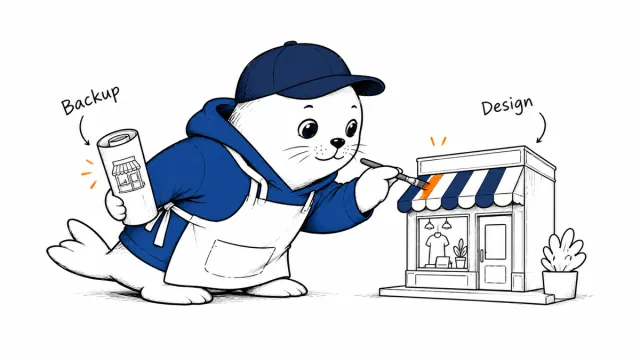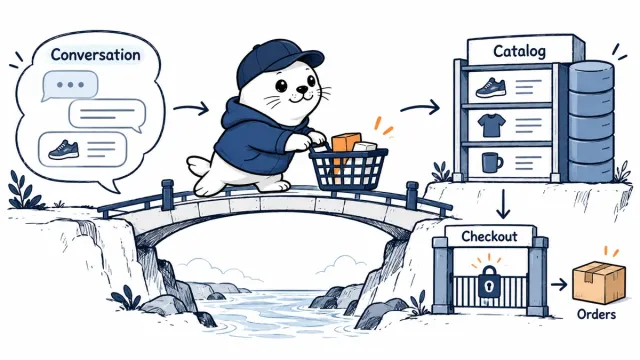

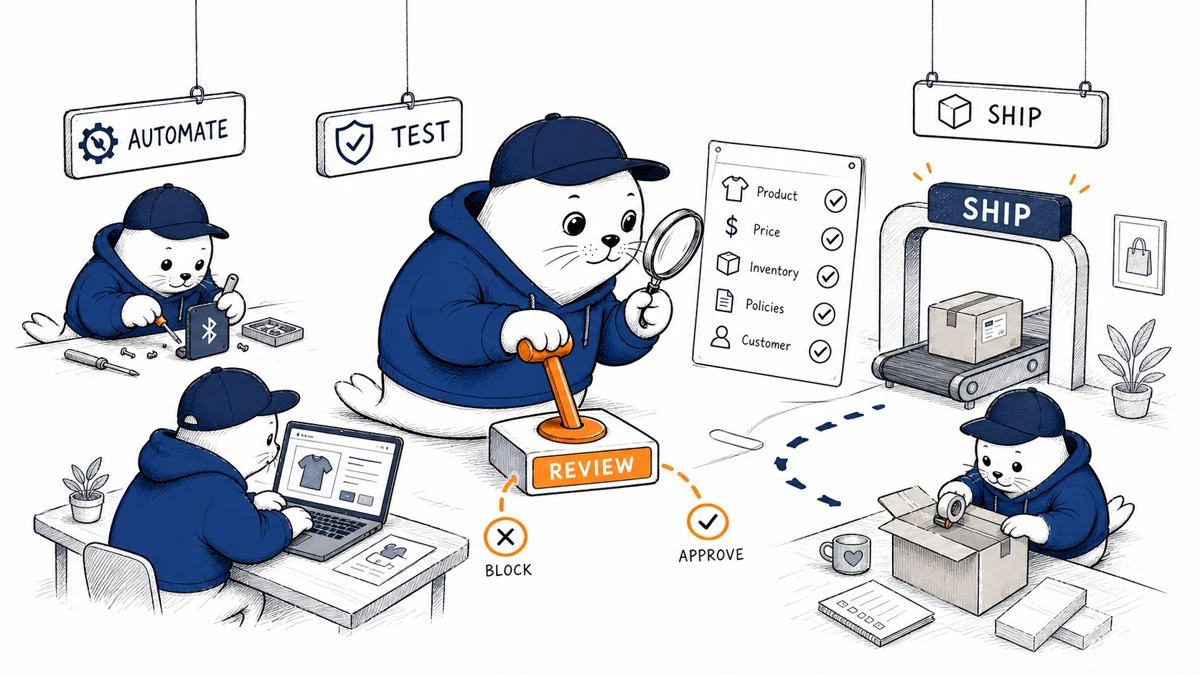
The most believable AI founder stories are not "we automated the company." They are smaller: a Bluetooth bug fixed, a store built faster, 200 old posts turned into a usable voice, and a draft stopped before a nutritionist reviewed it.
Shopify founders using AI offer a better case-study set than another list of tools. Shopify interviewed merchants who described using AI for technical troubleshooting, store creation, engineering leverage, content drafting, and review workflows. The examples are self-reported and selected by Shopify, but they contain an important pattern: the successful automation has a narrow job and a named human boundary.
The useful question is not "which model did they use?" It is which part of the workflow became faster, what evidence checked the output, and what the business owner refused to delegate.
Five cases, five bounded jobs
| Founder example | Reported AI use | Human boundary |
|---|---|---|
| Physical Phones | Used ChatGPT to help resolve a Bluetooth problem | Hardware testing and responsibility for the real device |
| Supreme Ecom | Reduced some store builds from 5–7 days to about 30 minutes | Offer, brand, merchandising, and launch judgment |
| Black Tux | Used AI to help a smaller engineering team ship | Architecture, review, tests, and production ownership |
| Shock Surplus | Trained Claude on more than 200 existing posts | Original expertise, voice, and factual review |
| Feel Goods | Generated initial drafts covering roughly 80% of the work | A nutritionist reviewed health-related content |
The figures and descriptions come from Shopify’s article. They are examples, not controlled productivity benchmarks.
Physical Phones: AI helped debug, the device had to prove it
A model can suggest likely Bluetooth failure modes and code changes. The final evidence is not the confident explanation. It is whether the phone connects reliably across real hardware, versions, interference, resets, and edge cases.
For founders building physical products, keep the model outside the acceptance test. Use it to expand the hypothesis list and explain logs; use instruments, test devices, and reproducible results to decide whether the issue is fixed.
Supreme Ecom: 30 minutes is a draft-speed claim
Shopify says Supreme Ecom reduced store-building work that once took five to seven days to about 30 minutes. That is a dramatic reported improvement, but "store built" can mean a generated theme and product structure rather than a validated business.
The remaining work includes positioning, product selection, photography, policies, checkout, accessibility, analytics, performance, mobile QA, and a reason for the first customer to trust the store. Our guide to AI product photos and mockups explains why a fast image cannot misrepresent the product that arrives.
Black Tux: a smaller engineering team needs a stronger gate
AI can help a compact team explore code, draft tests, and complete repetitive implementation. It also increases the volume of plausible changes reaching review. The bottleneck moves from typing to verification.
- Require a human owner for every production change.
- Run repository-specific tests and security checks.
- Measure accepted changes, escaped defects, and repair time, not generated lines.
- Keep deployment and rollback permissions separate from the drafting agent.
Shock Surplus: the archive became context
Shock Surplus reportedly gave Claude more than 200 prior posts to learn the company’s style. The moat is not the model. It is the body of real expertise accumulated before the model arrived.
A useful archive includes approved claims, terminology, customer questions, examples, and patterns the company no longer wants. Retrieve the relevant material for each draft rather than asking the model to imitate an undifferentiated voice from memory.
Our human-first AI content workflow makes the same division: let AI compress research and structure, then put experience and responsibility back into the piece.
Feel Goods: 80% drafted is not 80% approved
Shopify says AI produced initial drafts covering about 80% of the work and a nutritionist reviewed them. Health content makes the review boundary easy to see. A fluent draft can still contain a dangerous dosage, unsupported claim, missing contraindication, or context that changes the advice.
The qualified reviewer needs authority to reject the entire draft, not merely polish it. Keep sources beside claims, record material edits, and distinguish education from individualized medical advice.
A workflow ledger for small companies
| Workflow | AI may do | Human must own | Evidence |
|---|---|---|---|
| Technical repair | Suggest causes and patches | Acceptance criteria and release | Reproducible test |
| Store creation | Generate structure and copy | Offer, truthfulness, and QA | Mobile, checkout, and customer test |
| Engineering | Draft code and tests | Architecture and deployment | Tests, review, rollback |
| Brand content | Retrieve and draft | Experience and final claims | Source and edit log |
| Health content | Produce a first pass | Qualified factual review | Reviewer sign-off |
This ledger is more useful than an AI policy that says "use responsibly." It tells the team where speed is allowed, where judgment begins, and what proof closes the task.
My verdict: automate the bounded middle
The Shopify cases do not prove universal time savings, and Shopify has a commercial interest in successful merchant stories. They do show a credible operating pattern. Founders keep the customer problem, the acceptance test, and the final responsibility. AI handles a bounded middle: hypotheses, drafts, repetitive construction, retrieval, and first-pass implementation.
Start with one workflow where the input, output, failure state, and human owner are already clear. If you cannot define the acceptance test, automation will only make uncertainty arrive faster.
Read the primary case study
- Read Shopify’s interviews with founders using AI.
Which part of your workflow is repetitive enough to automate and testable enough to trust?
Checked August 14, 2026. Company names, workflow examples, time reductions, archive size, and draft share are attributed to Shopify and the quoted founders. The examples are selected case studies, not independent productivity experiments.