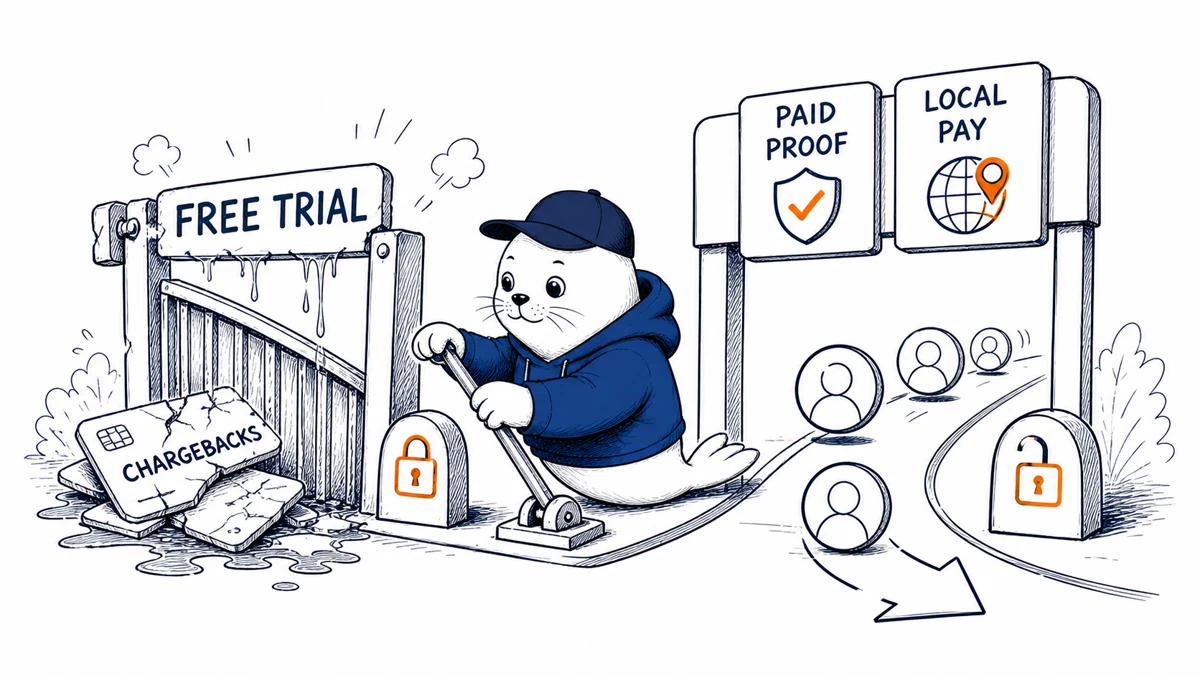
Monica AI reportedly cut chargebacks by 80% after removing its free trial. The interesting lesson is not "free trials are bad." It is that acquisition quality belongs in the checkout design.
The Monica AI free trial case shows how a familiar growth tactic can create payment risk. Paddle’s customer story says Monica removed the free trial and saw an 80% reduction in chargebacks. It also reports three-times annual recurring revenue growth in a year, three-times Black Friday revenue in under three weeks, up to 25% of revenue through Alipay, and a two-week implementation.
These are company-reported outcomes in a payment-provider case study. They do not prove that any one checkout change caused Monica’s overall growth. They do offer a useful framework for testing trial design, local payment methods, and promotion capacity.
What Monica and Paddle reported
| Reported outcome | Operational question |
|---|---|
| 3x ARR growth in a year | How much came from customer growth, pricing, retention, or payment access? |
| 80% chargeback reduction after removing the trial | Which abuse or expectation problem did the trial create? |
| 3x Black Friday revenue in under three weeks | Could billing, support, and model capacity handle the surge? |
| Up to 25% of revenue via Alipay | Which local method unlocks legitimate demand in each market? |
| Two-week implementation | What migration and tax work remained outside that window? |
A free trial can select the wrong behavior
Free trials reduce the first-purchase barrier. They also attract disposable accounts, repeated sign-ups, stolen payment details, and users who never understood when billing would begin. An AI product adds another risk: trial users can consume real model cost before the company knows whether they intend to pay.
Removing the trial can raise intent at checkout, but it can also suppress legitimate evaluation. The right decision depends on activation time, cost per trial, abuse rate, paid conversion, refund behavior, and how clearly the product can demonstrate value before payment.
Test a paid proof before abandoning evaluation
- Limited free demonstration: show the workflow with a sample or sandbox that cannot create external cost.
- Low-cost starter pack: sell a small number of credits without an automatic renewal surprise.
- Refundable proof period: take payment, disclose terms, and make the refund path easy.
- Sales-assisted pilot: use defined success criteria for higher-value accounts.
- Usage allowance: include enough real work to reach the first outcome, then stop at a hard limit.
The purpose is not to make evaluation difficult. It is to align the proof with a legitimate customer job and prevent an open-ended cost or identity loophole.
Local payment methods are product access
Paddle says Alipay can account for up to 25% of Monica’s revenue. The phrase "up to" matters; it may describe a period or segment rather than a stable global share. Even so, it shows that localization is not only translated copy. A willing customer who cannot use a familiar payment method is blocked from the product.
Measure payment-method approval, refund, dispute, and retention by country. A method that increases gross sales but produces high reversals or support cost may not improve contribution margin.
A promotion is a systems test
Three-times Black Friday revenue sounds like a marketing win. For an AI product, it is also a load test. More customers can mean more inference, slower queues, more support, more payment failures, and a larger refund wave after the promotion.
- Forecast model and tool use at the promoted price.
- Set rate limits and visible queue behavior before demand arrives.
- Explain renewal terms beside the offer, not inside a hidden policy.
- Staff payment and support exceptions for the full refund window.
- Measure retained contribution margin after discounts and reversals.
Our guide to AI product presentation for online sellers makes the same customer-expectation point: the preview should help a buyer understand the real deliverable, not create a surprise after purchase.
The metric set before changing a trial
| Metric | Why it matters |
|---|---|
| Cost per activated trial | Shows the real expense of free evaluation |
| Trial-to-paid conversion | Separates curiosity from purchase intent |
| Paid activation | Checks whether buyers reach the first useful result |
| Refund and chargeback rate | Surfaces expectation, abuse, and payment problems |
| 90-day contribution margin | Combines revenue, direct cost, discounts, and reversals |
Use a staged test rather than changing every market at once. Compare cohorts with the same product, traffic source, geography, and period where possible. Our AI income framework is deliberately skeptical of top-line screenshots; the retained margin is the business outcome.
My verdict: design the trial around qualified proof
Monica’s reported chargeback improvement is strong enough to justify auditing free trials in costly AI products. It is not strong enough to declare that every company should remove them.
Keep a trial when it helps legitimate users reach a verifiable result at controlled cost. Replace it when it mainly creates abuse, confusion, or an uncapped bill. The acquisition metric and the payment-risk metric should sit on the same dashboard.
Read the primary case study
- Read Paddle’s Monica AI customer case study.
Does your free trial prove value, or only make the signup chart look larger?
Checked August 14, 2026. ARR growth, chargeback reduction, promotional revenue, Alipay share, and implementation timing are attributed to Paddle and Monica. The case study does not isolate the causal contribution of each change.