

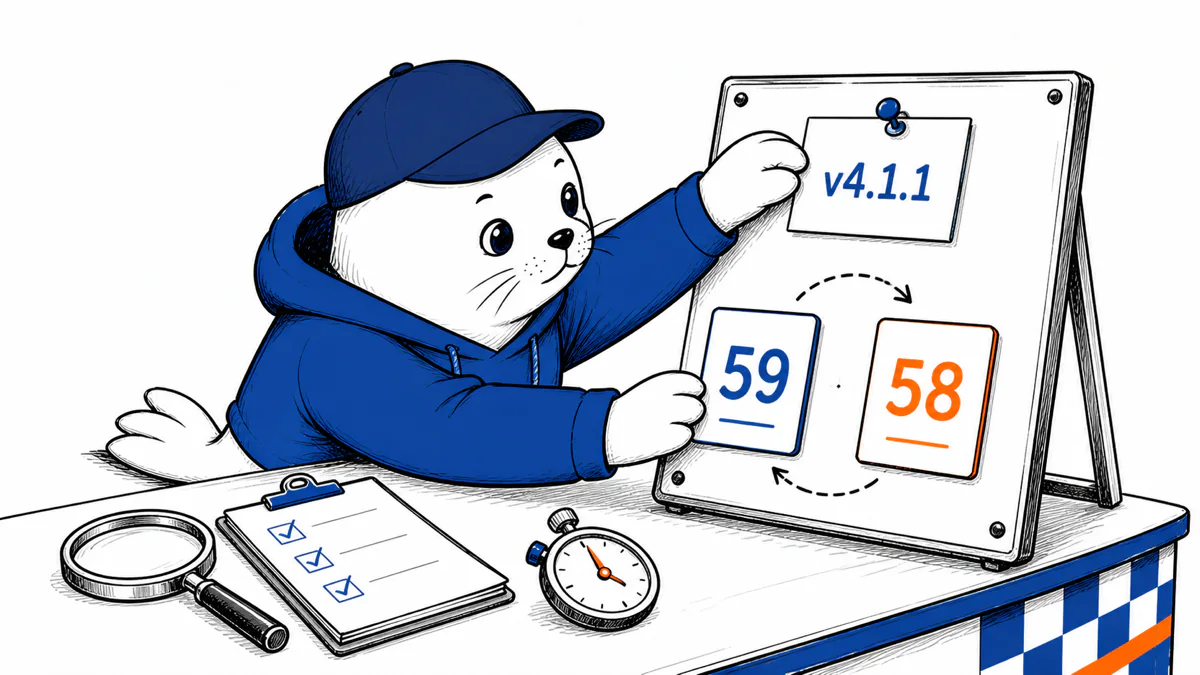
A model reached the top of a live leaderboard. Hours later, the benchmark changed and so did the order. Both results were real; neither was permanent.
That is the useful story behind this week’s Qwen 3.8 agent benchmark drama. A fast-moving Reddit thread said Alibaba’s new model had become the "best overall" system ahead of Claude Opus 5. It had not. Qwen3.8 Max had briefly led one narrower measure (the Artificial Analysis Agentic Index) before a planned methodology update moved it behind two Opus 5 configurations.
The correction does not make Qwen’s result uninteresting. It makes it more instructive. Artificial Analysis currently gives Qwen3.8 Max an Agentic Index score of 58, tied numerically with Claude Opus 5 at xhigh effort and one point behind Opus 5 at max effort. That is a strong result for a new Qwen release. It is also close enough that a benchmark version, an upstream task fix, or a tie-breaking rule can change the headline.
Update, August 16, 2026: Qwen has now published the Qwen3.8-27B weights, model card, configuration, tokenizer, and preprocessing files on Hugging Face. The canonical repository is public and ungated under Apache 2.0. At the checked commit, the weight package uses 18 safetensor shards plus an index.
The model card describes a dense 27B vision-language model with a 262,144-token native context window, optional extension to one million tokens, and thinking enabled by default. It lists Transformers, vLLM, SGLang, and TokenSpeed as compatible paths. Builders can now test a pinned artifact instead of a release promise; benchmark figures in the card remain company-reported.
What changed in one day
1
Qwen ships
On August 2, Qwen released Qwen3.8 Max through QwenCloud and described it as a 2.4-trillion-parameter model with 95 billion active parameters.
2
The model appears first
Artificial Analysis added the model, and a Reddit screenshot captured Qwen3.8 Max leading the Agentic Index. The post quickly attracted a large technical audience.
3
Version 4.1.1 reranks it
Artificial Analysis updated an upstream banking task and several graders. Its current page places Opus 5 max first, Opus 5 xhigh second, and Qwen third.
An Artificial Analysis team member joined the Reddit thread and said the update had already been planned. He acknowledged that it changed the order, while arguing that the original conclusion still held: Qwen’s agentic performance was a large step forward.
That is a more defensible reading than either viral extreme. Qwen did not become the universal best model, and the rerank did not erase its result.
The Agentic Index is not the overall leaderboard
The terminology caused much of the confusion. Artificial Analysis publishes an overall Intelligence Index built from nine evaluations. It also publishes narrower capability indexes. The Agentic Index measures two things: performance on real-world occupational tasks in GDPval-AA v2 and tool use in a banking-support environment called tau3-Banking.
The two component scores are averaged equally. They are relevant to tool use, planning, and multi-step work. They do not measure every kind of coding, research, writing, visual reasoning, safety behavior, latency, or production reliability.
The precise claim
Qwen3.8 Max briefly led Artificial Analysis’s Agentic Index. It did not lead the overall Intelligence Index, and the current Agentic Index puts it at 58 behind Opus 5 max at 59 and Opus 5 xhigh at 58.
Artificial Analysis separately gives Qwen3.8 Max an overall Intelligence Index score of 58. On the model page visible during this check, that is ninth among the displayed comparison class, not first.
What version 4.1.1 actually changed
The August 6 v4.1.1 release note describes two substantive changes.
- tau3-Banking moved to version 1.0.1. The upstream update corrected grading for trajectories that recover from unhappy paths. In plainer English: some agents reached a valid outcome through a messy route, and the older grader could judge that route incorrectly.
- Three general-intelligence evaluations received new graders. Humanity’s Last Exam, AA-LCR, and AA-Omniscience now use GPT-5.6 Luna at medium effort after Artificial Analysis’s grader validation.
The first change directly affects the Agentic Index because tau3-Banking is half of that index. The grader replacements affect the overall Intelligence Index, not its two-score agentic subset in the same way. This is why collapsing every Artificial Analysis chart into one "overall" ranking creates confusion.
Artificial Analysis says most overall scores moved by less than one point and that Claude Opus 5 remained first overall at 63. The company does not say that it changed the Agentic Index weights to target Qwen.
The bribery claim has no evidence
A second Reddit thread accused Artificial Analysis of changing the benchmark to protect Anthropic. Some replies asked how much Anthropic had paid. No one supplied evidence of a payment, private coordination, or a model-specific rule.
Skepticism about benchmark operators is healthy. Composite scores embed choices about tasks, weights, prompts, graders, retries, harnesses, and tie handling. Those choices deserve documentation and outside scrutiny. But a documented methodology update landing near a close result is not proof of corruption.
| Claim | Status | What supports it |
|---|---|---|
| Qwen briefly led the Agentic Index | Supported | The original ranking thread and a public response from an Artificial Analysis team member. |
| Version 4.1.1 changed the order | Supported | The current leaderboard, release note, and the team’s public explanation. |
| The update was planned | Company statement | An Artificial Analysis team member said so publicly; outside readers cannot independently inspect the internal release calendar. |
| Anthropic paid for the change | Unsupported | No payment record, communication, methodology evidence, or other corroboration was offered. |
The correct editorial move is to preserve both facts: the update had a technical explanation, and close live rankings remain sensitive to methodology.
Qwen’s result is still impressive
Qwen calls Qwen3.8 Max its most capable release so far. Its launch article describes 2.4 trillion total parameters, 95 billion active parameters, a one-million-token context window, and adjustable reasoning effort. The new Qwen3.8-27B repository is a separate 27B dense open-weight model. Pin the repository commit and test it directly rather than treating hosted Max results as evidence for the smaller checkpoint.
The company also presents long-running demonstrations: an autonomous coding repository, a paper-reproduction exercise, and a 500-turn hardware-design optimization. Some traces are public, which is better than a montage. They remain company-run demonstrations, not independent evidence that every team can reproduce the outcome.
Artificial Analysis adds useful independent context. It reports $2 per million input tokens, $6 per million output tokens, roughly 68 output tokens per second, and unusually high token use during its evaluation. A high score can therefore arrive with a large reasoning bill. Builders should compare cost per completed task, not only price per token.
That echoes the lesson from GitHub’s paused Kimi K3 rollout: the meaningful benchmark begins when a model touches your repository, permissions, CI queue, and recovery path.
A leaderboard row is a six-part measurement
A model name is only one part of a result. The same model can behave differently through another provider, at another reasoning effort, inside another harness, or after an evaluation patch. Artificial Analysis’s new Endpoint Accuracy Index makes the provider problem visible: output limits, tool-call parsing, context restrictions, quantization, kernels, and bugs can all change what reaches the user.
Before you copy a leaderboard winner into production, capture the full measurement.
The benchmark capture card
- Index and version: write down the exact benchmark name, methodology version, and date.
- Model configuration: record the model build, reasoning effort, temperature, and output limit.
- Endpoint: note the provider, region, context limit, caching behavior, and serving precision when known.
- Harness and permissions: record the agent wrapper, tools, retries, approvals, and recovery rules.
- Economics: measure cost and wall-clock time per completed task, including failed attempts.
- Your own cases: rerun a fixed set of representative jobs and keep the failures, not just the best answer.
This also applies to first-party plan comparisons. Our ChatGPT Go versus Plus analysis separates model access from reasoning controls and tool limits because the product configuration changes what "the same model" means in practice.
My verdict: publish the version with the score
Qwen3.8 Max did enough to deserve attention. It briefly led a relevant agentic measure and remains effectively tied with one Opus 5 configuration on the current page. That is a competitive result, even after the screenshot stopped being current.
The Qwen 3.8 agent benchmark rerank is not evidence that benchmarks are useless. It is evidence that benchmarks are software: versioned, maintained, occasionally corrected, and capable of changing a close ordering. The closer the scores, the less honest it is to turn a temporary rank into a permanent model hierarchy.
Use the leaderboard to choose what to test next. Then pin the version, measure the endpoint, run your own jobs, and keep a fallback. If the top row changes tomorrow, your decision should still make sense.
Read the source record
- Inspect the canonical Qwen3.8-27B model card and weight repository.
- Compare the official Qwen3.8-27B FP8 repository.
- Read Qwen’s Max release article and company-reported demonstrations.
- Check the current Qwen3.8 Max model page.
- Inspect the live Agentic Index and its two components.
- Read the v4.1.1 methodology note.
- Follow the original Reddit discussion as reaction evidence, not a benchmark specification.
What is the smallest benchmark change that would make you rerun a model decision?
Updated August 16, 2026. Artificial Analysis’s public pages can change as results and methodologies are updated. The public Qwen3.8-27B repository, Apache-2.0 license, file layout, and checked commit were verified directly. Model-card benchmark results and the one-million-token extension claim remain company-reported.